🧪 Vinegar Dosing Calculator for Reef Tanks
Plan a conservative acetic acid carbon dose from tank volume, nitrate and phosphate readings, vinegar strength, ramp limits, skimmer export, and bloom risk.
| Vinegar strength | Same carbon as 5 mL of 5% | Calculator effect | Use note |
|---|---|---|---|
| 4% acetic acid | 6.25 mL | More liquid needed | Some mild table vinegars |
| 5% acetic acid | 5.00 mL | Baseline dose | Common white vinegar |
| 6% acetic acid | 4.17 mL | Less liquid needed | Check bottle label |
| 8% acetic acid | 3.13 mL | Stronger dose per mL | Use cautious manual entry |
| Reef system | Typical net water | 5% vinegar start | Standard weekly ramp | Common max ceiling |
|---|---|---|---|---|
| 20 gal nano | 16 gal / 61 L | 0.5 mL/day | +0.5 mL/day | 3.8 mL/day |
| 40 breeder mixed | 38 gal / 144 L | 1.2 mL/day | +1.2 mL/day | 9.1 mL/day |
| 75 gal reef | 70 gal / 265 L | 2.2 mL/day | +2.2 mL/day | 16.8 mL/day |
| 120 gal SPS | 112 gal / 424 L | 3.6 mL/day | +3.6 mL/day | 26.9 mL/day |
| 180 gal fish-heavy | 170 gal / 644 L | 5.4 mL/day | +5.4 mL/day | 40.8 mL/day |
| 220 gal peninsula | 210 gal / 795 L | 6.7 mL/day | +6.7 mL/day | 50.4 mL/day |
| Condition | Low risk | Caution range | Hold or reduce dose | Why it matters |
|---|---|---|---|---|
| Nitrate NO3 | 5 to 15 ppm | 1 to 4 ppm | 0 to 1 ppm | Do not chase zero nitrate |
| Phosphate PO4 | 0.03 to 0.12 ppm | 0.02 to 0.03 ppm | Below 0.02 ppm | Bacteria need phosphorus |
| Water clarity | Clear | Slight haze | Cloudy bloom | Clouding can signal bacterial surge |
| Skimmer export | Wet stable foam | Dry or inconsistent | No skimmer | Bacteria need export and oxygen |
| Ramp pace | Weekly small steps | Large weekly steps | Daily increases | Fast changes raise bloom risk |
| After one week | Nitrate trend | Phosphate trend | Water clarity | Recommended action |
|---|---|---|---|---|
| Stable and clear | No change | Still measurable | Clear | Increase by the ramp amount |
| Nitrate dropping | Down 2+ ppm | Above 0.03 ppm | Clear | Hold current dose |
| PO4 getting low | Any trend | Below 0.03 ppm | Clear or pale coral | Hold or reduce dose |
| Cloudy water | Any trend | Any trend | Haze or bloom | Stop increases and reduce dose |
Vinegar dosing feeds bacteria. Strong skimming, surface agitation, and steady gas exchange help export that biomass and reduce the chance of cloudy water or low oxygen.
Use vinegar to lower nitrate gradually, not to force sterile water. If phosphate approaches zero, bacteria can stall while corals and other organisms become stressed.
Carbon dosing with vinegar is a technique that can be used to removing nutrients from the water in a reef tank. Carbon dosing with vinegar works because vinegar provides a source of carbon for the heterotrophic bacteria that live in the tank. When you add vinegar to the water, the heterotrophic bacteria consume the vinegar.
As the heterotrophic bacteria consume the vinegar, the bacteria grow in size. As the heterotrophic bacteria grow in size, they consume the nitrate and phosphate ion that are present in the water. The bacteria consume the nitrate and phosphate ions because the bacteria require those nutrients in order to form new cell.
How to Use Vinegar Safely in a Reef Tank
Once the bacteria have consumed the nitrate and phosphate ions in the water, the skimmer in the reef tank removes the bacteria from the tank, and thus, removes the nitrate and phosphate from the reef tank as well. However, carbon dosing with vinegar can lead to problems if the dose of vinegar that is added to the reef tank is too high, or if the balance of the nitrate to phosphate level in the tank is incorrect. If the phosphate levels in the water are too low, the heterotrophic bacteria will stop grow.
If the heterotrophic bacteria no longer grow, the ntrate levels will no longer decrease in the water. If the nitrate levels do not decrease, the process of reducing the nutrients in the water will stall. As a result of the stalled reduction of nutrients, the corals in the reef tank may become stressed.
To avoid these problems, it is important to ensure that there is enough phosphate in the tank to allow the heterotrophic bacteria to continue consuming the nitrate in the water. The volume of the reef tank is another factor to consider when performing carbon dosing with vinegar. In determining the amount of vinegar to add to the tank each time, it is important to calculate the volume of the reef tank.
The tank volume includes the volume of water in both the main tank and the sump tank, but it does not include the volume in the tank that is occupied by the sand and rocks in the tank. If the calculated volume of the reef tank is too high, the amount of vinegar that is added will be too high. Adding too much vinegar at once can lead to excesive growth of heterotrophic bacteria, which can lead to low levels of dissolved oxygen in the water.
Another factor related to carbon dosing that should be considered is skimmer strength. The heterotrophic bacteria consume some of the dissolved oxygen in the reef tank while they are consuming the vinegar. If the levels of dissolved oxygen in the tank become too low, the health of the reef tank may be at risk.
Skimmers that are stronger will remove more heterotrophic bacteria, but also will help to maintain the levels of dissolved oxygen in the tank. If the skimmer is weak, the amount of vinegar that is added to the reef tank should be lower to account for the fact that the weak skimmer will remove fewer heterotrophic bacteria, and will provide less protection of the oxygen levels in the reef tank. A ramp schedule should be used when initiating the process of carbon dosing with vinegar.
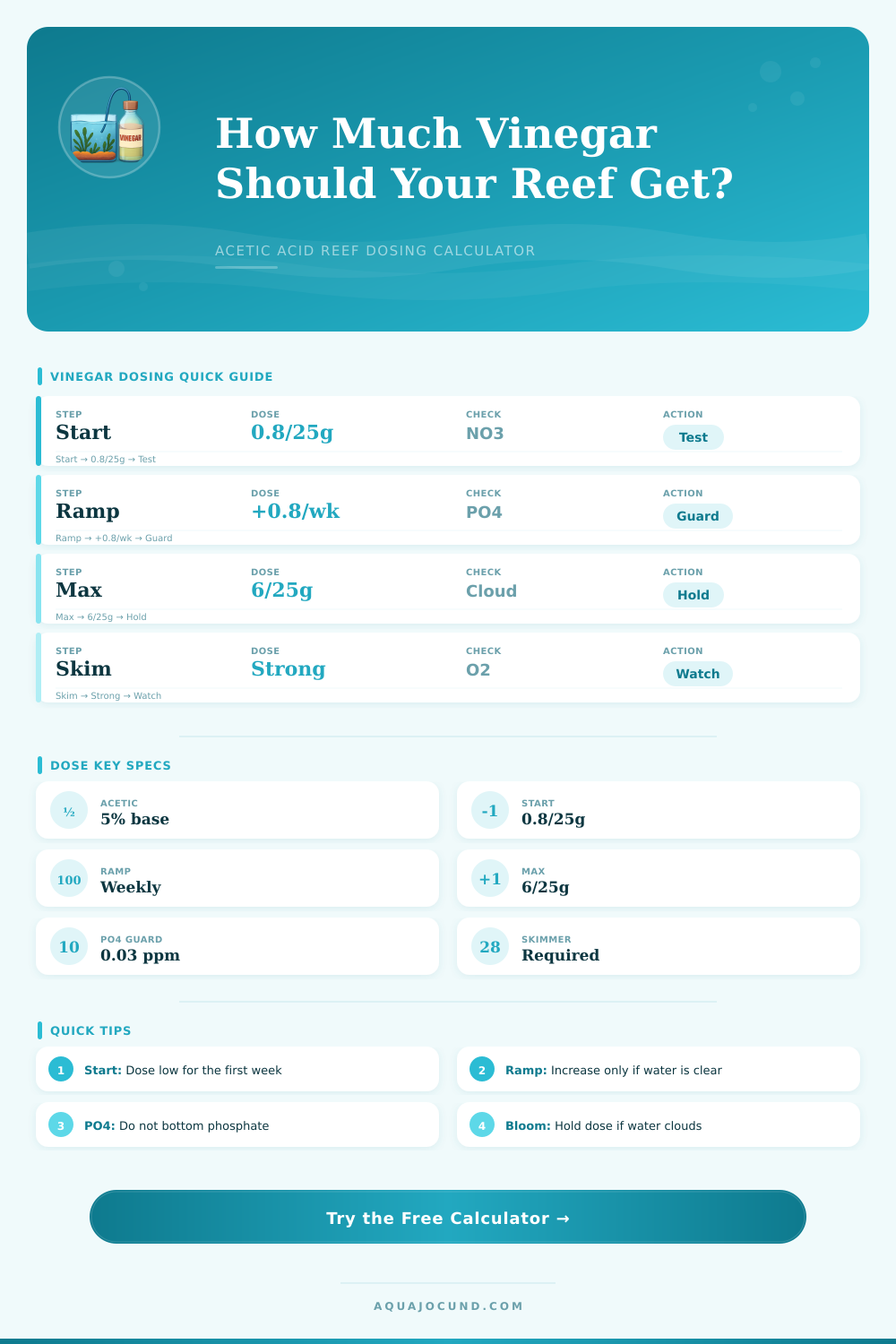
This means that the amount of vinegar that is added to the reef tank should start at a low dose, and the dose should be slowly increase over a period of several weeks. For instance, the dose could start at 0.8 milliliters of five percent vinegar per 25 gallons of water in the reef tank, and then be increased to, say, 1.0 milliliters of five percent vinegar per 25 gallons of water after several weeks. This slow ramping of the dosage allows the reef tank to adjust to the increased amount of vinegar, and it helps to ensure that the heterotrophic bacteria do not grow at a rate that the skimmer cannot remove from the reef tank.
One of the ways to monitor the effects of carbon dosing with vinegar is to monitor the water for clarity. If the water becomes cloudy or hazy, this indicates that the levels of heterotrophic bacteria in the water are too high to be removed by the skimmer. If the water becomes cloudy, the increase in the amount of vinegar that is dosed into the reef tank should be stopped.
Additionally, if the water becomes cloudy, aeration for the tank should be improved to ensure that the levels of dissolved oxygen in the water dont drop too low. Another important factor to consider when adding vinegar to a reef tank is the target levels of nitrate and phosphate ion in the water. Most reef tanks have good health with nitrate levels between 5 and 15 parts per million (ppm), and phosphate levels between 0.03 and 0.12 ppm.
If either of these levels drops to too low of a level, the corals in the reef tank may develop a nutrient deficiency. To avoid these problems with the corals, the levels of nitrate and phosphate in the water should be frequently monitored to ensure that the levels are not dropping too low. In addition to the factors discussed above, there are several ways to reduce the risks that may be associated with carbon dosing with vinegar.
One way to reduce the risks of carbon dosing with vinegar is to split the amount of vinegar that is to be dosed into the reef tank into several different dose throughout the day. For instance, small amounts of vinegar can be dosed into the reef tank twice each day. Adding the vinegar in smaller amounts during multiple periods throughout the day is generally safer than adding a large amount all at once.
Finally, it is important to remember that the test kit analyses of the tank, as well as the health of the corals in the tank, may change over time. The amount of vinegar that should be dosed into the reef tank may need to be held steady, or may need to be increased, based off these analyses. For example, prior to increasing the amount of vinegar that is dosed into the reef tank, it is important to perform another analysis of the levels of nitrate and phosphate in the water.
Additionally, it is also important to watch the skimmer for changes in the color or wetness of the skimmed water. If the health of the corals declines, or if the test kit analysis indicates low levels of nutrients in the water, the dose of vinegar should be held steady. Thus, while the calculator helps to determine the starting dose of vinegar that may be added to the reef tank, the reef tank owner himself or herself should make the actual decisions regarding the dosing of vinegar.