🧪 Two-Part Dosing Calculator
Plan reef alkalinity and calcium corrections, daily consumption, balanced dosing, and staged safe-dose days.
| Parameter | Common Reef Range | Fast Change Limit | Notes |
|---|---|---|---|
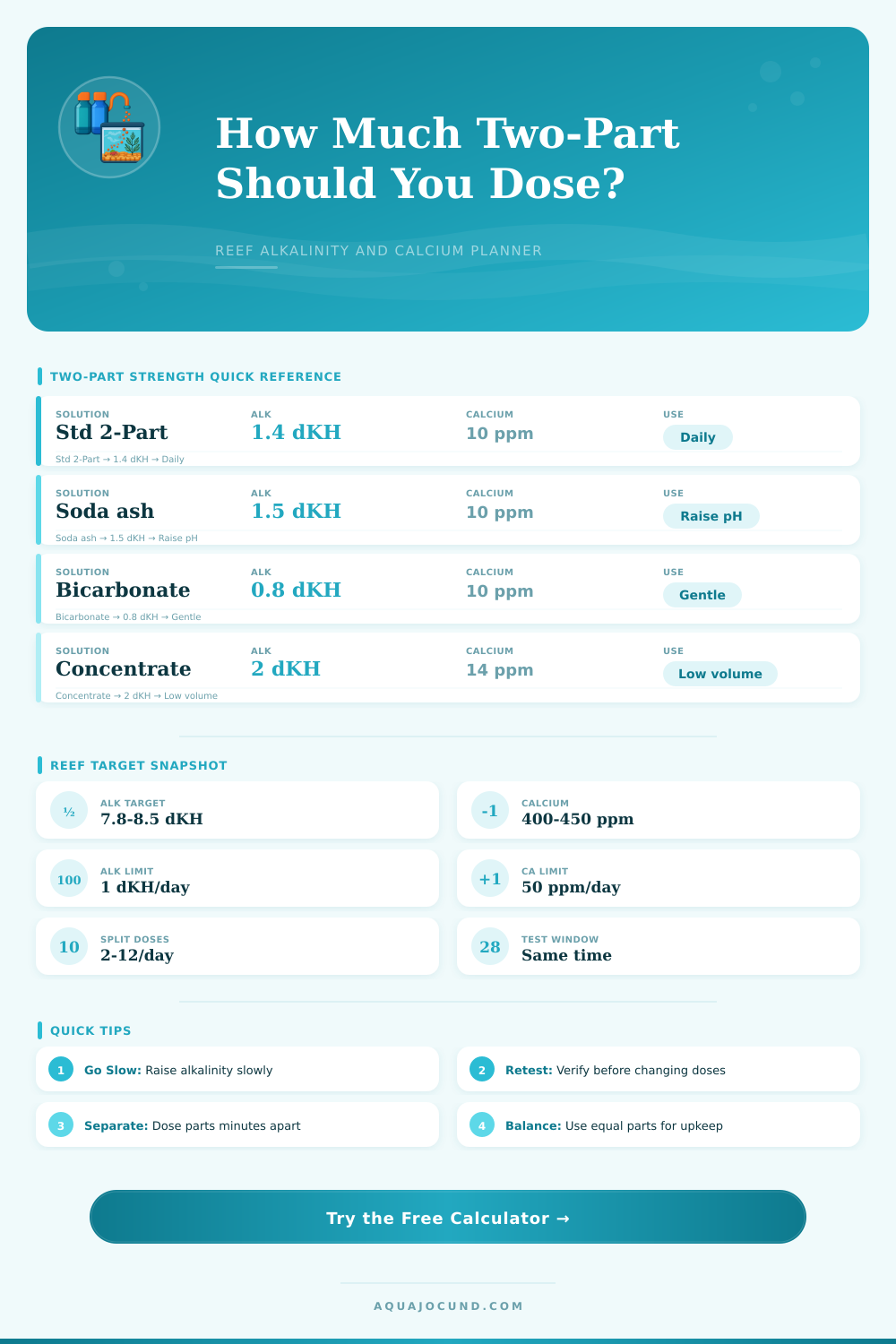
| Alkalinity | 7.0-9.0 dKH | 0.5-1.0 dKH/day | SPS tanks usually prefer stability over chasing a high number. |
| Calcium | 400-450 ppm | 25-50 ppm/day | Correct calcium separately before locking in equal daily parts. |
| Magnesium | 1250-1400 ppm | 50-100 ppm/day | Low magnesium can make alkalinity and calcium harder to stabilize. |
| pH | 7.8-8.4 | Observe trend | Soda ash raises pH more than bicarbonate alkalinity part. |
| Preset | Alkalinity Strength | Calcium Strength | Best Use |
|---|---|---|---|
| Standard commercial two-part | 1.40 dKH per 1 mL/gal | 10 ppm per 1 mL/gal | General dosing pump setup and daily maintenance. |
| DIY soda ash alkalinity | 1.53 dKH per 1 mL/gal | 10.8 ppm per 1 mL/gal | When pH support is useful and the tank tolerates it. |
| DIY bicarbonate alkalinity | 0.78 dKH per 1 mL/gal | 10.8 ppm per 1 mL/gal | Gentler alkalinity part for tanks where pH already runs high. |
| Concentrated two-part | 2.00 dKH per 1 mL/gal | 14 ppm per 1 mL/gal | Large systems or low-volume dosing heads. |
| System | Net Volume | Typical Alk Use | Typical Calcium Use |
|---|---|---|---|
| Soft coral nano | 15-25 gal | 0.05-0.20 dKH/day | 0.5-2 ppm/day |
| LPS cube | 25-40 gal | 0.15-0.35 dKH/day | 1-4 ppm/day |
| Mixed 75 gallon | 60-80 gal | 0.25-0.70 dKH/day | 2-7 ppm/day |
| SPS dominant reef | 80-200 gal | 0.60-1.50 dKH/day | 6-18 ppm/day |
| Clam heavy display | 100+ gal | 0.80-2.00 dKH/day | 8-22 ppm/day |
Reef keeping require a significant degree of patience. However, the chemical parameter of a reef tank require more frequent attention. Alkalinity and calcium are two of the most important chemical parameter to maintain in a reef tank.
Corals use alkalinity and calcium constant to perform the biological processes necessary for there growth. If the levels of alkalinity or calcium isnt maintained within the target range, the reef tank will be unstable. Two-part dosing can be used to replace the alkalinity and calcium that the reef inhabitants use.
How to Dose Alkalinity and Calcium in a Reef Tank
Two-part dosing is useful in that it allow the removal of alkalinity and calcium from the tank without using many different single-element product. It is necessary to decide the amount of two-part dosing to perform each day and how quickly to perform the correction of the alkalinity or calcium if test show a deficit. To assist in calculating the amount of two-part dosing to add to the reef tank, the calculator requires the entering of the volume of the reef tank, the current levels of alkalinity and calcium in the tank, the target levels of alkalinity and calcium in the tank, and the consumption rate of the system.
The consumption rate is the most important value that must be entered into the calculator. The consumption rate is the rate at which the corals and coralline algae in the reef tank remove alkalinity and calcium from the water each day. The consumption rate can be determined by testing the levels of alkalinity and calcium at the same time over several day.
If you dont enter the consumption rate into the calculator, dosing calculations will be guesses, which can lead to the addition of either too much or too little alkalinity or calcium to the reef tank. Another important factor to consider is the strength of the two-part solution that is to be used in the reef tank. Commercial two-part solution will list the strength of the solution in dKH or ppm per milliliter per gallon.
The strength of the solution will determine the volume of liquid that must be dosed into the tank. Stronger two-part solutions will require smaller volume of liquid to be added to the reef tank than weaker solutions. Smaller volumes of liquid is helpful in reef tanks if the dosing pump that is used to add the liquids has a low output.
Weaker two-part solutions will require larger volumes of liquid to be added to the tank. However, weaker solutions will have a gentler effect on the pH of the water in the reef tank. The calculator allows reef tank keeper to switch between solution strengths to calculate the amount of each strength that can be used for dosing each day.
The calculator output a staged correction of the alkalinity and calcium levels. Rapidly increasing the levels of either alkalinity or calcium too quickly for the reef tank can cause precipitation in the tank and stress the corals that live within the tank. The staged correction output provided by the calculator is not a strict rule that must be followed.
However, it does provide an estimate of how often to dose the two-part solution into the reef tank for realistic correction of the alkalinity and calcium levels without having to dosing the reef tank continuously. Reef tank keepers can choose to use either equal-part maintenance or measured maintenance with two-part dosing solution. Equal-parts maintenance is simply dosing the alkalinity solution and the calcium solution at the same time and in the same volume into the reef tank once it reaches the target levels of alkalinity and calcium.
Many people prefer choosing a maintenance schedule that use equal-parts maintenance to keep the routine simple and provide a balance to the solutions. Other people prefer to track the consumption of each element separately so that the ratio of the dose can match the consumption of each element. Both maintenance schedules is supported by the calculator, but each will provide different results.
If the consumption of the alkalinity and calcium elements isnt the same, choosing equal-parts maintenance will unbalance one of the elements. In this case, the parameters should be retested after a few days. There are several variable that may impact the consumption of alkalinity and calcium levels in the tank.
Variables such as the temperature of the tank, the light intensity, and the addition of new corals can impact the consumption of these elements. If the tank has been stable for some time and a new coral is added to the tank, the tank may need to be supplemented with more alkalinity. In this case, the consumption rate should of been updated every few week.
Additionally, if water change are performed for the tank, the new water will replace the alkalinity and calcium levels. In this case, the two-part dosing supplements should be adjusted for several days following a water change. Although magnesium levels are separate from two-part dosing, they are important to maintain a stable alkalinity and calcium level in the tank.
If the magnesium levels is low, it will be difficult to maintain the correct levels of alkalinity and calcium. Many people find that their two-part dosing supplements become adequate once the magnesium levels in the tank are corrected. Although the calculator does not calculate the magnesium levels in the tank, the reliability of the calculations will be improved if the magnesium levels in the tank is correct.
The location of the addition of alkalinity and calcium supplements is also important to avoid precipitate formation. If the two solution are added to the same area of the tank with low water flow, a chemical reaction may occur. To avoid this reaction, the supplements should be added to separate area of the tank with high water flow.
Additionally, the supplements should be added with several minutes between each supplement to avoid a chemical reaction. The calculator provides an average amount of each supplement when adding each solution separately to the tank. The time that the parameter are tested is important to provide accurate measurements of the alkalinity levels.
The alkalinity levels will rise during the light period for the tank and drop during the dark portion of the cycle. If the parameter is tested at a different time each time, the test will not be accurate. A specific time should be chosen for testing the alkalinity and these tests should occur at the same time.
For best results, the consumption rate should also be updated to reflect these measurement. Because two-part dosing supplements will replace the chemicals used by the corals, the supplements will be effective only if the calculation is updated to reflect the needs of the tank at this time.