🧪 Reef Tank Strontium Calculator
Estimate a strontium dose from tank volume, current and target ppm, supplement strength, coral demand, water change correction, and daily increase limits.
✅ Strontium dosing plan
| Coral load | Multiplier | Typical Sr uptake | Best planning use |
|---|---|---|---|
| Soft coral dominant | 0.60 | 0.01-0.03 ppm/day | Low skeleton demand with occasional testing |
| Mixed reef | 1.00 | 0.03-0.06 ppm/day | Balanced LPS, soft coral, and moderate stony growth |
| LPS heavy | 1.15 | 0.04-0.08 ppm/day | Higher calcium carbonate growth but slower than SPS |
| SPS dominant | 1.45 | 0.06-0.12 ppm/day | Frequent testing and steady dosing pump schedules |
| Fast-growing frag system | 1.70 | 0.08-0.16 ppm/day | High turnover trays with rapid skeletal deposition |
| System | Display size | Estimated net water | 1 ppm Sr requires |
|---|---|---|---|
| Nano cube | 20 gal / 76 L | 15-18 gal | 57-68 mg Sr |
| 40 breeder reef | 40 gal / 151 L | 30-36 gal | 114-136 mg Sr |
| 75 gal mixed reef | 75 gal / 284 L | 58-68 gal | 220-257 mg Sr |
| 125 gal display | 125 gal / 473 L | 95-115 gal | 360-435 mg Sr |
| 180 gal SPS reef | 180 gal / 681 L | 140-170 gal | 530-644 mg Sr |
| Planning factor | Conservative | Moderate | Aggressive |
|---|---|---|---|
| Daily Sr correction rise | 0.3-0.5 ppm | 0.6-1.0 ppm | 1.1-1.5 ppm |
| Testing after correction | 48-72 hours | 3-4 days | Next day |
| Water change correction | Use tested salt Sr | Assume 8 ppm | Skip only if none |
| Routine maintenance | Dose uptake only | Small weekly trim | Avoid blind dosing |
| Step | Formula | Why it matters | Output |
|---|---|---|---|
| Net liters | gal x 3.78541 | ppm is mg per liter | Water volume |
| Water change level | old x remain + new x change | Prevents dosing what new salt already added | Post-change ppm |
| Correction mass | deficit ppm x liters | Converts Sr shortage to milligrams | mg Sr |
| Dose volume | mg Sr / mg per mL | Matches the selected supplement strength | mL |
Strontium is another element that exists in reef chemistry, as strontium help stony corals to build there skeletons. Seawater contains approximately eight parts per million of strontium, but many reef tank have low levels of strontium due to the consumption of strontium by the corals. If the levels of strontium within a reef tank are too low, a person must create a dosing plan for the water to add strontium to the tank.
The strontium that is dosed into a reef tank should not simply be an additive that is added to the water. The amount of strontium that should be dosed into the reef tank depend upon a variety of factors. For instance, the amount of strontium that is needed for the reef system depends upon the amount of strontium that the system remove each day.
How to Test and Add Strontium to Your Reef Tank
The amount of strontium that is needed also depends upon the amount of strontium that is already provided to the system through water changes. Additionally, the amount of strontium that is needed depends upon the amount of strontium that is desired to raise the levels within the system during that dosing session. For example, a small tank with soft corals may lose a small amount of strontium each day, but a large tank with fast growing stony corals may lose a large amount of strontium each day.
The amount of strontium that is provided to the system through water changes also changes the amount of strontium that is required to be dose into the system. For example, if water changes are performed with saltwater that contains eight parts per million of strontium, then the water changes will provide some of the strontinium to the system. Thus, the amount of strontium that is needed to be dosed into the tank must take into account the strontium that the water changes provide.
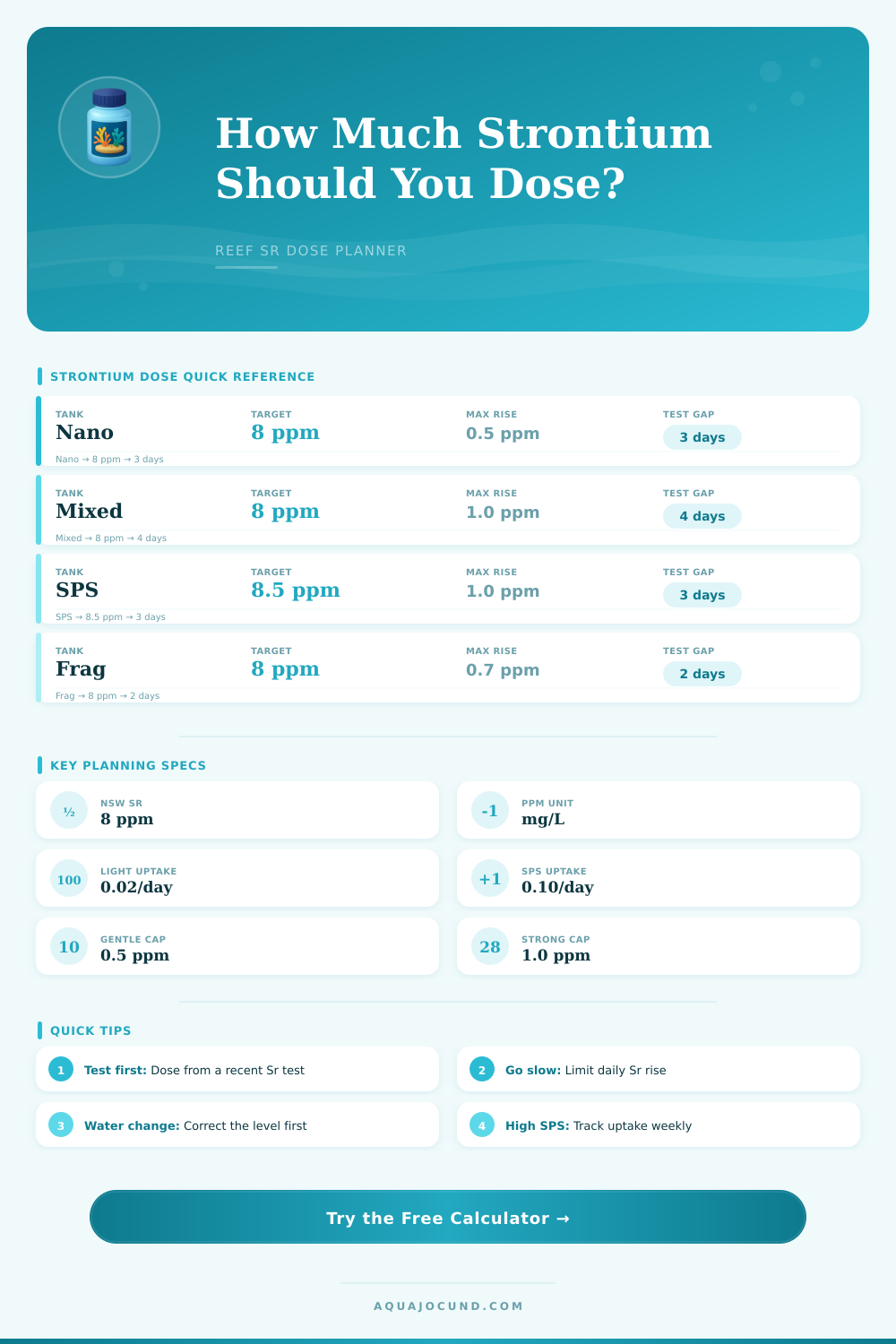
Any dosing of strontium that does not take into account the amount of strontium that is provided by water changes may add too much strontium to the system. Strontium levels in the system should be limited, since high concentrations of strontium can interfere with the other ions in the water. In most cases, individuals limit the amount of strontium to between a half and one part per million per day.
The strontium calculator will ensure that an individual does not dose too much strontium into the water by automatically extending the dosing schedule if the amount of strontium that is needed to be added to the system each session exceeds the daily limit for strontium that is choose by the individual. The strength of the strontium supplement that is provided to the reef system is also important. For instance, a strontium supplement that is five milligram per milliliter may be used in small nano reef systems, but twenty or fifty milligram strontium supplements may be used in large display tanks.
The amount of strontium that the corals in the system use can depend upon the age of the tank and the amount of coral in the system. For example, a reef tank that contains less than six month of corals may use less strontium than a tank that is more mature and contains numerous stony corals. Taking strontium tests of the reef system can determine the amount of strontium that is used by the corals.
Two tests of strontium can be performed over several days to determine the drop in strontium levels in the water. Strontium test kits can contain a margin of error in the measurement of the strontium concentration in the water. For this reason, an individual may wish to adjust the calculations for strontium that are performed for the reef tank by applying a margin of error to the calculations.
The calculator also allows for adjustments to the strontium dose in the tank by a percentage to account for the margin of error in the strontium test kits. Once the strontium levels have been corrected to the appropriate levels for the reef tank, a person will need to maintain the strontium levels in the system. To maintain strontium levels in the system, small amounts of strontium will need to be added to the system according to a schedule.
The dosing days can be entered into the calculator to determine how frequent strontium should be dosed into the system. In addition, the strontium dose should be set to the “max-rise” setting to ensure that the strontium levels do not rise too quick in the system. By determining the rate at which corals in the tank use strontium and by establishing a repeatable schedule for dosing strontium into the water, the strontium levels will remain steady in the system, ensuring the continued growth of the stony corals in the reef tank.
It should of been noted that you’ll need to watch the levels actualy.