🐚 Reef Tank Sand Calculator
Estimate reef-safe sand weight, bed volume, bag count, and footprint coverage by tank shape, depth, and substrate type.
✅ Reef Sand Estimate
| Material | Bulk Density | Grain Size | Best Depth | Best Reef Use |
|---|---|---|---|---|
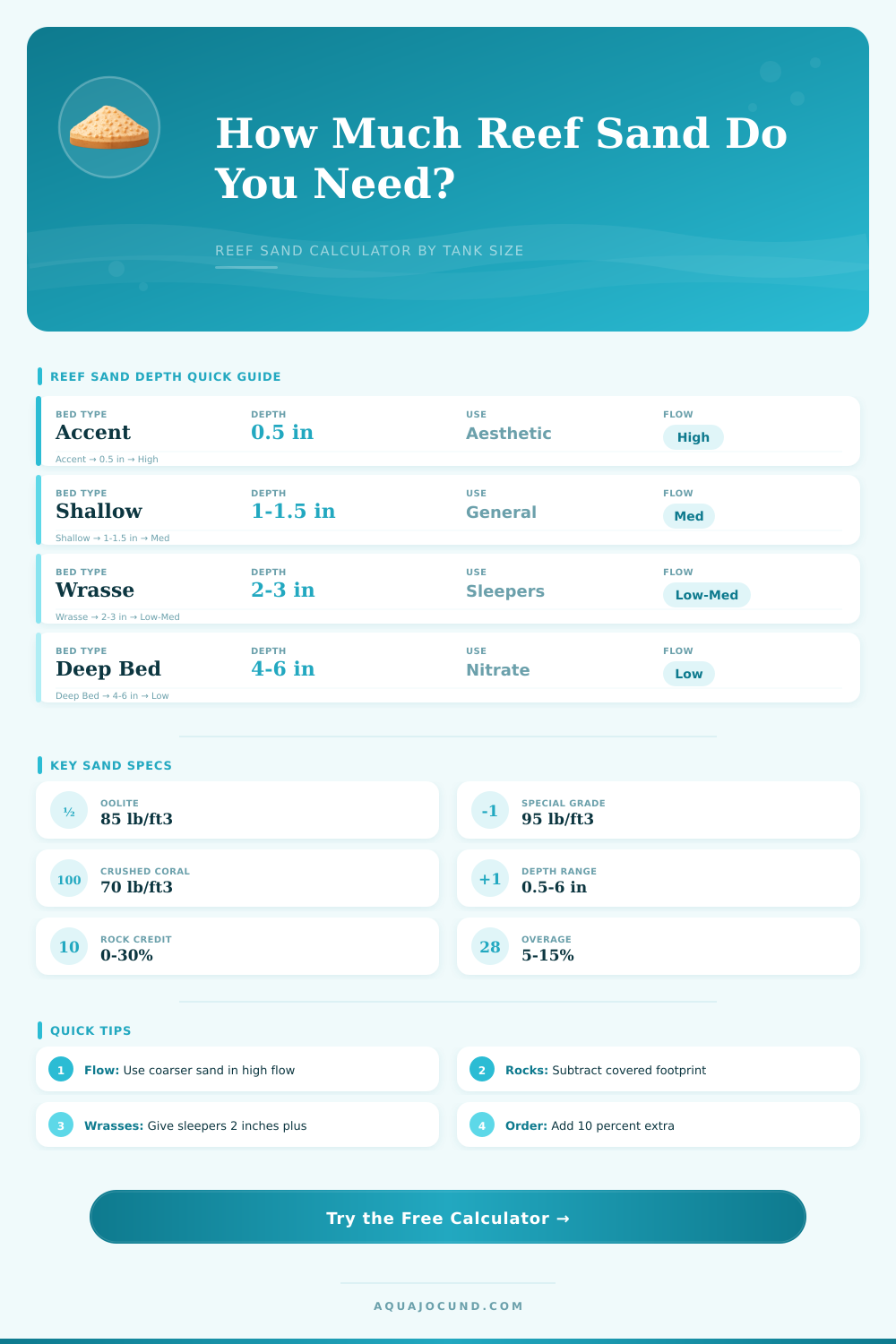
| Sugar fine oolite aragonite | 85 lb/ft³ | 0.25-1 mm | 1-3 in | Low-flow nano reefs, burrowing wrasses, natural white bed |
| Fiji pink fine aragonite | 90 lb/ft³ | 0.5-1.5 mm | 1-2.5 in | Mixed reefs, soft coral tanks, balanced appearance |
| Special grade aragonite | 95 lb/ft³ | 1-2 mm | 0.75-2 in | SPS flow, gyre pumps, tanks with active cleanup crews |
| Crushed coral | 70 lb/ft³ | 2-5 mm | 0.5-1.5 in | Fish-only reefs, high oxygen beds, easy siphon cleaning |
| Black aragonite blend | 92 lb/ft³ | 0.5-2 mm | 0.75-2 in | Contrast aquascapes, LPS gardens, medium flow reefs |
| Wet packed live aragonite | 108 lb/ft³ | 0.5-2 mm | 1-2 in | Quick starts where bag weight includes shipped water |
| Shell and coral rubble mix | 62 lb/ft³ | 3-10 mm | 0.5-1 in | Pod zones, high flow corners, rubble valleys |
| Refugium mud and fine sand | 74 lb/ft³ | mud-1 mm | 3-5 in | Sump refugiums, seagrass, mangrove starts, nutrient zones |
| Tank | Dimensions | Metric Size | At 1 in Special Grade | At 2 in Fiji Pink |
|---|---|---|---|---|
| 5 gal nano | 16 × 8 in | 41 × 20 cm | 7 lb | 13 lb |
| 10 gal frag | 20 × 10 in | 51 × 25 cm | 11 lb | 21 lb |
| 20 long | 30 × 12 in | 76 × 30 cm | 20 lb | 38 lb |
| 29 gal reef | 30 × 12 in | 76 × 30 cm | 20 lb | 38 lb |
| 40 breeder | 36 × 18 in | 91 × 46 cm | 36 lb | 68 lb |
| 55 gal reef | 48 × 13 in | 122 × 33 cm | 34 lb | 65 lb |
| 75 gal reef | 48 × 18 in | 122 × 46 cm | 48 lb | 90 lb |
| 125 gal display | 72 × 18 in | 183 × 46 cm | 71 lb | 135 lb |
| Bed Style | Depth | Good For | Watch Point |
|---|---|---|---|
| Accent | 0.25-0.75 in | Clean glass-bottom look with a light sand veneer | Does not support burrowing animals |
| Shallow Reef | 1-1.5 in | Most mixed reefs, easy maintenance, natural appearance | Fine sand may drift in strong flow |
| Wrasse Bed | 2-3 in | Halichoeres and other sand-sleeping wrasses | Use rounded grains, avoid sharp coral rubble |
| Goby Zone | 2.5-4 in | Watchman gobies, pistol shrimp, jawfish-style zones | Secure rock on glass before adding sand |
| Deep Sand Bed | 4-6 in | Denitrification zones and mature biodiversity | Needs careful flow, stocking, and long-term planning |
| Refugium | 3-5 in | Sump macroalgae zones, pods, mud and sand blends | Keep flow gentle enough to prevent storms |
| Tank Shape | Footprint Formula | Volume Formula | Best Input Tip |
|---|---|---|---|
| Rectangle | L × W | L × W × H | Use inside glass dimensions when possible |
| Cube | L × L | L × L × H | Set length to one inside side panel |
| Cylinder | π × r² | π × r² × H | Enter true inside diameter |
| Bow front | L × W plus half ellipse | Footprint × H | Measure extra bow depth at the center |
| Custom volume | Volume divided by height | Direct volume | Useful for odd all-in-one reef tanks |
High-flow SPS tanks usually need special grade aragonite or a mixed grain bed. Sugar-fine oolite looks natural, but it can blow into dunes under gyres and strong return nozzles.
Rockwork sitting on the glass replaces sand footprint. Subtracting 10-30 percent is usually closer than filling the entire rectangle, especially in modern negative-space reef aquascapes.
When you begin to build your reef tank, you must calculate the correct amount of sand for your tank. If you have too little sand in your tank or if you have too much sand, you will encounter a variety of problem within your reef tank. Many people treat sand within their reef tanks as if it is a filler for the tank.
However, sand serve a variety of important function for your reef tank. Therefore, you must select the apropriate type of sand to use within your reef tank and you must also select the apropriate depth for the sand within your tank. The type of sand that you select for your reef tank is important because not all sand are created equally.
How Much and What Sand to Use in Your Reef Tank
For instance, you can purchase fine oolite sand for your reef tank. The fine oolite sand will look great within your reef tank. However, the fine oolite sand is very light in weight.
In some cases, the lightness of the sand will cause the wavemakers and the powerheads in your reef tank to move the sand. These moving sand can lead to the formation of sand dunes that may bury some of the coral fragment. An alternative to fine oolite sand is special grade aragonite.
The aragonite is heavier than the fine oolite sand. Therefore, the high flow pump that are present in many reef tanks will not easily move it. If you use high flow pumps within your reef system, you should use aragonite in place of fine oolite sand because the heavier sand will remain in place within the tank.
The depth of the sand in your reef tank is also important. The depth of sand will determine what kinds of animal will live within the sand in your tank. For instance, if you want a more minimalist look for your reef tank, you can use a thin layer of sand in your reef tank.
However, if you are using a thin layer of sand in your reef tank, you will not be able to accommodate some of the animals that like to dig in the sand. For instance, watchman gobies and sleeper wrasses will need deep sand bed within the tank. You must provide deep sand beds for these fish because they require sand tunnels in which to sleep when the reef lights are turned off.
When calculating how much sand you should buy for your reef tank, you must account for the amount of water that the rockwork in your tank will displace. For instance, if you calculate the length and width of the reef tank alone, you will likely buy too much sand for the reef tank. The base rocks in your reef tank will displace some of the sand.
You should therefore subtract a percentage for the rockwork that will be covered in your reef tank. Furthermore, you should also consider the density of the sand that you select to purchase for your tank. Crushed coral and aragonite have different densities.
Therefore, a bag of crushed coral may weigh more or less than a bag of aragonite. You must be aware of the different densities of sand so that you can ensure that you can reach the target depth that you calculate that your sand bed should reach. You must also ensure that you dont purchase too much sand for your reef tank.
Too deep a sand bed within a reef tank can lead to anaerobic zone within the sand for your reef tank. Another consideration when purchasing sand for your reef tank is the rinse loss of the sand. You will have to rinse the sand that you purchase for your reef tank to remove any organic debris that may grow within the sand.
If you do not rinse the sand, it may affect the water chemistry of your reef tank. However, you will lose some of the sand during the rinsing process. Therefore, you have to purchase an extra amount of sand when you buy the sand for your reef tank.
It is better to purchase an extra amount of sand so that you dont have a sand bed that is more shorter than your target depth for your reef tank. Finally, you must plan the placement of the sand in your reef tank. You should place the reef rocks in your reef tank first and then add the sand to the reef tank around the base of the rocks.
By placing the rocks in the reef tank first, you will be able to create a natural look for the reef tank. Furthermore, by placing the rocks first, you will prevent the crushing of the animals that live in the sand beneath the rocks. If you follow these steps, you will have created an environment that is suitable for the biology of your reef tank.
By selecting the correct sand grain size for your reef tank based off your flow and by making the calculations for the amount of sand that you need in your reef tank based on your reef rockwork, you will have created a perfect foundation for the reef tanks chemistry and fish.