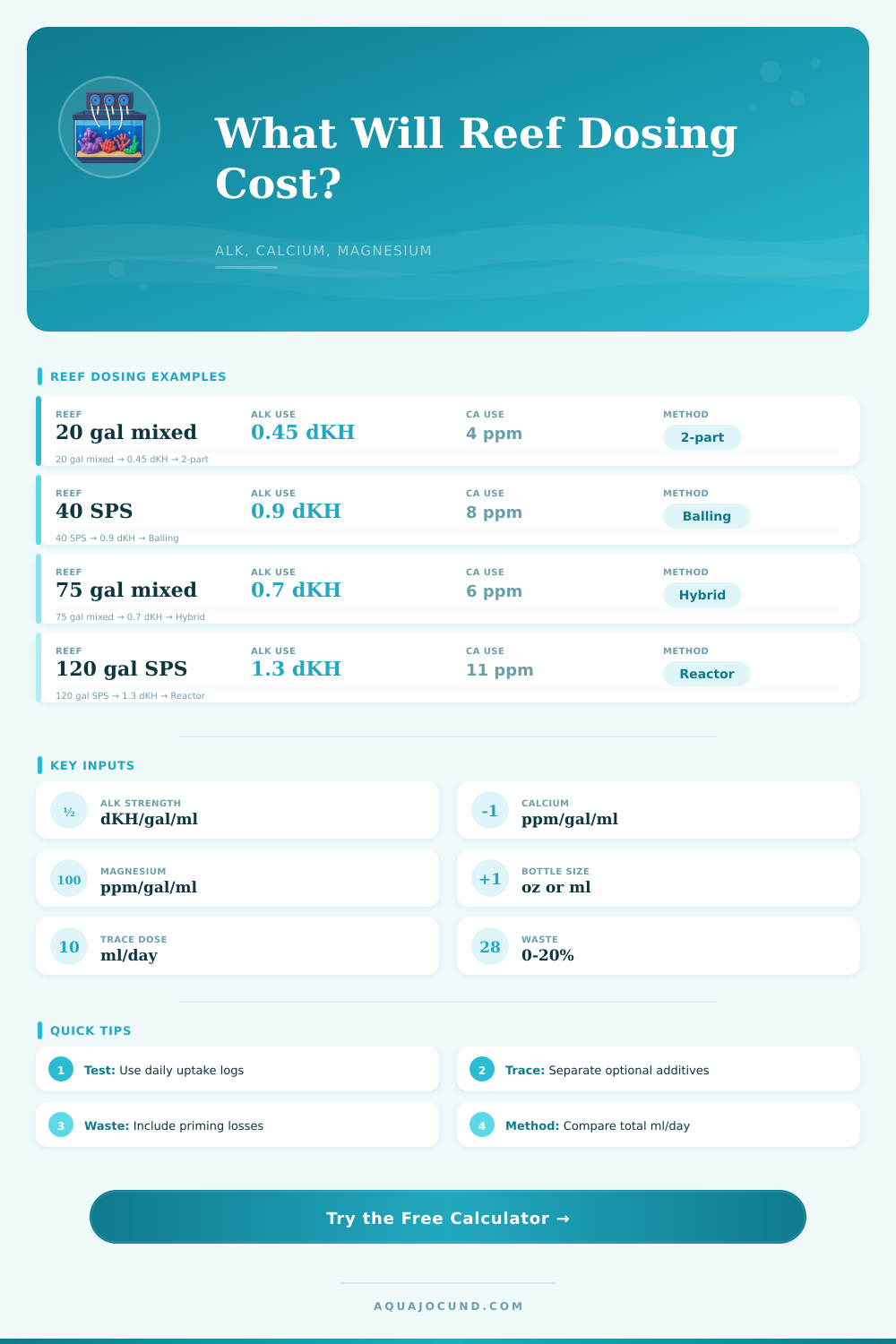
Reef Tank Dosing Cost Calculator
Estimate daily, monthly, and plan-period reef dosing spend from alkalinity, calcium, magnesium, trace dosing, bottle size, solution strength, and waste margin.
⚙Unit system
🧪Dosing profile
Used for comparison context and default solution assumptions only.
No brand recommendation; strengths are generic planning values.
Reef dosing cost results
📊Solution strength grid
🧮Dosing method comparison
2-part liquids
Balling salts
Kalk hybrid
Calcium reactor
📘Reference tables
| Generic solution | Alk strength | Calcium strength | Magnesium strength |
|---|---|---|---|
| Standard balanced liquids | 0.035 dKH/gal/ml | 0.72 ppm/gal/ml | 0.19 ppm/gal/ml |
| High-strength alkalinity | 0.050 dKH/gal/ml | 0.72 ppm/gal/ml | 0.19 ppm/gal/ml |
| Low-pH alk blend | 0.028 dKH/gal/ml | 0.72 ppm/gal/ml | 0.19 ppm/gal/ml |
| Balling light style | 0.040 dKH/gal/ml | 0.80 ppm/gal/ml | 0.22 ppm/gal/ml |
| Kalkwasser hybrid trim | 0.018 dKH/gal/ml | 0.37 ppm/gal/ml | 0.10 ppm/gal/ml |
| Dry salt stock solution | 0.060 dKH/gal/ml | 1.08 ppm/gal/ml | 0.30 ppm/gal/ml |
| Common reef | Approx dimensions | Actual volume | Typical daily demand |
|---|---|---|---|
| 13.5 nano | 22 x 12 x 15 in / 56 x 30 x 38 cm | 10-12 gal / 38-45 L | 0.15-0.35 dKH |
| 20 long mixed | 30 x 12 x 12 in / 76 x 30 x 30 cm | 16-18 gal / 61-68 L | 0.3-0.6 dKH |
| 40 breeder SPS | 36 x 18 x 16 in / 91 x 46 x 41 cm | 32-36 gal / 121-136 L | 0.7-1.1 dKH |
| 75 gal mixed | 48 x 18 x 21 in / 122 x 46 x 53 cm | 58-68 gal / 220-257 L | 0.5-0.9 dKH |
| 120 gal SPS | 48 x 24 x 24 in / 122 x 61 x 61 cm | 95-110 gal / 360-416 L | 1.0-1.6 dKH |
| Consumption band | Alk use | Calcium use | Cost signal |
|---|---|---|---|
| Light soft coral | 0.05-0.25 dKH/day | 0.5-2 ppm/day | Trace dose can dominate |
| LPS mixed reef | 0.25-0.60 dKH/day | 2-5 ppm/day | Balanced 2-part is easy to compare |
| Moderate SPS | 0.60-1.00 dKH/day | 5-9 ppm/day | Bottle life becomes important |
| Dense acropora | 1.00-1.80 dKH/day | 9-16 ppm/day | Bulk stock or reactor may pencil out |
| Math item | Formula | Unit | Use |
|---|---|---|---|
| Required ml | Daily use / strength | ml/day | Each major solution |
| Cost per ml | Bottle price / bottle ml | $/ml | Liquid comparison |
| Waste margin | ml x (1 + waste %) | ml/day | Priming and calibration loss |
| Bottle life | Bottle ml / daily ml | days | Refill planning |
💡Dosing cost tips
There’s nothing worse than reaching into your cabinet only to find that your bottle of alkalinity is dry. You suddenly has to calculate how long the next refill will last and whether you can afford to buy bulk size right now. Or will it be enough to get you to the next purchase date?
Knowing the chemistry isn’t enough to maintain stable water parameters in a reef tank; you also need to figure out how to afford liquid that keep your corals alive. While dosing is simple math on paper, real world application gets complicated with priming losses, waste, and strength differences between solution.
How to Plan Your Reef Tank Supplies and Budget
How much do they take in daily? Most hobbyist are very aware of this number and track it with a combination of water changes and/or test results. Nothing wrong with that; those numbers tell you exactly what your livestock is consuming. Where we go astray is our attempt at matching their biological requirements to real world inventories and finances.
Knowing how many milliliters to dispense today isn’t enough…you want to know how long that bottle is going to last until empty! By having some idea of your grand total for the day, you avoid running out of bottles and panicking.
Once you measure your own consumption rates and enter your tank’s true water volume into the calculator above, the calculator do all the work for you. It factors in strength of whatever solution(s) you employ, from homebrewed salts to high-strength mixes to good old-fashioned two-part liquid stuff.
Many people forget one thing: the “waste” margin. You’ll inevitably lose some product each time you calibrate a dispenser or prime a new line on a dosing pump. That’s where this eight to ten percent buffer comes in. If you don’t include this, your calculated bottle life will always be inaccurate and overly-optimistic.
The economics shift depending on which type of dosing you do. If it’s two part liquids, some variables is fixed for more precise and convenient cost comparisons. If it’s balling with dry salts, then there are disciplines involved in mixing but higher margins when doing this at a larger scale. If it’s kalkwasser, you save money because fewer liquid are consumed. However, the equipment become more complex.
Each option has one cost driver. Depending on the tank size and what sort of corals you keep, the trace additives might become a greater expense then the major elements. So, instead of your alk or calcium cost being the driver, iodine and amino acids are the drivers. You’ll still have all those separate bottles to watch closely. But that doesn’t mean it won’t work.
For larger systems that require many small polyp stony corals, the biggest cost will be amount of major elements needed for dosing. Daily cost per mil is less important then bottle life. For example, going through a gallon every couple of weeks results in lots of shipping and ordering. Even though it’s an upfront investment, it may work out better long term by using a reactor set up or bulk purchases.
That table on the page illustrates that as your corals become more dense, the cost shifts from being mostly about trace elements to mostly about major elements. It’s all based off testing accuracy. Your whole estimate falls apart if you take inaccurate readings of how much stuff you’re adding every day. Take an average over several days of your measured alkalinity while measuring at roughly the same time each day. One high read and one low isn’t reality. It’s biology fluctuating or it’s human error. Use that steady average as the basis for your math. Don’t let chasing individual readings drive your estimates.
In short, there’s always a fine line between the logistical aspect of having a reef tank and the biological aspects of it. On one hand, you have healthy coral. On the other hand, you want to go to bed at night and know that the supply chain isn’t going to fall apart. Rather than scrambling at the last minute, wouldn’t you like to know exactly when you’ll run out of something so you can order in advance? Make it a calendar reminder instead of a crisis. Sure, you need to keep your water chemistry in range, but you also want to maintain the rhythm of maintenance while avoiding any financial surprises along the way. You should of stayed ahead of things so the entire system runs smoothly.