🧪 Carbon Dosing Reef Tank Calculator
Estimate a conservative daily carbon dose, ramp limit, and nutrient safety check for reef aquariums.
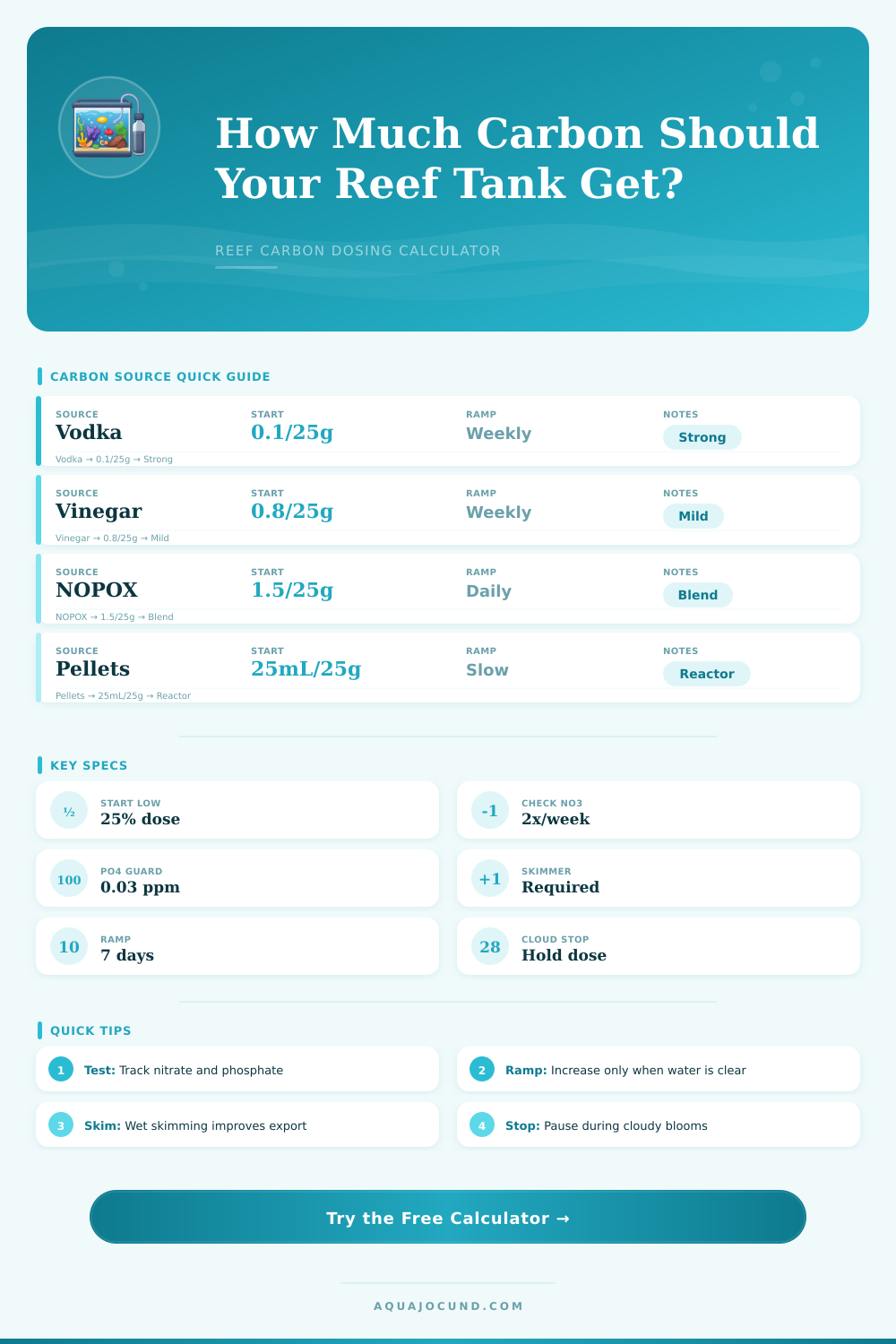
| Source | Starting Baseline | Typical Ramp | Best Use | Watch Closely |
|---|---|---|---|---|
| Vodka 40 percent | 0.1 mL / 25 gal | +0.1 mL / 25 gal weekly | High nitrate with strong skimming | Bacterial bloom, pale coral |
| White vinegar 5 percent | 0.8 mL / 25 gal | +0.8 mL / 25 gal weekly | Gentler daily dosing | pH dip if dosed at once |
| NOPOX style blend | 1.5 mL / 25 gal | Adjust after 7 days | Mixed carbon source routine | Skimmer overflow |
| Ethanol 20 percent | 0.2 mL / 25 gal | +0.2 mL / 25 gal weekly | DIY diluted ethanol approach | Concentration accuracy |
| Vinegar / vodka blend | 0.9 mL / 25 gal | +0.5 mL / 25 gal weekly | Balanced potency and control | Cloudy water after increase |
| Sugar solution 10 percent | 0.2 mL / 25 gal | Small changes only | Short-term cautious use | Cyano and film algae |
| Mild DIY blend | 1.0 mL / 25 gal | Adjust after testing | Established tanks with records | Recipe consistency |
| System | Display Size | Typical Net Water | Vodka Start | Vinegar Start |
|---|---|---|---|---|
| Nano soft coral | 20 gal / 76 L | 16 gal / 61 L | 0.06 mL/day | 0.51 mL/day |
| Breeder mixed reef | 40 gal / 151 L | 34 gal / 129 L | 0.14 mL/day | 1.09 mL/day |
| Cube SPS reef | 60 gal / 227 L | 52 gal / 197 L | 0.21 mL/day | 1.66 mL/day |
| Standard reef | 75 gal / 284 L | 70 gal / 265 L | 0.28 mL/day | 2.24 mL/day |
| Large SPS system | 120 gal / 454 L | 112 gal / 424 L | 0.45 mL/day | 3.58 mL/day |
| Fish-heavy reef | 180 gal / 681 L | 170 gal / 644 L | 0.68 mL/day | 5.44 mL/day |
| Reading | Low Range | Usable Range | High Range | Carbon Dosing Action |
|---|---|---|---|---|
| Nitrate NO3 | 0 to 1 ppm | 2 to 10 ppm | 20+ ppm | Do not chase zero; reduce slowly |
| Phosphate PO4 | 0 to 0.02 ppm | 0.03 to 0.10 ppm | 0.20+ ppm | Hold dose if phosphate bottoms out |
| Water clarity | Clear | Slight haze | Cloudy | Pause increases until clear |
| Coral response | Normal color | Slight lightening | Pale tips | Back down dose and feed normally |
| Skimmer output | Dry foam | Wet foam | Overflowing | Lower dose and tune skimmer |
| Week | Vodka | Vinegar | NOPOX Style | Decision Point |
|---|---|---|---|---|
| 1 | Baseline start | Baseline start | Baseline start | Confirm clear water and stable oxygen |
| 2 | Up to 2x start | Up to 2x start | Adjust to nitrate trend | Increase only if nitrate is unchanged |
| 3 | Up to 3x start | Up to 3x start | Hold or trim dose | Stop ramp when nitrate drops weekly |
| 4+ | Maintenance dose | Maintenance dose | Maintenance dose | Use the lowest dose that holds target |
Carbon dosing depends on bacterial export, so an efficient protein skimmer and good gas exchange are part of the calculation. If the tank clouds, oxygen drops, cyano spreads, or corals pale, hold or reduce the dose before increasing again.
Do not use carbon dosing to force phosphate to zero. Many reef tanks stall when phosphate is too low, because bacteria need both nitrate and phosphate to grow and be skimmed out.
Carbon dosing is a method that can be used to control the levels of nitrate and phosphate in the aquarium water. The idea behind carbon dosing is that if you add organic carbon to the reef aquarium, the bacteria will utilize that carbon as a food source. When the bacteria consume the organic carbon, the bacteria also consume the nitrate and phosphate in the water.
Furthermore, a protein skimmer can physically remove the bacteria from the aquarium. Thus, carbon dosing is a process by which the bacteria can remove the nutrient from the water. However, if you add too much carbon to the reef aquarium too quick, the bacteria will grow too rapidely in the water.
How to Carbon Dose a Reef Aquarium Safely
The rapid growth of bacteria will cause the reef aquarium water to become cloudy. Cloudy water indicates that the bacteria is growing in the water rather than in the rocks of the reef aquarium. Furthermore, the rapid consumption of oxygen by the rapidly-growing bacteria can lead to low level of dissolved oxygen in the water, which can lead to the death of the reef aquarium’s fish.
Because every reef aquarium is different, and because each aquarium has a different biological load, the biological load of that reef aquarium determines the level of carbon that should be added to the reef aquarium. A new reef aquarium will have few or no bacteria living within the water. Therefore, a new reef aquarium will require a very small amount of carbon to be added to the water.
An established reef aquarium will have more bacteria then a new reef aquarium. Thus, you can add more carbon to an established reef aquarium than to a new reef aquarium. Furthermore, the amount of carbon that can be safely added to a reef aquarium also relates to the strength of the export (skimmer) equipment that is used to remove the bacteria from the reef aquarium.
A reef aquarium that has a large protein skimmer will allow for more carbon to be dosed into the reef aquarium than a reef aquarium with a small protein skimmer. There are many different types of carbon that can be dosed into the reef aquarium. For instance, vodka is a type of carbon dosing that is very potent.
Vodka can be used as carbon dosing to remove the nitrate from the water if the levels of nitrate are high in the reef aquarium. However, because vodka is so potent, there is very little room for error if using vodka as a carbon source. Vinegar is another type of carbon dosing that is less potent than vodka.
Therefore, there is more room for error when using vinegar than with vodka. However, care must be taken when using vinegar because adding too much vinegar will lower the pH of the reef aquariums water. Finally, commercial carbon blends and biopellets are other type of carbon dosing products.
Each of these products has a different level of potency to the reef aquarium water. Thus, different amounts of these products must be used relative to each other so that the reef aquariums bacteria have enough carbon to utilize. It is important to understand that the level of nitrate and phosphate in the reef aquarium should never be reduced to zero.
Corals require some amount of nutrients to survive. Furthermore, the bacteria that are used to remove the nitrate and phosphate from the water require both types of nutrients to perform their biological processes. Thus, if carbon dosing removes all of the phosphate from the reef aquarium, the bacteria will cease growing.
As a result, the corals will lose their tissue or turn pale. It is important, therefore, to use test kits to determine the amount of nitrate and phosphate in the reef aquarium. These tests will allow the reef aquarium’s keepers to avoid reaching levels of zero nitrate and zero phosphate.
Furthermore, if the water within the reef aquarium becomes cloudy, or if the corals begin to lose tissue, it is a sure sign that too much carbon was added to the reef aquarium. In order to add carbon to a reef aquarium, the dose of carbon must be increased slowly. If you increase the dose of carbon all at once to the level that is recommended for the reef aquarium for maintenance, the bacteria will grow rapidly in the water.
The rapid growth of the bacteria will result in cloudy water and the potential death of the reef aquarium’s fish due to low levels of dissolved oxygen in the water. Additionally, if the water within the reef aquarium becomes cloudy during the process of increasing the dose of carbon to be dosed into the reef aquarium, the process of increasing the dose of carbon must be stopped. The dose of carbon should be held at the current level until the reef aquarium water becomes clear of any suspended solids.
Finally, carbon dosing is a means of maintaining balance in the reef aquarium. It is a means of carbon that does not lead to the total elimination of all nutrients from the reef aquarium. However, carbon dosing is a means of managing the levels of nitrate and phosphate.
Calculations can be used to determine the amount of carbon that should be added to the reef aquarium to ensure the safety of the inhabitants of that aquarium. Furthermore, regular tests of the water for nitrate and phosphate content, as well as the appearance of the reef aquariums corals can help ensure that the reef aquarium is managed in a safe manner. By monitoring the levels of nitrate, phosphate, and the appearance of the corals, the reef aquarium can be managed in a safe manner.
You should of used more caution when starting.