🌊 Reef Return Pump Calculator
Size your sump return pump from real target turnover, vertical rise, plumbing drag, fittings, and pump curve behavior.
✅ Return Pump Sizing Result
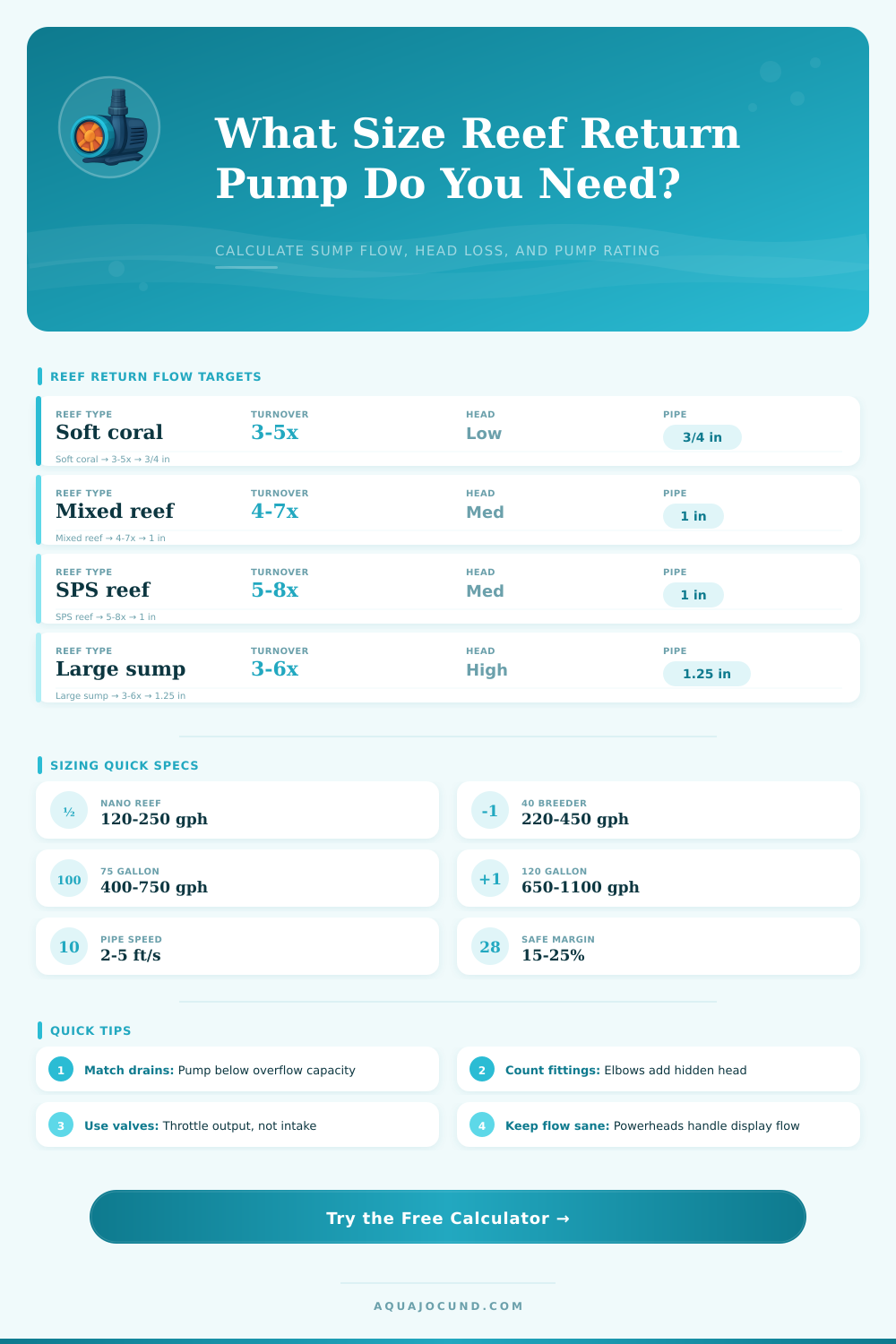
| System Type | Typical Return Turnover | Why It Works | Display Flow Note |
|---|---|---|---|
| Soft Coral Reef | 3–5x display volume per hour | Gentle sump exchange keeps noise and bubbles low. | Use powerheads for coral movement. |
| Mixed Reef | 4–7x display volume per hour | Balanced for skimmer contact time and stable overflow depth. | Return flow is not total reef circulation. |
| SPS Dominant Reef | 5–8x display volume per hour | Higher exchange can help temperature and nutrient consistency. | Most random flow still comes from wavemakers. |
| Large Remote Sump | 3–6x display volume per hour | Long plumbing benefits from efficient, moderate turnover. | Oversizing can make drains louder. |
| Frag or Utility System | 4–10x display volume per hour | Shallow tanks and manifolds often need extra return capacity. | Keep standpipe and sump limits in mind. |
| Pipe ID | Comfortable Reef Flow | Velocity at Mid Flow | Best Use |
|---|---|---|---|
| 1/2 in | 100–250 gph | 2.2–5.5 ft/s | Nano returns and short runs. |
| 3/4 in | 250–600 gph | 2.1–5.1 ft/s | Common reef-ready tank returns. |
| 1 in | 450–1000 gph | 2.1–4.5 ft/s | Most medium and large reef systems. |
| 1 1/4 in | 700–1500 gph | 2.0–4.2 ft/s | Large displays, manifolds, low-friction runs. |
| 1 1/2 in | 1000–2200 gph | 1.9–4.2 ft/s | Fish rooms, basement sumps, long plumbing. |
| Component | Typical Equivalent Length | Calculator Treatment | Sizing Note |
|---|---|---|---|
| 90 Degree Elbow | 1.5–4 ft each | Based on selected pipe diameter. | Use sweep elbows or flex bends when possible. |
| Union Pair | About 1 ft total | Included in restriction setting. | Worth the tiny loss for maintenance access. |
| Ball or Gate Valve | 1–3 ft when mostly open | Included as valve and unions. | Throttle the output side only. |
| Manifold Tee | 3–8 ft plus branch demand | Uses larger restriction multiplier. | Dedicated feed pumps can be simpler. |
| UV or Reactor Loop | Device dependent | Adds head and reserve capacity. | Check the device flow range separately. |
| Display Size | Target Return Flow | Common Head Range | Typical Pump Rating to Shop |
|---|---|---|---|
| 20 gal nano sump | 80–140 gph | 3–4.5 ft | 150–300 gph pump |
| 40 gal breeder | 160–280 gph | 4–5 ft | 350–600 gph pump |
| 75 gal reef ready | 300–525 gph | 5–6 ft | 650–1000 gph pump |
| 120 gal SPS reef | 600–960 gph | 5–7 ft | 1200–2000 gph pump |
| 180 gal peninsula | 720–1080 gph | 6–9 ft | 1800–3200 gph pump |
The return pump only needs to exchange water through filtration at a steady rate. Coral flow is usually handled by wavemakers, gyres, or closed-loop circulation inside the display.
A pump that outruns the drain can raise display water level, add noise, and create microbubbles. Size below the tested drain limit, then tune with a valve or DC controller.
When you choose a return pump for your aquarium, you must understand that the flow rate is teh theory maximum that the return pump can move. The theoretical maximum of the return pump is the amount of water that the return pump can move when it is moving water horizontal across a flat surface. In the aquarium, though, a return pump must overcome head heights and friction.
If you dont account for these variable, the return pump will move less water than the flow rate listed on the box. A return pump must overcome static head and friction head to effectivly move water through the aquarium. Static head is the distance that the return pump must move the water from the top of the water in the sump to the nozzle of the return pump.
How to choose the right return pump for your aquarium
Friction head is the resistance that the water encounters against the walls of the plumbing. Any 90-degree elbow in the plumbing also create friction head. Each elbow adds to the total length of the plumbing, thus creating more friction head.
More friction head from elbows will lead to a decrease in the total flow rate of the return pump. If you do not account for static head and friction head, the return pump will not move enough water for proper filtration. Many peoples believe that the return pump is the only pump that provides water movement to the corals in the reef tank.
However, the return pump is not responsible for the water movement to the corals. The return pump is responsible for move water through the skimmer, the refugium, and the mechanical filter. Instead, wavemakers and powerheads provide the water movement needed for the corals to receive the water movement to prevent detritus from settling on the corals.
In this case, you do not need a return pump with an excessive flow rate. Instead, you only want to ensure that the return pump can provide a steady flow of water. Too much flow rate can lead to the tank overflow.
The diameter of the pipe that you use to move the water from the return pump to the aquarium also create a variable in the flow rate of the return pump. If you use a small pipe to move a high volume of water, the velocity of the water will be high. High velocity of water will create a high degree of friction and noise.
If you use a larger diameter pipe, such as one inch or one and a quarter inch, the return pump will encounter less friction head. A lower friction head will allow the return pump to move with less effort and create less noise. There are different styles of return pumps that you can purchase.
For instance, there are AC mag drive pumps and DC pumps. AC mag drive pumps are quite durable but have a much lower flow rate as the height of the head increase. DC pumps a controller can control.
If you purchase a DC pump that has a higher flow rate than you need, you can use the controller to reduce the flow rate of the return pump. This extra capacity in the DC pump will provide a safety margin in case algae or salt creep enters the impeller of the pump. The last factor to consider when purchasing a return pump is the relationship between the return pump and the overflow drain.
The return pump should not move as much water per hour as the overflow drains can remove. If the return pump does push more water into the aquarium per hour than the overflow drains can remove, the aquarium will flood. To control this variable, you can adjust the flow rate of the return pump by use a gate valve to set the flow rate of the return pump.
Use the gate valve to control the return pumps output but never its intake. If you restrict the flow of the intake side of a return pump, the return pump may experience cavitation, which will damage the return pump motor. In choosing a return pump, you must balance the flow rate of the return pump.
On the one hand, the return pump should move enough water to maintain the chemistry in the aquarium. On the other hand, you should avoid excessive noise create by the return pump. If you calculate the static and friction head in your aquarium, you can determine the proper flow rate and create a plumbing system that works well for your reef aquarium.