🦠 Phytoplankton Dosing Calculator for Reef Tanks
Estimate daily live phyto volume, split-feed amounts, cells delivered, and nutrient caution for reef aquariums.
Hardy green water, strong for pods and general reef feeding.
Brown-gold flagellate often chosen for clams and larval feeds.
Larger motile cells, useful for rotifers and mixed filter feeders.
Diatom option with silica demand, often used for bivalve nutrition.
| Phyto Type | Typical Cells/mL | Cell Size | Best Reef Use | Nutrient Load |
|---|---|---|---|---|
| Mixed live reef blend | 1.5B | 1-12 um | General coral, pods, feather dusters | Medium |
| Nannochloropsis live | 2.0B | 0.8-2 um | Copepods, rotifers, starter reef dosing | Lower |
| Tetraselmis live | 0.8B | 8-12 um | Rotifers, larger filter feeders | Medium |
| Isochrysis live | 0.6B | 4-7 um | Clams, oysters, larval feeds | Medium |
| Chaetoceros diatom | 1.0B | 4-10 um | Bivalves, feather dusters, varied diet | Medium |
| Diluted concentrate | 3.0B | Varies | Small measured doses, high cell delivery | Higher |
| Display Size | Common Dimensions | Typical Net Water | Starter Dose | Mixed Reef Dose |
|---|---|---|---|---|
| 13.5 gal nano | 22 x 12 x 15 in | 10-12 gal | 2-3 mL/day | 4-5 mL/day |
| 20 gal long | 30 x 12 x 12 in | 15-18 gal | 3-4 mL/day | 6-7 mL/day |
| 40 breeder | 36 x 18 x 16 in | 32-38 gal | 6-8 mL/day | 13-15 mL/day |
| 75 gal reef | 48 x 18 x 21 in | 60-75 gal | 12-15 mL/day | 24-30 mL/day |
| 120 gal reef | 48 x 24 x 24 in | 95-125 gal | 19-25 mL/day | 38-50 mL/day |
| 200 gal display | 72 x 24 x 27 in | 165-230 gal | 33-46 mL/day | 66-92 mL/day |
| Feeding Level | Base Dose | Good For | Increase When | Reduce When |
|---|---|---|---|---|
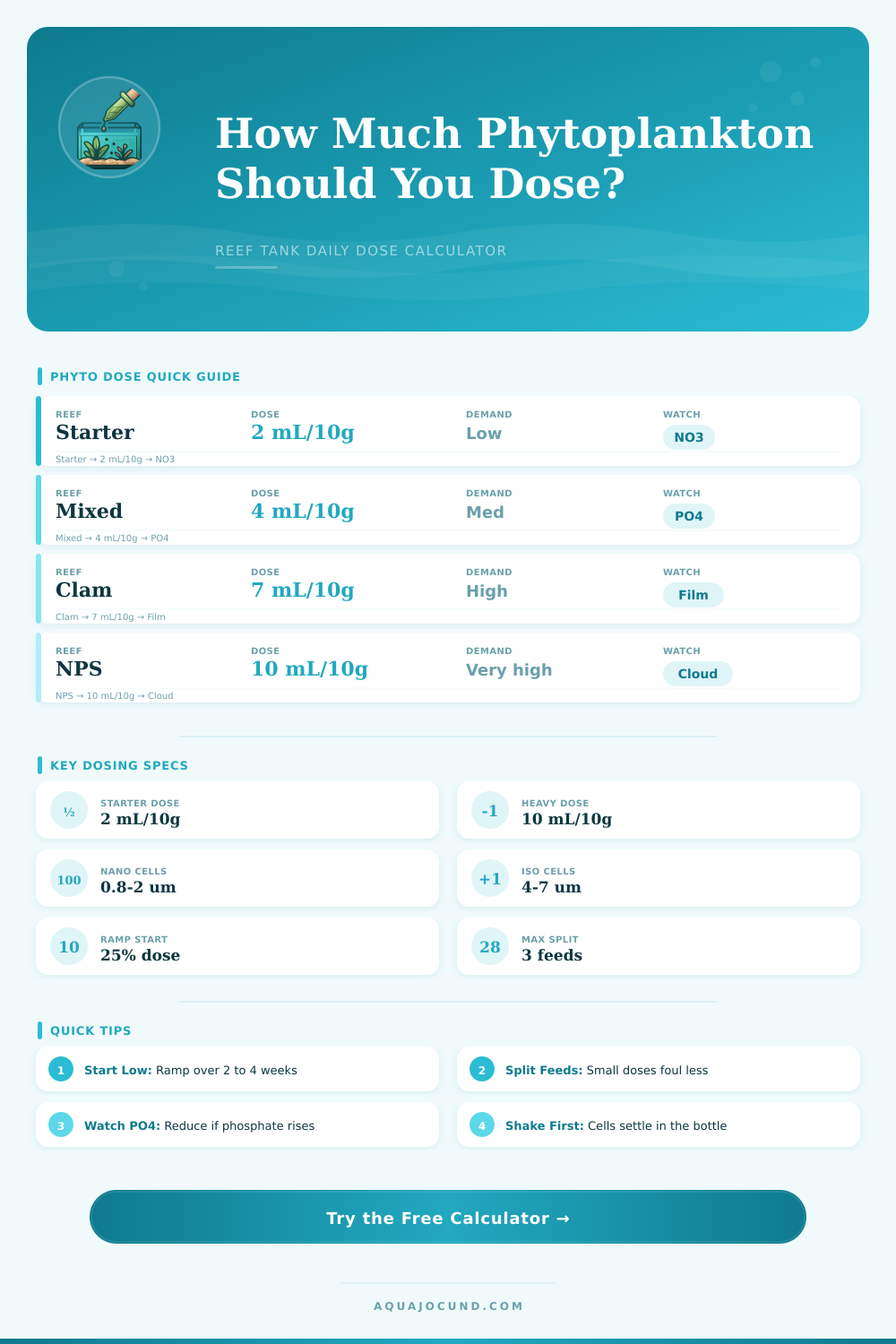
| Starter | 2 mL / 10 gal / day | New phyto dosing, algae caution | Pods decline or nutrients stay low | Film algae appears |
| Maintenance | 4 mL / 10 gal / day | Most mixed reef aquariums | Clams or dusters are added | PO4 trends upward |
| Clam support | 7 mL / 10 gal / day | Clams, gorgonians, pod focus | Export is heavy and water stays clear | Skimmer sludge spikes |
| Heavy NPS | 10 mL / 10 gal / day | Non-photosynthetic feeding systems | Target feeding is split often | Water clouds after dosing |
| Adjustment | Multiplier | Why It Matters | Practical Note |
|---|---|---|---|
| Skimmer off during feed | 0.85x | More cells stay available | Restart after 30-60 minutes |
| Normal export | 1.00x | Baseline removal rate | Good for daily automatic dosing |
| Oversized skimmer | 1.15x | Some suspended cells are stripped | Split dosing helps availability |
| UV plus heavy skimming | 1.30x | High export and sterilization pressure | Dose upstream of flow, not through UV |
| Every other day | 2x per event | Same weekly target in fewer feeds | Use only on stable systems |
| Three daily feeds | 0.33x per event | Lower nutrient pulse per dose | Best for dosing pumps |
Begin at 25% to 50% of the calculated target when the reef has not received phyto before. Track nitrate, phosphate, glass film, and skimmer response for two weeks before increasing.
Shake live phyto before measuring, dose into high flow, and consider pausing skimming briefly. Split doses are gentler than one large cloudy pour.
Phytoplankton are a microscopic form of algae that provide energy to many of the organisms in the reef aquarium. Phytoplankton is a food source for many small organism in the aquarium, and phytoplankton provide nutrients to the larger organisms in the system. By providing phytoplankton to your reef aquarium, you are providing a food source for the biological life in an aquarium.
However, if you provide too much phytoplankton to your reef aquarium, you may cause several problem in regard to the chemistry of the water in that tank. If you add too much phytoplankton to your reef aquarium, you may find that the phosphate level in the water increase, or that nuisance algae begin to bloom in the tank. In order to add phytoplankton to the aquarium in a proper amount, you must calculate the actual volume of water in the aquarium.
How to Add Phytoplankton to Your Reef Aquarium
Many reef aquarium owner use the nominal size of the aquarium to calculate the amount of phytoplankton that they will add to the water. However, the rock and sand that line the bottom of the aquarium can displace some of the water in the tank. Thus, the actual volume of water in the aquarium is less than the nominal size of the aquarium.
To add phytoplankton to the aquarium, use the actual volume of the aquarium to ensure that you are not overfeed the aquarium. The species of phytoplankton that you choose to add to the aquarium will impact the aquarium in different ways. Some species of phytoplankton is very small and beneficial in increasing the population of pod.
However, other species of phytoplankton may be larger and contain more nutrient, which makes them beneficial to feed the clams within the reef aquarium. To calculate the proper amount of phytoplankton to add to the aquarium, use the phytoplankton dosage calculator that is available for reef aquarium owner. The dosage calculator will take into consideration the density of the phytoplankton and the number of organism in the aquarium.
Using this calculator will save you the effort of calculating the amount of phytoplankton that you need based off the cell concentration of the phytoplankton culture. Some of the equipment that is use in the aquarium to help maintain healthy water chemistry can also remove the phytoplankton that you add to the water. For instance, both the protein skimmer and the UV sterilizer can remove the particle from the aquarium water, but they will also remove the phytoplankton.
If your protein skimmer is very large, it will remove the phytoplankton very efficient. In these case, it is often recommended that you turn off the protein skimmer for one hour after you add phytoplankton to the aquarium. This will allow the pods and the clams to consume some of the phytoplankton.
If you do not turn off the protein skimmer, the protein skimmer will remove the phytoplankton from the water and waste it in the process. When you first begin to add phytoplankton to your aquarium, you should not add a full dose of phytoplankton to the system. Many new reef aquarium owner often make this mistake.
Adding a full dose of phytoplankton at the start-up of the aquarium can overwhelm the biological filter system. Start with only a quarter of your planned dose of phytoplankton, and then gradually increase the amount of phytoplankton that you add to the aquarium over time. You must monitor the aquarium for the presence of film on the glass and sludge in the protein skimmer to ensure that the inhabitant of the tank is utilizing the phytoplankton.
It is far more easier to increase the amount of phytoplankton than it is to lower the amount of phosphate that may have become excessive in the water. Adding phytoplankton to the aquarium in smaller dose throughout the day will often be more effective than adding one large dose of phytoplankton. If you add phytoplankton all at once, it may create organic matter in the dead spot of the reef aquarium.
However, if you add small dose of phytoplankton throughout the day, you will provide a continuous supply of food to the organisms in the reef tank. This method of dosing phytoplankton mimics the natural environment in which the organisms would find the food, and it helps to maintain a stable reef aquarium system. Through observation of your aquarium and the life within it, you can find the correct balance of phytoplankton to add to the system.
By finding the proper balance among the volume of the water, the function of the equipment, and the species of phytoplankton that you add, you will be able to maintain your reef aquarium system in a stable state.