Reef Parameter Dosing Balance Calculator
Plan reef dosing for alkalinity, calcium, magnesium, nitrate, and phosphate with correction limits, daily uptake, nutrient ratio checks, and a staged schedule.
🪸Reef Dosing Presets
⚙Water Volume and Dosing Profile
🧪Current and Target Parameters
⏱Daily Uptake and Safety Limits
Reef Dosing Balance Estimate
📊Reef Parameter Comparison Grid
⚗Dosing Profile Strength Reference
| Profile | Alk strength | Calcium strength | Nutrient note |
|---|---|---|---|
| Balanced two-part stock | 0.036 dKH per mL/100 L | 0.37 ppm per mL/100 L | Standard nitrate and phosphate stock |
| Strong two-part stock | 0.056 dKH per mL/100 L | 0.55 ppm per mL/100 L | Smaller daily mL, dose carefully |
| Gentle nano diluted stock | 0.018 dKH per mL/100 L | 0.18 ppm per mL/100 L | Useful when tiny doses are hard |
| Balling light solutions | 0.030 dKH per mL/100 L | 0.32 ppm per mL/100 L | Balanced with separate magnesium |
| Kalkwasser assisted reef | 0.014 dKH per mL/100 L | 0.10 ppm per mL/100 L | Use only for top-off-limited planning |
| Dry salts mixed to stock | 0.040 dKH per mL/100 L | 0.42 ppm per mL/100 L | Depends on final mixed concentration |
🚦Daily Change Limit Guide
| Parameter | Gentle pace | Standard cap | Why it matters |
|---|---|---|---|
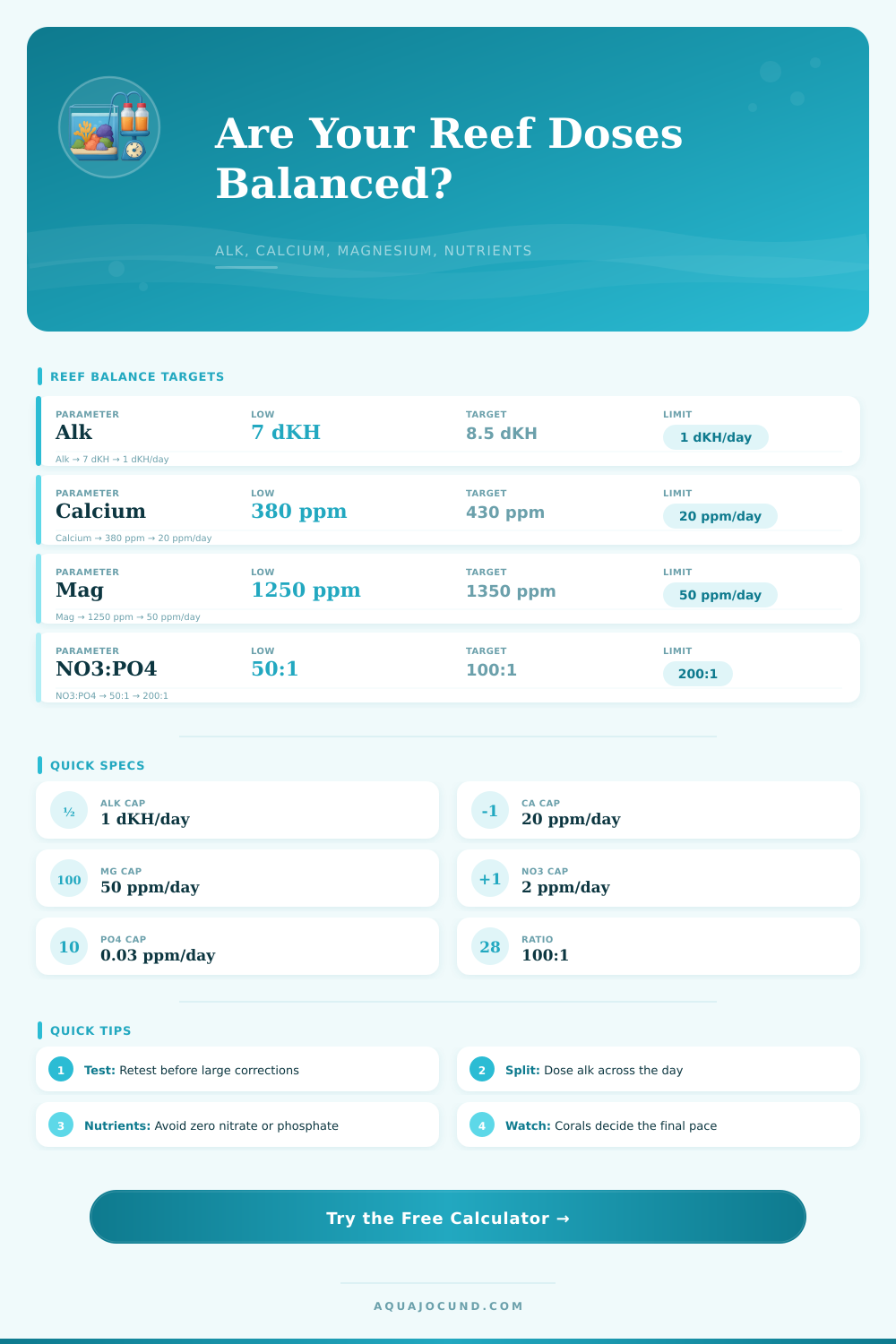
| Alkalinity | 0.3-0.5 dKH/day | 0.8-1.0 dKH/day | Fast swings can stress calcifying corals |
| Calcium | 10 ppm/day | 20 ppm/day | Large corrections can unbalance alkalinity |
| Magnesium | 25 ppm/day | 50 ppm/day | Big shifts can alter ionic balance |
| Nitrate | 0.5-1 ppm/day | 2 ppm/day | Sudden nutrient jumps can fuel nuisance growth |
| Phosphate | 0.01 ppm/day | 0.03 ppm/day | Small decimal changes are biologically meaningful |
🌊Common Reef Target Ranges
| Reef style | Alkalinity | Calcium / Magnesium | Nutrients |
|---|---|---|---|
| Soft coral reef | 7.5-9 dKH | 400-440 / 1280-1380 ppm | NO3 3-15, PO4 0.03-0.12 |
| LPS mixed reef | 8-9 dKH | 410-450 / 1300-1400 ppm | NO3 2-10, PO4 0.03-0.10 |
| SPS dominant | 7-8.5 dKH | 420-450 / 1300-1400 ppm | NO3 1-8, PO4 0.02-0.08 |
| Higher nutrient display | 8-10 dKH | 400-450 / 1280-1400 ppm | NO3 10-25, PO4 0.08-0.20 |
| Ultra-low nutrient system | 7-8 dKH | 410-440 / 1300-1380 ppm | Avoid true zero readings |
📐Common System Volume Examples
| System | Planning volume | 1 dKH alk correction | 10 ppm calcium correction |
|---|---|---|---|
| 13 gal nano reef | 49 L | 13.6 mL standard alk | 13.2 mL standard calcium |
| 25 gal lagoon | 95 L | 26.3 mL standard alk | 25.6 mL standard calcium |
| 40 breeder reef | 151 L | 42.1 mL standard alk | 40.9 mL standard calcium |
| 75 gal display | 284 L | 78.8 mL standard alk | 76.8 mL standard calcium |
| 120 gal with sump | 454 L | 126.1 mL standard alk | 122.7 mL standard calcium |
On the surface, all appears well in your aquarium. Lights turn on and off, and fish swim around, unaware of what is happening behind the scenes. But then it happens…you do a test and find that alkalinity has decreased by 1/2 degree overnight. Calcium levels continues to drop but magnesium hasn’t budged. It stresses you out because something unseen within the tank have changed.
Don’t just throw stuff at problem. Understand the rhythm of what you’re adjusting. You don’t need to do any of math. The tool on this page will do it all for you. It will even remove guesswork by calculating conversion factors/coefficients. Simply enter daily uptake (your livestock), current test results, and water volume. Then let calculator do the rest.
How to Use This Reef Calculator
It will provide a dosing schedule with respect to biological limitations. What’s important though is that you consider how those inputs translates to actual tank before plugging numbers in. Once you input reef parameters, the calculator crunches numbers. So there isn’t need for time-consuming conversions. But it doesn’t confirm that your testing methods are correct. That’s where margin field comes into play.
A five percent buffer is more then being cautious. It also recognizes variance found in test kits. All test kit exhibit some level of inconsistency. Dosing daily to the highest possible amount expose your chemistry to potential shock levels if you experience a small measurement error. It happens quicker than you can respond.
Don’t forget about magnesium. Calcium won’t stay in solution unless there is some magnesium around. Think of it as glue that keeps calcium and alkalinity attached. When magnesium plummets, it’s typically not due to rapid consumption by corals. More likely, both calcium and alkalinity is crashing out of solution in your rock work. With this calculator you can adjust the rate of magnesium correction different than other values.
Large swings in magnesium impact ionic balance. Ionic imbalance can stresses fish gills. Keep your magnesium level stable. A gradual, continual increase are better than a mega-dose on Sunday morning.
Many hobbyists gets anxious about nutrients in their tanks. People are afraid of algae so they attempt to drive down phosphate and nitrate to zero. This is an error. Food exists in your aquarium. Nutrient ratios is checked as part of the tool. Even if it’s just dissolved nutrients, corals still need food. If corals is starved completely, they will stop growing. Eventually, they’ll begin to consume their own tissue.
The safe working ranges vary by aquarium style. For example, a soft coral tank can tolerate more nutrients than a sensitive SPS frag tank. And neither tank should of be anywhere near zero nutrients. You want a balanced ecosystem, not a sterile one.
Another hidden variable is how often you dose. One big pour first thing in the morning doesn’t mimic nature like splitting your alkaline doses throughout the day. To estimate distribution of dosing, the calculator will ask about a spacing window. This small detail also make a difference. Calcium can precipitate rapidly when levels spike. If you have high alkalinity + high calcium then it could precipitate rapid in poor flow areas. By spacing out your doses, you keep things stable in water column. No more cloudy water episodes messing with filter clogs and ruining your visibility.
There’s a variety of correction paces available on the calculator. If you’re not sure, if you’re working with sensitive species, then go with conservative pace. If your parameters are already crashing, then maybe try assertive pace. Many times, though, people push too far and they end up overshooting their parameter value which means starting all over. To avoid this, use the daily change limit guide found in the results section. This will tell you just how fast any given parameter should be able to change without stressing the living thing.
It’s all about reading the water, and ultimately dosing isn’t just about following numbers. Today’s data gets you a plan from the calculator. Tomorrow, you test again and adjust the plan accordingly. That’s where stability lives…in that feedback loop. Make your doses small and make your tests frequent. Have realistic expectations of what your tank can handle. Corals respond better to a steady hand than to aggressive corrections.