Ozone Dosing Calculator Reef
Estimate reef ozone generator output, ORP target planning, skimmer or reactor contact time, airflow, and carbon safety contact for offgas and water effluent.
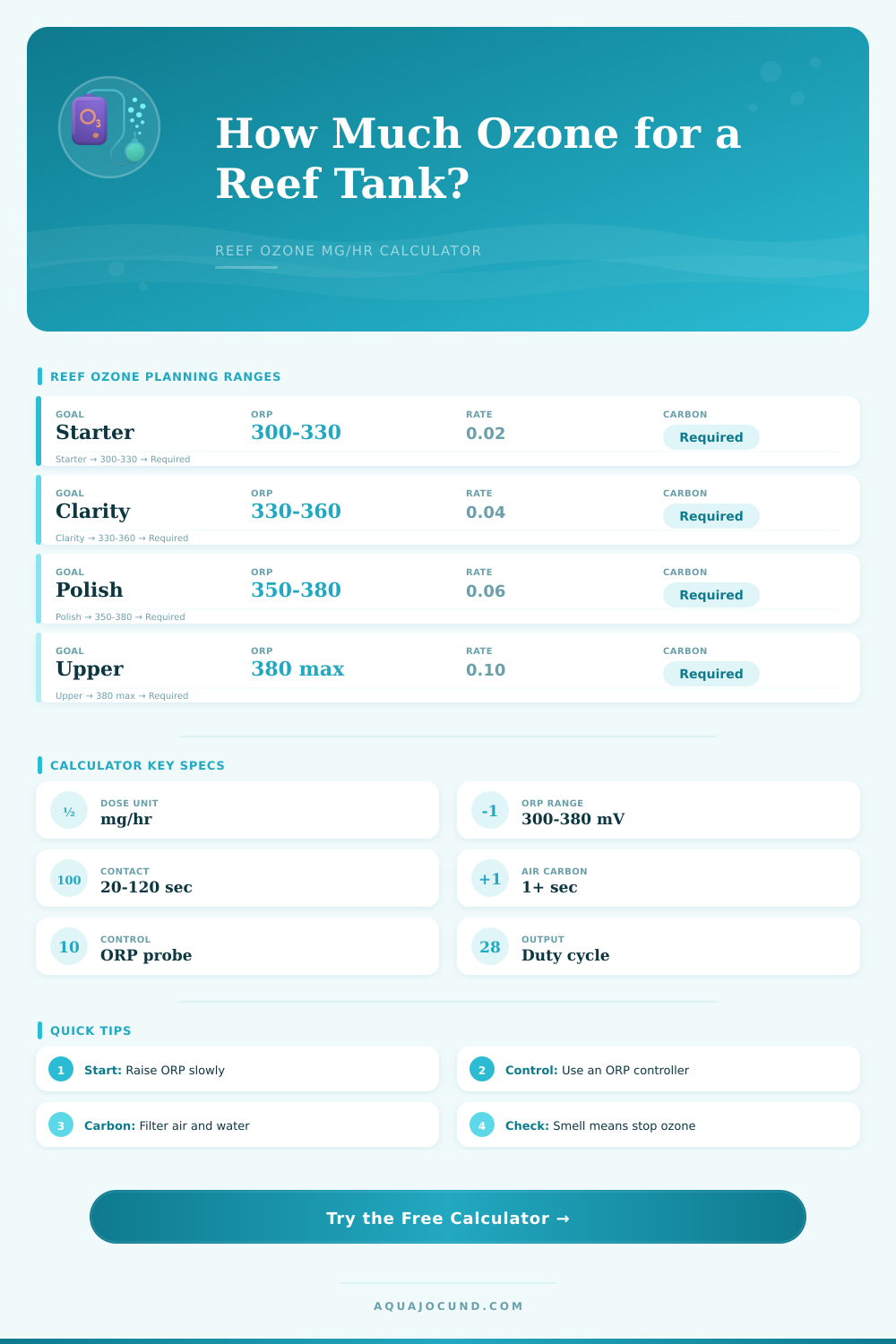
| Use Case | Planning Rate | Typical ORP Goal | Calculator Meaning |
|---|---|---|---|
| Starter ORP nudge | 0.02 mg/hr/gal | 300-330 mV | Gentle first pass for verified probe |
| Yellow water clarity | 0.04 mg/hr/gal | 330-350 mV | Clearer water with low residual risk |
| Water polishing | 0.06 mg/hr/gal | 350-370 mV | Normal controller-limited reef use |
| Heavy fish load polish | 0.08 mg/hr/gal | 350-375 mV | Higher demand from feeding and organics |
| Upper reef cap | 0.10 mg/hr/gal | 380 mV max | Planning ceiling, not a target |
| Delivery Method | Transfer Estimate | Target Contact | Carbon Need |
|---|---|---|---|
| Protein skimmer venturi | 45% | 20-45 sec | Air cup and skimmer effluent |
| Dedicated ozone reactor | 65% | 45-90 sec | Offgas and outlet water carbon |
| Recirculating ozone reactor | 75% | 60-120 sec | Offgas carbon plus outlet polish |
| Short contact skimmer | 30% | 15-30 sec | Extra caution, more offgas load |
| Large contact column | 80% | 90+ sec | Still route all air through carbon |
| Reef System | Common Volume | Starter Output | Polish Output |
|---|---|---|---|
| Nano reef plus sump | 25 gal / 95 L | 0.5 mg/hr | 1.5 mg/hr |
| Mixed cube reef | 40 gal / 151 L | 0.8 mg/hr | 2.4 mg/hr |
| Standard reef with sump | 75 gal / 284 L | 1.5 mg/hr | 4.5 mg/hr |
| SPS display system | 120 gal / 454 L | 2.4 mg/hr | 7.2 mg/hr |
| Large fish-heavy reef | 180 gal / 681 L | 3.6 mg/hr | 10.8 mg/hr |
| Large display reactor | 250 gal / 946 L | 5.0 mg/hr | 15.0 mg/hr |
| Safety Check | Formula | Good Target | Why It Matters |
|---|---|---|---|
| Offgas carbon EBCT | carbon mL / air mL/sec | 1 sec or more | Gives ozone time on dry carbon |
| Water carbon EBCT | carbon L / flow L/sec | 10 sec or more | Polishes oxidants before return |
| Unreacted ozone load | output x unused share | As low as practical | Sizes carbon and odor checks |
| Controller duty cycle | planned / adjusted output | Under 80% | Leaves room for ORP shutoff |
| ORP rise limiter | gap and daily rise cap | 5-25 mV/day | Prevents rapid chemistry swings |
Ozone is an gas that can help improve the water quality in a reef tank. However, ozone can also be detrimental to the reef tank if it isnt managed correctly. A person must understands how much ozone will reach the reef tank and how much ozone will escape the water.
The amount of ozone that are in the water will determine the stability of the reef tank. Therefore, dosing calculation are necessary to help manage the ozone in the reef tank. In order to effectively manage the dosing of ozone into the reef tank, a person must first determine where they would like to use the ozone.
How to Use Ozone Safely in a Reef Tank
For instance, some individuals uses ozone to prevent the ORP in their reef tank from dropping after feeding their livestock. Others use ozone to improve the water clarity and color in there tank. In order to effectively dose the tank, a person will need to provide the calculator with information about the size of their reef tank, the current ORP in the tank, the desired ORP in the tank, and the sensitivity of the livestock to ORP changes.
Additionally, the dosing calculation will require the rate at which the ORP is allowed to rise each day because a rapid change in ORP is more dangerouser for the reef tank than a stable ORP that is lower than ideal. Another of the variables that must be calculated is the contact time between the ozone and the water. Because only a portion of the ozone gas will dissolve into the water during the contact time, a person will have to decide whether the ozone gas will travel through a protein skimmer or a dedicated ozone reactor.
Each of these devices will allow for some of the ozone gas to become off-gas. Therefore, the dosing calculator will be able to estimate how much ozone gas will dissolve into the water, and how much will become off-gas based off the chosen method for traveling through the tank and the airflow of the system. The contact time will allow for calculations of how much ozone will escape during contact, thus a person using the dosing calculator will be able to determine if the contact chamber for the ozone is large enough for the water in the reef tank to pass through.
Another of the components that will be necessary in the reef tank is activated carbon. Activated carbon will help to remove the residual oxidant in the water, as well as the ozone off-gas that can leave the reef tank. In many instances, however, the activated carbon in the reef tank may be failing as a result of being insufficient in its volume or being old.
Therefore, activated carbon will have to be present in the water to ensure that any treated water does not reenter the reef tank with residual oxidants in the water. Furthermore, the dosing calculator will also track the volume of the activated carbon as well as its condition so that the dosing calculator can make the person using it aware if the activated carbon is performing its necessary function for the reef tank. If the activated carbon becomes fouled, or if it is too small in the tank, then the ozone system can become dangerous for the livestock in the reef tank.
In addition to the mathematical calculations for dosing ozone into the tank, there are some of the complications that may occur within the reef tank itself. For instance, while calculations can be made for the ORP in the system, these may drift over time. Additionally, air dryers may lose their effectiveness over time, and feeding schedule for the reef tank may change.
Therefore, although the dosing calculator will help to establish the baseline for ozone use in the reef tank, it is also important to observe the reef tank itself. For instance, if a person smells ozone near the reef tank, or if the corals in the reef tank are exhibiting signs of stress, then the person will have to reduce the ozone output, as well as they will have to inspect the activated carbon. In general, the goal in introducing ozone into a reef tank is not to achieve the maximum amount of ozone output from the system.
Instead, the goal is to achieve a beneficial yet controlled improvement in the reef tank water quality. Therefore, the amount of ozone that is dosed into the system should remain within the limits of the equipment itself, as well as within the limits of the livestock in the reef tank. The dosing calculator will help to ensure that the ozone dosing remains within these safe limit, as will the observation that are made on a daily basis of the reef tank itself.
You should of used the calculator to avoid any accidents. Actually, it is alot of work to monitor everything manualy. Making sure the ozone levels dont gets too high is vital for your corals.