Reef Nitrate Dosing Calculator
Plan a controlled NO3 increase from sodium nitrate, potassium nitrate, or a measured liquid stock while checking daily rise and nutrient balance.
Dosing result
| Source | Formula basis | NO3 fraction | Companion ion |
|---|---|---|---|
| Sodium nitrate | NaNO3 molar mass 84.99 | 72.95% | Sodium, about 0.37 ppm per 1 ppm NO3 |
| Potassium nitrate | KNO3 molar mass 101.10 | 61.33% | Potassium, about 0.63 ppm per 1 ppm NO3 |
| Liquid stock | Measured mg NO3 per mL | User defined | Depends on the stock source |
| Unknown blend | Label dose or lab data | Not estimated | Byproduct not calculated |
| Reef style | Common NO3 band | Daily rise cap | Retest timing |
|---|---|---|---|
| Ultra low nutrient SPS | 1-3 ppm | 0.25-0.5 ppm | 12-24 hours |
| Mixed reef | 2-8 ppm | 0.5-1 ppm | 12-24 hours |
| LPS and soft coral | 5-15 ppm | 1-2 ppm | 24 hours |
| Fish heavy reef | 8-20 ppm | 1-2 ppm | 24 hours |
| Displayed size | After 15% displacement | 1 ppm NO3 need | NaNO3 at 99% |
|---|---|---|---|
| 20 gal / 76 L | 17 gal / 64 L | 64 mg NO3 | 0.089 g |
| 40 gal / 151 L | 34 gal / 129 L | 129 mg NO3 | 0.178 g |
| 75 gal / 284 L | 64 gal / 241 L | 241 mg NO3 | 0.334 g |
| 125 gal / 473 L | 106 gal / 402 L | 402 mg NO3 | 0.557 g |
| Balance signal | What it can mean | Calculator response | Next check |
|---|---|---|---|
| NO3 near zero, PO4 present | Nitrate-limited uptake is possible | Use smaller daily rise | NO3 and coral response |
| NO3 rises, PO4 near zero | Phosphate may become limiting | Shows a high ratio flag | PO4 and algae films |
| Both climb quickly | Export may be undersized | Shows target dose only | Feeding and filtration |
| NO3 drops after dosing | System uptake is active | Shows uptake replacement | Trend over several tests |
For months you’ve been testing your water each week. Ammonia and nitrite? Zero. Nitrate? No luck on the test kit. It’s just plain blue. Just won’t go pink. Your SPS corals is looking skinny. Even during feeding time, their polyps aren’t coming out. You suspect there’s a lack of nutrient in the system.
What’s more, you’re worried about introducing nutrients because that could lead to an algae bloom. That’s what stops some reefers who cut their teeth on ultra-low nutrient systems. Back then, zero was the name of the game. Empty was pristine. Today we know differently. Life requires fuel. How do you provide it without creating issues?
How to Add Nitrates Safely
After plugging in your tank volume and displacement factors, the above calculator takes care of all of the math for you. No need to guess at any conversions or coefficients. But what’s important is knowing why they’re there. Dosing based off the display stand or sump size doesn’t matter. Dosing based on how much water the tank holds is what matters.
Sand and live rock displace quite a bit of volume. They commonly occupy between fifteen and twenty percent of nominal tank size. So if you calculate your nitrate dose based on your seventy-five gallon display but it only contains sixty gallons of water, you’ll overdose each time. And that’s where people mess up. They think the label speaks for itself. It doesn’t. The tool takes into account this displaced volume so you don’t accidently spike your parameters.
There is more to selecting between potassium nitrate and sodium nitrate than which bottle to pick. By weight, potassium nitrate contains approximately sixty-one percent nitrates. Sodium nitrate contains about seventy-three percent nitrates. This means you must weigh out more potassium nitrate to obtain the same amount of ppm increase in your water column.
Sounds bad…until you realize most reef tanks suffer from low potassium levels as well. When you use potassium nitrate, you’re actually raising two nutrients at once. Use the calculator and you’ll see how much potassium or sodium is added to the system along with the nitrogen. This is known as the companion ion rise. A small trade off…but important if you’re trying to keep calcium and alkalinity stable.
But the most important parameter for your corals’ well-being might be the daily rise cap. Changes should be slow; both corals and beneficial bacteria will acclimate to this. Rapid increase in any parameter will shock the symbiosis inside those polyps. As a result, they either stop feeding or eject their zooxanthellae.
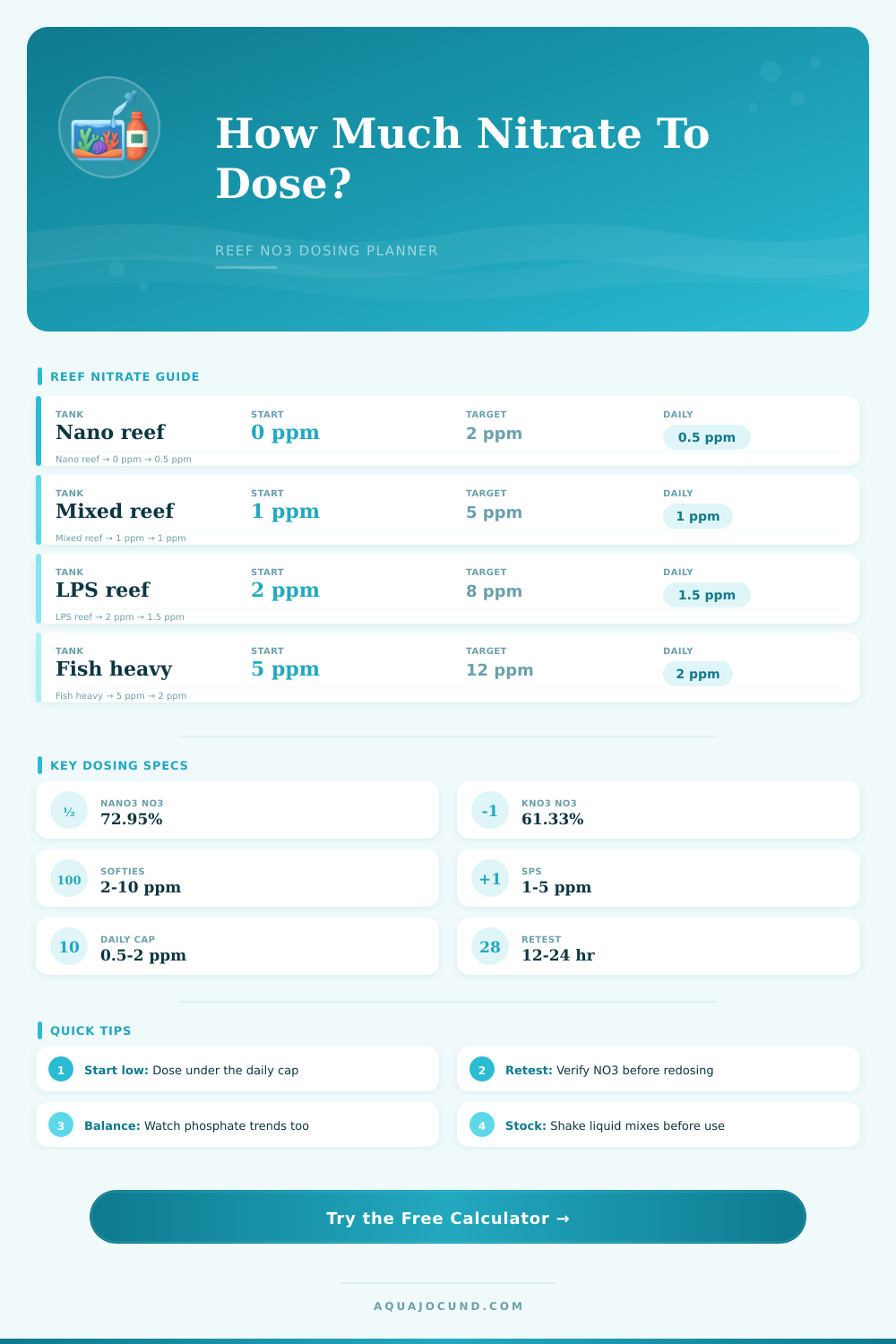
The tool restricts your dose to a safe incremental amount each day. Typically, that’s usually around one ppm per day for a mixed reef. That takes patience. You can’t replace three weeks of nutrient deficit in one evening. It requires a plan. Dose it, wait for it, test it, do it again.
The table below (on the page) plots these conservative increments across different styles of tanks. As it reminds us, some corals can handle more than others… LPS corals tend to fare better with higher dosing than the more fragil SPS frags.
Everything must be in balance. Nitrates don’t stand alone. They’re used together with another parameter: phosphate. Changing your nitrates without also accounting for phosphate will create a different imbalance. Lack of phosphate can lead to odd algae outgrowth or even dull coral colors. To that end, the calculator flags the nitrate/phosphate ratio, and there are more than just those two. This lets you know when something isn’t right before it turns into a visual mess.
Always adjust one then check the other, if you change nitrates, check phosphate. If they both spike, your exports aren’t keeping pace with the bioload in your tank. If one spikes while the other drops, congrats! You’ve discovered your limiting nutrient.
Another place that good intentions fail is with testing timing. I see people test five minutes after they dose. Chemicals has to have time to disperse and mix properly through the system. Even high flow pumps aren’t instantaneous. Letting it sit for twelve to twenty-four hours allows the water column to come back into equilibrium.
If you rush this part of the process, it will cause confusion with your decisions and your data won’t be consistent. So you may believe you haven’t reached your desired parameters but really you are just testing too early. You should of taken a chill pill. Let the tank breathe, let it digest what you’ve given it, and wait for it to settle down.
Nitrate dosing isn’t about getting a chart number perfect. Nitrate dosing is about watching life. Notice how your corals respond to the gradual increase. Do they extend further out of their skeleton? Do they take on more color? Yes, continue slowly. No, stop or slow down. Numbers are your guide, biology is your confirmation.
Go slow. Start low. Let your tank tell you what it wants. Don’t force it to reach a number that ignores its current state. That’s the difference between a chaotic tank and a thriving reef. And that takes time.