Reef Coral Growth Rate Calculator
Estimate coral growth by type, lighting, flow, alkalinity stability, nutrients, observed growth, and future time horizon.
🪸Coral Growth Presets
⚙Coral Type and Starting Size
☀Light, Flow, and Stability
🧪Nutrients and Feeding Signal
Coral Growth Projection
📊Coral Growth Comparison Grid
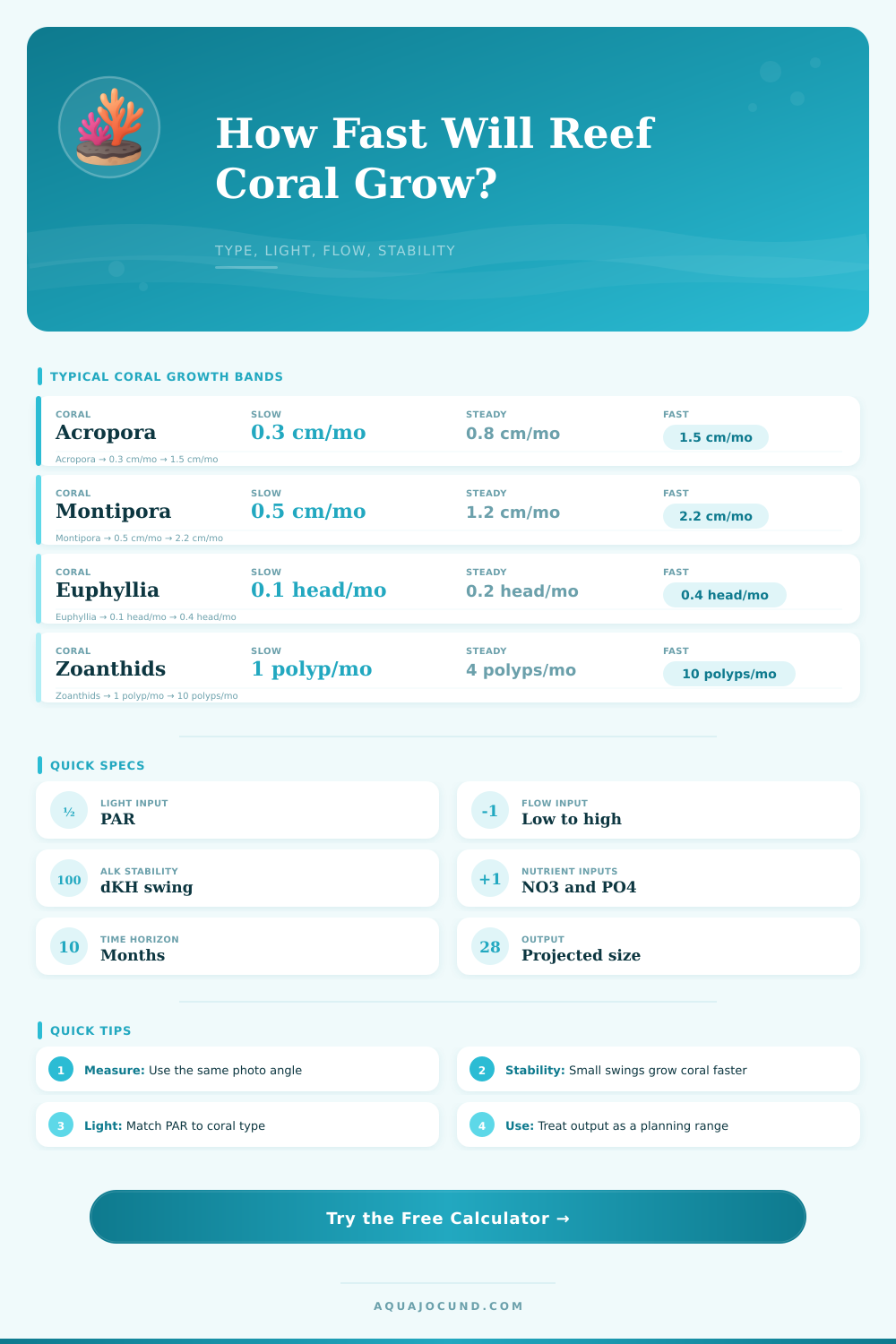
🪸Coral Type Growth Reference
| Coral type | Typical base growth | Best PAR band | Preferred flow | Planning note |
|---|---|---|---|---|
| Zoanthids / palythoa | 0.8 cm/mo mat or 2-8 polyps/mo | 80-180 | Moderate | Spreads faster after the first attached polyps settle |
| Green star polyps | 1.8 cm/mo mat edge | 80-220 | Moderate to high | Fast encrusting growth can exceed nearby rock space |
| Mushroom / ricordea | 0.35 cm/mo disc expansion | 50-140 | Low to moderate | Growth is often by splitting, not steady diameter |
| Euphyllia / branching LPS | 0.2 heads/mo proxy | 80-180 | Moderate | Head splitting comes in bursts after tissue extension |
| Montipora cap | 1.2 cm/mo plating edge | 150-300 | Moderate to high | Good alkalinity stability strongly changes the projection |
| Acropora | 0.8 cm/mo branch extension | 200-400 | High random | Small frags may pause before steady encrusting and branching |
| Birdsnest / seriatopora | 1.0 cm/mo branch extension | 180-350 | High random | Often faster than many SPS when nutrients are not stripped |
| Favia / favites | 0.45 cm/mo encrusting edge | 70-180 | Low to moderate | Slow steady tissue expansion is more useful than skeleton size |
| Chalice | 0.3 cm/mo plating edge | 60-160 | Low to moderate | Low light tolerance does not always mean faster growth |
☀Light and Flow Adjustment Guide
| Input | Ideal signal | Mild penalty | Strong penalty | Calculator use |
|---|---|---|---|---|
| PAR | Inside coral-specific band | Within 25% below or above | Far below band or excessive light | Scales the base coral growth rate |
| Flow | Matches coral preference | One level away | Too still, direct blast, or surge mismatch | Adjusts tissue extension and waste removal |
| Placement stress | Settled and uncrowded | Recent move | Shaded or stung nearby | Reduces near-term projection |
| Tank maturity | 12+ months stable | 6-11 months | New system under 6 months | Applies a maturity multiplier |
🧪Stability and Nutrient Reference
| Factor | Strong growth range | Watch range | Growth risk |
|---|---|---|---|
| Alkalinity swing | 0.0-0.3 dKH/day | 0.4-0.7 dKH/day | Above 1.0 dKH/day often slows calcification |
| Temperature swing | 0-1.5°F / 0-0.8°C | 1.6-3.0°F / 0.9-1.7°C | Large daily swings reduce the score |
| Nitrate | 2-15 ppm | 0.5-2 or 15-25 ppm | Zero readings or very high levels can slow growth |
| Phosphate | 0.03-0.12 ppm | 0.01-0.03 or 0.12-0.20 ppm | Zero phosphate or excessive phosphate reduces growth |
| Feeding signal | Normal or rich with export | Lean | Heavy feeding without export lowers projection |
⏱Common Projection Examples
| Scenario | Start size | Inputs | 12 month planning range |
|---|---|---|---|
| Acropora frag | 1 in / 2.5 cm | 250 PAR, high flow, stable alk | 5-8 in branch height in strong systems |
| Montipora cap | 2 in / 5 cm | 220 PAR, varied flow | 7-12 in plate spread if space remains open |
| Zoanthid plug | 5-10 polyps proxy | 120 PAR, moderate flow | Several times the original mat area |
| Euphyllia frag | 2 heads proxy | 120 PAR, moderate flow | 3-5 heads with stable chemistry |
| Chalice frag | 1.5 in / 3.8 cm | 90 PAR, low flow | Slow visible rim expansion over 12 months |
The reason I say that is that when you purchase a coral frag for the first time, there’s always a part of you that hopes it will grow up fast and become a giant colony. That doesn’t always happen. In fact, it often doesnt. Why? Because corals don’t just grow with time; they grow based off water chemistry. Your lights might be awesome. However, your alkalinity could swing like crazy, or your flow could create dead spots where your coral won’t survive. It’s a biological negotiation between the animal and its environment.
The calculator (above) include things like nutrients, PAR levels, and other variables in its projection. It does the math for you regarding expected future size, so you don’t have to guess based on stories found on forums that may not apply to your tank’s specific limits. You input what your current coral is and then see how big it might grow within a range of expectations. It provides you with a reasonable expectation, enough for you to decide whether or not the growth rate will work for your tank’s condition.
Why Corals Need Good Water to Grow
Because corals rely on energy for calcification, the amount of available light is typically one of the first variables that hobbyists becomes obsessed with. While more light is certainly better (sometimes), intense light can be just as harmful than insufficient levels and cause low-light corals to bleach before growing out. To account for this, the tool asks for the average PAR at the point where the corals are located instead of just at the surface of the water. Why does that matter? Light degrades as it travels through the water column. Matching the intensity of light to the species will help you distinguish between thriving colonies and struggling ones.
The second important factor is flow, as both turbulence cleans waste from the coral’s polyps and delivers food. Stagnant water surrounding the coral will still contain nutrients but won’t feed it. Some corals requires high, random water movement (high on the scale). Some require a gentle sway (low on the scale). This is accounted for by the calculator. Too little flow and nothing grow. Too much or misdirected and you’ll end up with broken coral or a coral that retracts its polyps to save energy.
Because corals are hard-bodied animals they need stable water conditions to build calcium carbonate. They deposit it most efficiently when chemical conditions remain constant. Any large swings in alkalinity from day to night will stop calcification all together as the coral spends time surviving instead of growing. The tool has fields for temperature stability and alkalinity stability. These are two factor that determine how metabolically efficient a tank is. Stable water is more important than perfectly balanced but dramatically changing water each day.
Finally, nutrients round out the scenario. Most today’s reef trends moves toward ultra low nutrients; this minimizes algae problems, but it may also deprive corals of the building blocks they need to grow. Moderate nutrient levels (usually some phosphate/nitrate) serve as fuel for substantial growth. The calculator will take into account your nutrient goals/targets and your feeding routine to tweak the projection. If you run a lean system with minimal nutrients and don’t feed much, expect less growth. On the other hand, if you feed frequently and have moderate nutrient levels, you can expect greater growth. You should of expected that.
At its core though, monitoring coral growth has less to do with prediction than trend. Use the estimated ranges to help you plan upgrades, space out frags, etc. But if you find you’re always seeing less growth than the conservative estimate, then something’s got to be tweaked in your environment. The point of all this is maintaining a stable environment where your corals can grow at their own pace while remaining healthy. Naturaly, things like luxurios setups wont help if chemistry is bad.