Reef Alkalinity Correction Calculator
Plan dKH or meq/L correction dose amounts, daily alkalinity limits, supplement strength adjustments, and a staged schedule for reef aquariums.
🧪Correction Presets
📏Tank Water Volume
⚖Alkalinity and Supplement Inputs
Correction Plan
📊Alkalinity Supplement Comparison
| Supplement | Calculator basis | Typical effect | Use note |
|---|---|---|---|
| Standard liquid two-part alk | 0.056 dKH per 1 mL per 25 gal | Moderate strength liquid | Common daily correction style |
| Soda ash stock solution | 2.34 meq per mL | Strong liquid, raises pH | Dose slowly in high flow |
| Sodium bicarbonate stock | 0.93 meq per mL | Gentler liquid, lower pH effect | Useful for cautious raises |
| Dry soda ash powder | 18.9 meq per gram | Very concentrated dry alk | Dissolve before adding |
| Dry sodium bicarbonate | 11.9 meq per gram | Concentrated dry alk | Dissolve and add gradually |
| Saturated kalkwasser | 0.0408 meq per mL | Low alk per mL, high pH | Better for top-off style dosing |
| Dilute label liquid | 0.025 dKH per 1 mL per 25 gal | Low strength liquid | Often needs larger volume |
| Custom product | User-entered strength | Uses your label or test data | Best for unknown mixtures |
📐Common Reef Correction Examples
| System | True volume | Correction | Soda ash dry | Bicarbonate dry |
|---|---|---|---|---|
| Nano reef | 20 gal / 76 L | 0.5 dKH | 0.7 g | 1.1 g |
| Mixed reef | 75 gal / 284 L | 1.0 dKH | 5.4 g | 8.5 g |
| Frag system | 120 gal / 454 L | 0.7 dKH | 6.0 g | 9.5 g |
| Large reef | 180 gal / 681 L | 1.2 dKH | 15.4 g | 24.3 g |
📏Common Tank Sizes
| Tank | Typical dimensions | Nominal volume | Estimated true water | 1 dKH soda ash dry |
|---|---|---|---|---|
| 20 long | 30 x 12 x 12 in / 76 x 30 x 30 cm | 20 gal / 76 L | 16-18 gal | 1.2-1.4 g |
| 40 breeder | 36 x 18 x 16 in / 91 x 46 x 41 cm | 40 gal / 151 L | 32-36 gal | 2.3-2.7 g |
| 75 gallon | 48 x 18 x 21 in / 122 x 46 x 53 cm | 75 gal / 284 L | 60-68 gal | 4.3-4.9 g |
| 120 gallon | 48 x 24 x 24 in / 122 x 61 x 61 cm | 120 gal / 454 L | 95-108 gal | 6.8-7.7 g |
| 180 gallon | 72 x 24 x 24 in / 183 x 61 x 61 cm | 180 gal / 681 L | 145-162 gal | 10.3-11.6 g |
⏱Daily Change and Unit Reference
| Conversion | Formula | Example | Calculator use |
|---|---|---|---|
| dKH to meq/L | dKH / 2.8 | 8.4 dKH = 3.0 meq/L | Internal alkalinity demand |
| meq/L to dKH | meq/L x 2.8 | 3.2 meq/L = 8.96 dKH | Metric-style alk entry |
| dKH to ppm CaCO3 | dKH x 17.86 | 1.0 dKH = 17.86 ppm | Reference only |
| Total meq needed | delta meq/L x liters | 0.36 x 100 L = 36 meq | Base dose calculation |
If your alkalinity is below what you think it should be, you might panic. Your corals seem stressed. Your calcium have dipped (the buffer wasn’t up to par). Don’t panic. While reef chemistry isn’t forgiving, it’s also very predictable, if you view chemical changes as a process instead of an emergency.
Enter the numbers for the tank volume and the desired parameters into the calculator. It will do the rest of the math. It will save you time and prevent you from having to convert units and guess at coefficients. It’ll make a chaotic scenario into something that you can manage with a plan and a schedule.
How to Use Alkalinity Calculator Safely
There are several inputs to the calculator but the most critical one is the volume of your systems water. How many times have we heard someone say “I have a seventy five gallon tank” implying that it actualy contains seventy-five gallons? It almost never does. Equipment, sand, and live rock take up space displacing water from the tank. Unless you use the actual volume of your tank rather than what’s marked on the label when dosing, you’ll overshoot. The overshoot result in pH spikes which do far worse damage to your livestock then the initial low alkalinity. To allow for this fact the tool lets you input displacement percentages. It may not seem like much but it has a huge impact on the accuracy.
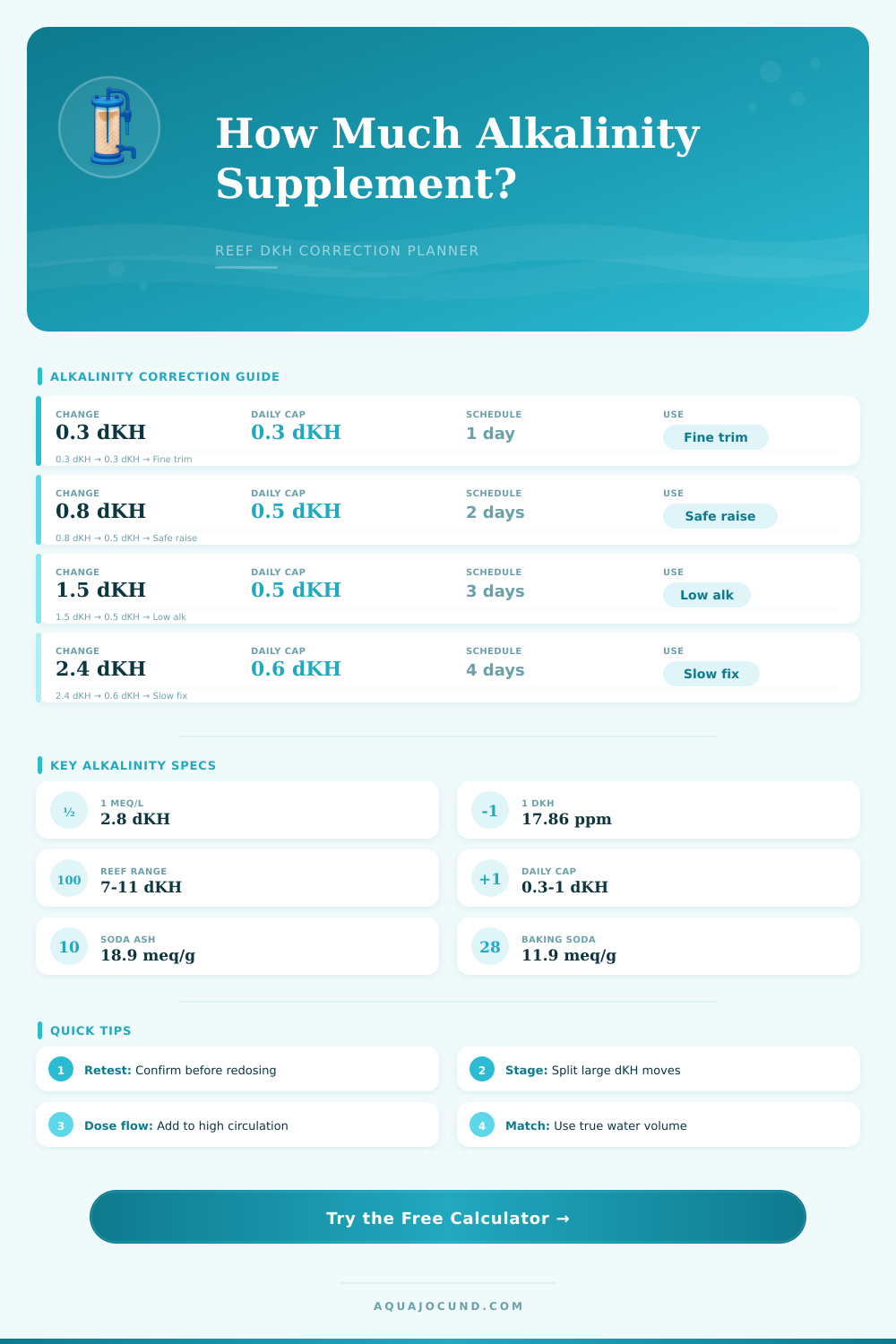
Not all supplements are equally strong. Soda ash comes dry; it’s powerful stuff, at almost nineteen milliequivalents per gram. Baking soda is less so, about twelve milliequivalents per gram. Two-part liquid solution are somewhere between the two. However, how was that solution mixed and how has it aged? The calculator handles both dilution and product age. Whatever you put into the water is what determine chemistry. You can’t just think “I’m adding baking soda.” You’ve got to know how much is actualy in the bottle. Was it six months old when you opened it? Did it pick up humidity? It won’t work like the label says it did when it was new.
Accuracy is important, but so is speed. You can raise your alkalinity two points in a day, and that sounds great on paper. In reality, however, corals don’t adapt well to rapid environmental change; even when stable, they suffer bodily stress from quick changes, including bleaching or tissue recession. By forcing you to split dosages and cap changes each day the tool slows you down. It advises against increasing more than one dKH per day (often less for sensitive species). It will break up your adjustments over time to let the ecosystem slowly acclimate, just like what happens on nature’s reefs.
There’s also testing error to consider here. You can get cheap test kits with big margins for error. This means a number that appears to indicate a drop may actualy be nothing more than noise. For example, say you want your level to be eight but your test kit reads seven. But the margin of error on that test kit was plus or minus zero point five. Chasing that half-point is usually a money/time suck. That’s where the tolerance setting in the calculator comes into play. It weeds out those small variations. It tells you that not every change matters and sometimes doing nothing at all is the right move.
Last but not least, where do you put it? Putting it too close to a heater will cause precipitation which is when dissolved chemicals become cloudy solids. They then don’t get mixed in with remainder of the water. Always dose in an area of good circulation. The reference tables on the page show how various supplements react so you can decide if you want a gentler bicarbonate raise or a stronger soda boost depending on what is best for you.
The point here is that reef keeping is less about getting exact numbers as it is about being consistent. You don’t have one shot at getting it right; you’re trying to keep conditions steady over time, years and months. Measured, slow adjustments will serve your livestock much better than any rush jobs ever would of. Let things play out on their own time. Respect the volume. Trust the schedule. And let the chemistry take its course.