🧪 Baking Soda Reef Calculator
Calculate sodium bicarbonate alkalinity dosing in grams, teaspoons, solution mL, dKH rise, and staged daily corrections.
🔬 Full Calculation Breakdown
| Alkalinity Unit | Conversion | Reef Use | Calculator Role |
|---|---|---|---|
| dKH | 1 dKH = 0.357 meq/L | Most common reef hobby unit | Input and target unit |
| meq/L | 1 meq/L = 2.8 dKH | Chemistry and older kits | Shows chemical rise |
| ppm CaCO3 | 1 dKH = 17.86 ppm | Water treatment reference | Cross-check only |
| NaHCO3 mass | 1 dKH = 30 mg/L | Dry baking soda dosing | Base dose formula |
| Material | Typical Purity | Dose Factor | pH Effect | Best Use |
|---|---|---|---|---|
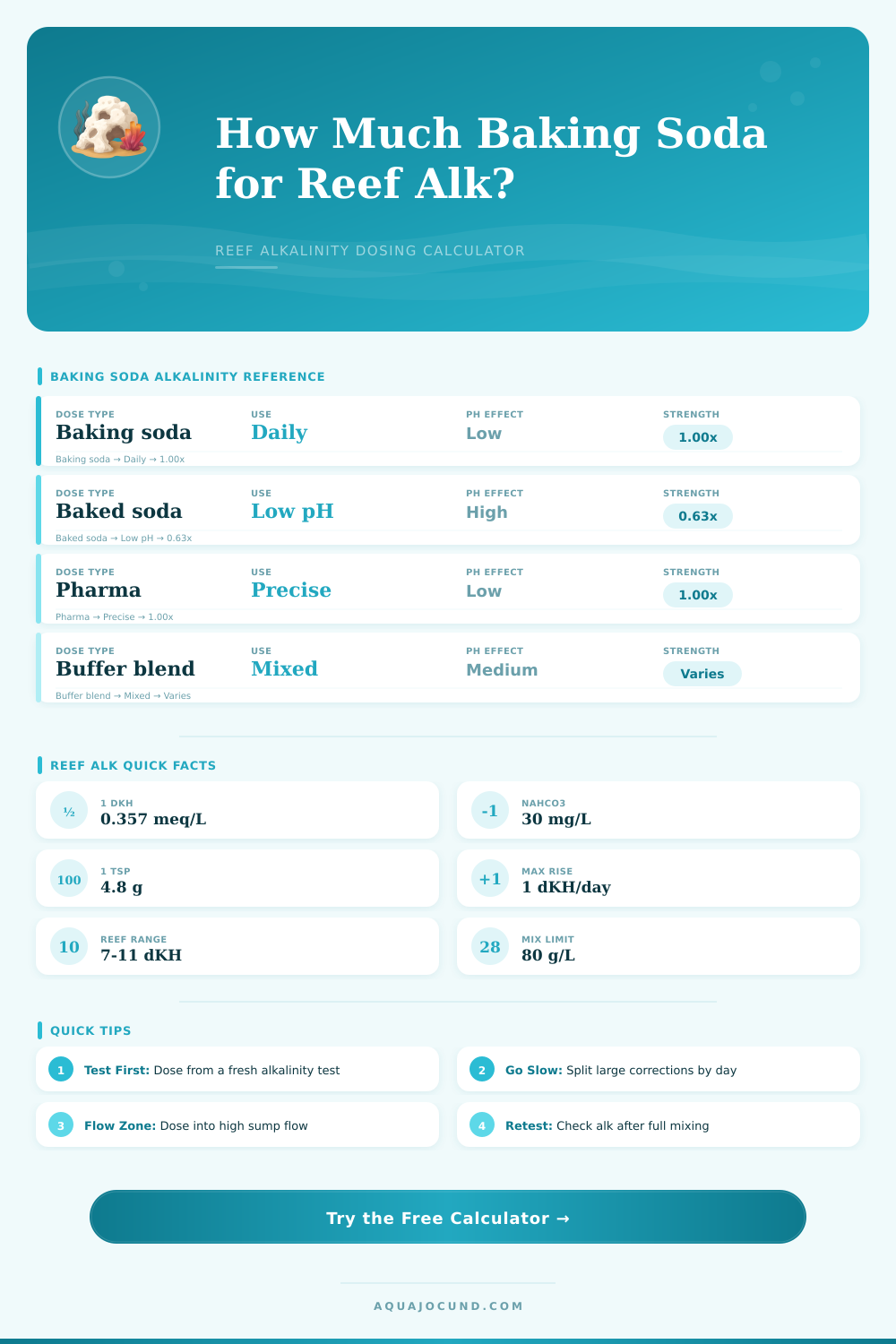
| Food grade baking soda | 99-100% | 1.00x | Low | Routine alkalinity correction |
| Pharma grade NaHCO3 | 99.5-100% | 1.00x | Low | High precision stock solutions |
| Bulk sodium bicarbonate | 96-99% | 1.00x | Low | Large reef systems |
| Baked baking soda / soda ash | 98-100% | 0.63x | High | Low pH systems needing alk |
| Balanced alk buffer blend | Varies | 0.85x | Medium | Mixed carbonate products |
| Older opened baking soda | 90-98% | 1.00x | Low | Use only if clean and dry |
| Strength | Mix Example | 1 mL Adds | Notes |
|---|---|---|---|
| 30 g/L | 30 g in 1 L RO/DI | 0.030 g | Easy to dose small nanos |
| 60 g/L | 60 g in 1 L RO/DI | 0.060 g | Balanced for most reefs |
| 80 g/L | 80 g in 1 L RO/DI | 0.080 g | Near practical cold-water limit |
| 100 g/L | 100 g in 1 L RO/DI | 0.100 g | Warm mixing may be needed |
| Situation | Daily Rise | Risk Level | Practical Action |
|---|---|---|---|
| Routine trim | 0.1-0.3 dKH | Low | Dose once in high flow |
| Normal correction | 0.3-0.7 dKH | Low | Retest after full mixing |
| Large correction | 0.7-1.0 dKH | Medium | Split across light cycle |
| Emergency jump | Over 1.0 dKH | High | Stage over multiple days |
Alkalinity swings stress corals more than a slightly imperfect target. If the calculator calls for a big correction, use the staged schedule and retest before each follow-up dose.
Dissolve baking soda in RO/DI water before dosing. Add it slowly to a high-flow sump chamber, away from heaters, probe tips, and delicate coral tissue.
When the alkalinity level in a reef tank has decreased, it may be tempting to add baking soda to a reef tank immediatly. However, adding too much baking soda to a reef tank can cause a chemical crash within the water. Corals is sensitive to changes in chemistry within a reef tank.
Therefore, it isnt the goal of a reef keeper to add baking soda to achieve an alkalinity level of an perfect reading. Rather, the goal is for alkalinity to remain stable within a tank. To understand alkalinity in a reef tank, one must understand the difference between the display volume of a reef tank and the actual volume of water in that reef tank.
How to Add Baking Soda Safely to a Reef Tank
Reef tanks contains live rock, sand, and other equipment. These items all displace water. A reef tank may display 100 gallon, but it may only contain 80 gallons of water.
Adding baking soda to 100 gallons of water when the tank only contains 80 gallons of water will add too much baking soda. Adding too much baking soda will lead to an overshoot of alkalinity. Thus, one must account for water displacement when adding baking soda to a reef tank.
Baking soda, or sodium bicarbonate, is used in reef tanks due to its relatively low cost and its chemical predictability. However, not all powders are the same in there chemical properties. Most reef keeper use food-grade baking soda to maintain alkalinity in their tanks.
However, other reef keepers use baked baking soda, or soda ash, if the alkalinity and pH level of the reef tank are low. Soda ash increases the pH level of the water more than food-grade baking soda do. Therefore, different calculations are made when using soda ash rather then baking soda.
A calculator can aid in determining the amount of baking soda need to increase the alkalinity of a reef tank. Most calculators ask for the current and target alkalinity levels of the reef tank. The calculator will provide the number of grams of dry powder or liquid solutions of baking soda needed to reach the target alkalinity level.
In addition, calculators will provide a staged schedule for adding alkalinity to the reef tank. Increasing the alkalinity of a reef tank too quick can create stress for the corals. Providing a staged schedule allows time for the corals to acclimated to the change in alkalinity.
For reef keepers who have nano reef tanks, it can be difficult to accurately measure the amount of baking soda needed for alkalinity. Thus, making a stock solution of baking soda can be helpful. One can dissolve baking soda in RO or DI water to prepare the stock solution.
You must ensure the solution contains all of the baking soda that was purchased. If the prepared solution is cloudy, then the solution has reached its saturation point and cant hold any more baking soda. When adding baking soda to a reef tank, care should be taken in the placement of the dose.
Adding baking soda directly on or near a coral can harm the coral. The high level of alkalinity can cause chemical burns on the coral. Adding baking soda to an area of high water flow in the sump of the reef tank will allow the alkalinity to reach the rest of the tank without harming any corals.
Additionally, the keeper should place the dose away from the heaters and pH probes in the reef tank so that the bicarbonate in the baking soda will mix with the water in the tank. If the bicarbonate is not mixed with the water in the tank, the alkalinity will not reach the corals. When dosing alkalinity to a reef tank, it is important to use a factor to allow for errors in the test kits that measure alkalinity.
One must dose alkalinity slightly less than calculated for the target alkalinity level. By dosing alkalinity slightly less than calculated, any errors in the dosage will allow for the addition of alkalinity the following day rather than removing alkalinity from a reef tank that has been overshot in terms of alkalinity goals. Stability of alkalinity is the most important factor in maintaining a healthy reef tank.
Whether the target alkalinity level in a reef tank is an 8 dKH or a 10 dKH, stability is the most important factor. Stability provides the corals in the tank the best conditions in which to exhibit growth and color. Thus, the slow and steady method of maintaining alkalinity is the best method to keep a reef tank thriving.