Reactor Media Bed Volume Calculator
Estimate settled media charge, expanded bed height, headspace margin, tank-dose fit, and service timing for aquarium media reactors.
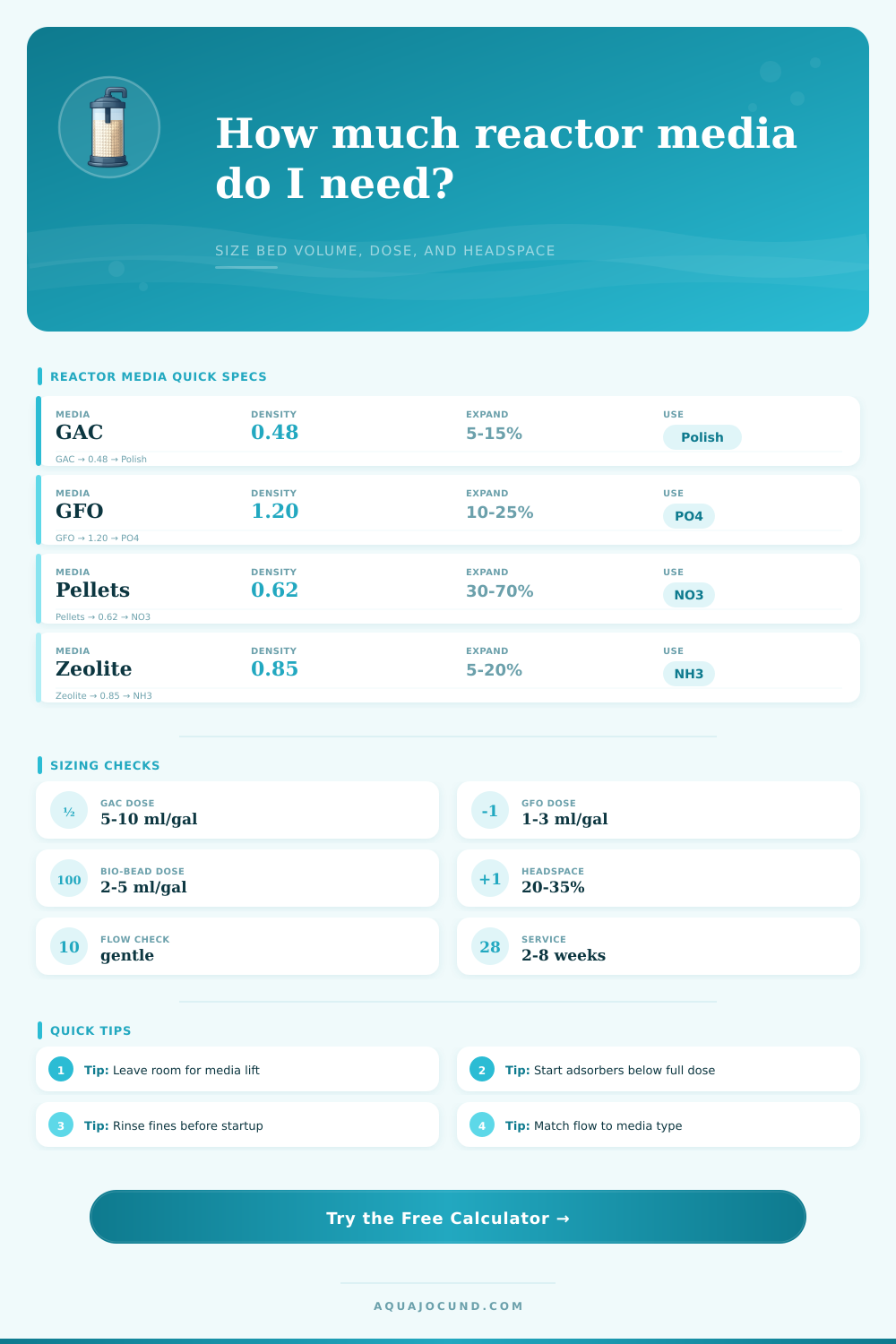
| Media type | Bulk density | Usual dose range | Typical expansion | Best reactor motion |
|---|---|---|---|---|
| Granular activated carbon | 0.40-0.55 g/mL | 5-10 mL/gal | 5-15% | Slow upward flow or gentle shimmer |
| Granular ferric oxide | 0.95-1.35 g/mL | 1-3 mL/gal | 10-25% | Surface shimmer only, no grinding |
| Biopellets | 0.55-0.70 g/mL | 2-5 mL/gal | 30-70% | Continuous rolling fluidized bed |
| Zeolite chips | 0.75-0.95 g/mL | 4-8 mL/gal | 5-20% | Packed or lightly pulsed flow |
| Ceramic bio media | 0.35-0.60 g/mL | 8-20 mL/gal | 0-10% | Submerged packed chamber |
| Mixed bed resin | 0.65-0.78 g/mL | 2-6 mL/gal | 0-8% | Packed bed with even flow |
| Synthetic adsorber beads | 0.58-0.75 g/mL | 2-5 mL/gal | 5-18% | Gentle tumble after rinsing |
| Crushed coral media | 1.15-1.55 g/mL | 10-25 mL/gal | 0-5% | Slow packed contact chamber |
| Reactor class | Typical inside size | Total chamber volume | 55% settled bed | Useful note |
|---|---|---|---|---|
| Nano cup insert | 2 in dia x 5 in tall | 0.07 gal / 0.27 L | 145 mL | Carbon, resin, tiny polishing batches |
| Small hang-on reactor | 2.5 in dia x 10 in tall | 0.21 gal / 0.80 L | 440 mL | 20-40 gallon tanks with carbon or GFO |
| Standard media reactor | 3 in dia x 14 in tall | 0.43 gal / 1.63 L | 900 mL | Common 55-75 gallon reef reactor |
| Large reef reactor | 4 in dia x 18 in tall | 0.98 gal / 3.70 L | 2.04 L | Room for bio media expansion or large GAC beds |
| Jumbo cylinder | 6 in dia x 20 in tall | 2.45 gal / 9.27 L | 5.10 L | Large systems and shared sump loops |
| Tank size | Low carbon dose | Moderate GFO dose | Bio-bead start dose | Why start here |
|---|---|---|---|---|
| 10 gal / 38 L | 50 mL | 15 mL | 25 mL | Nano tanks react quickly to fresh media |
| 20 gal / 76 L | 100 mL | 30 mL | 50 mL | Enough contact volume without stripping fast |
| 40 gal / 151 L | 200 mL | 60 mL | 100 mL | Good baseline for lightly stocked systems |
| 75 gal / 284 L | 375 mL | 110 mL | 190 mL | Scale slowly if nutrients are already low |
| 125 gal / 473 L | 625 mL | 190 mL | 315 mL | Large beds still need enough headspace |
| Bed behavior | Expansion target | Headspace target | Flow cue | Risk if too high |
|---|---|---|---|---|
| Packed resin or ceramic | 0-8% | 10-20% | Even flow through the column | Channeling around the bed |
| Carbon polishing | 5-15% | 20-30% | Top surface just moves | Carbon dust and fines |
| GFO phosphate control | 10-25% | 25-35% | Slow shimmer at the top | Grinding and rusty dust |
| Bio-bead reactor | 30-70% | 35-50% | Whole bed rolls freely | Clumps, oxygen dips, overflow |
So filling up a reactor tube seems easy, just add some media until it looks like it’s full of media! But do you have enough volume for the chemical dose? If not, then you’ll crash your tank (or at least clog your screens). Under-dosing a reactor because you under-estimated how much room the media require to breathe is a common occurrence which leads to tank crashing or clogging. You need to figure out if the dose will be supported by the physical volume of the reactor. Suffocate the bed and the reaction won’t happen.
So what’s the real work involved? The answer is figuring all this out before the first grain touches the water. How does that media behave while water passes through it? You don’t need to calculate all that in your head. That’s why this tool was created. The calculator up there do all the geometry for you.
Why You Need Space in Your Reactor
It uses interior size of whatever custom or stock reactor shape you are considering. Cylinder? Square chamber? No problem. It converts the linear dimensions to usable volume. Next, it adds in the expected expansion rate (which varies by media type) and settled fill percentage for the type of media you’re using. Why? Because various media behave very differently under flow.
Some (like activated carbon) is quite dense and won’t go anywhere…just gently shimmying at the water surface. Others (biopellet media for example) need to be able to roll around. Packed as tightly as carbon, they will clump together and create dead zones where bacteria die off from lack of oxygen. The tool accounts for this by allowing head space based on how much each media is inclined to lift naturaly.
Take the phosphate remover granular ferric oxide, which is heavy. Force too much water through it, and it dissolves into a fine dust. If there isn’t enough space for the bed to expand slightly during flow, it will grind against top screen and neighboring grains. The calculator calculates how much space is needed and whether your desired dose will fit comfortabley inside this safety buffer zone.
If the numbers indicate a narrow fit, it’s telling you that you’ll choke the reactor by packing in additional media. This may mean increasing the volume of the tank you feed into, or simply accepting a reduced dose rate that avoids choking the flow. New hobbyists often stumble here, wanting as much removal power as possible while ignoring hydraulic realities of their equipment.
When starting, be conservative on dosages. Carbon works through surface area contact rather than bulk volume. Because of this, a small properly flowing bed will likely outperform a huge bed packed into channels where water cuts corners around the media. The service interval input also sets your replacement schedule.
Even though you can technically get more life out of carbon, changing it every two weeks ensures consistent polishing. With bio-pellets, waiting eight weeks to change them makes sense because you are managing a colony, not just swapping a filter. To prevent media fines from leaking into the main tank, you need to know how much your flow compares to the density of the media.
It’s also very easy to forget that what goes into the reactor should not come back out. Check out that table of reference on the page showing bulk densities and typical expansion rates. That’s what explains why a single reactor configuration is great with carbon but not with zeolite. Because zeolite chips are light and behave like sand, they need to be handled different than a heavy phosphate binder when managing flow.
Knowing this about the physical characteristics transforms blind trial-and-error into a thought-out approach. No more guesswork as to when to swap out the media; now you know how much it can hold and plan accordingly. The space above the media in a reactor is what makes or breaks one. It’s not dead space, it’s the safety valve of the bed itself working under pressure.
Don’t grab another bag when you notice your reactor is half full. The empty space is where the magic happens and it’s the math doing all of the work…letting water be water. You should of left physics alone while leaving this stuff behind. Measure twice and fill once.