PVC Pipe Volume Calculator
Estimate water held in aquarium PVC plumbing from nominal pipe size, schedule inside diameter, horizontal and vertical runs, fitting equivalent length, line count, and retained hold-up.
Pipe water volume snapshot
Volume updates from pipe ID, developed length, equivalent fittings, line count, and water hold-up.
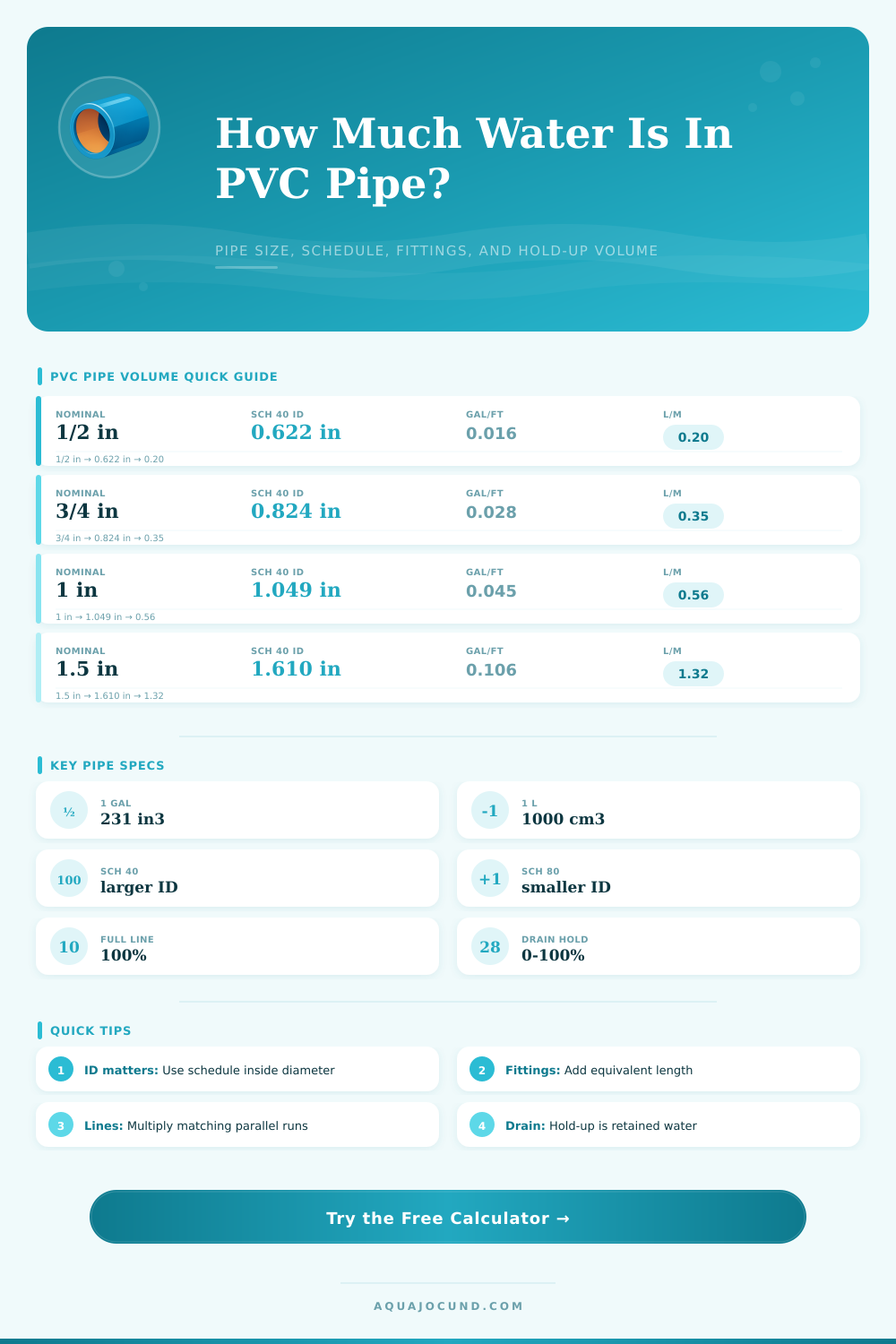
Schedule 80 holds less water per foot because its wall is thicker than Schedule 40.
Two equal returns double straight and fitting volume when both stay full.
Vertical rise and drain drops count as volume just like horizontal pipe.
Use less than 100 percent when a drain line empties after the pump stops.
| Nominal PVC size | Schedule 40 ID | Schedule 80 ID | Sch 40 gal/ft | Sch 80 gal/ft |
|---|---|---|---|---|
| 1/2 in | 0.622 in | 0.546 in | 0.0158 | 0.0122 |
| 3/4 in | 0.824 in | 0.742 in | 0.0277 | 0.0225 |
| 1 in | 1.049 in | 0.957 in | 0.0449 | 0.0374 |
| 1-1/4 in | 1.380 in | 1.278 in | 0.0778 | 0.0670 |
| 1-1/2 in | 1.610 in | 1.500 in | 0.1057 | 0.0918 |
| 2 in | 2.067 in | 1.939 in | 0.1742 | 0.1534 |
| 3 in | 3.068 in | 2.900 in | 0.3839 | 0.3430 |
| 4 in | 4.026 in | 3.826 in | 0.6607 | 0.5967 |
| Aquarium plumbing run | Typical pipe | Developed length | Approx volume | Hold-up note |
|---|---|---|---|---|
| Nano return | 1/2 in Sch 40 | 6-10 ft | 0.10-0.16 gal | Usually stays primed |
| Small sump return | 3/4 in Sch 40 | 10-16 ft | 0.28-0.44 gal | Some drains back through nozzle |
| Single overflow drain | 1 in Sch 40 | 8-14 ft | 0.36-0.63 gal | May partly empty to sump |
| High-flow drain | 1-1/2 in Sch 40 | 8-16 ft | 0.85-1.69 gal | Count retained water in standpipe |
| Pond or fish-room loop | 2 in Sch 40 | 20-60 ft | 3.5-10.5 gal | Long runs can hold much more |
| Fitting type | Calculator input | Equivalent length model | Volume effect |
|---|---|---|---|
| Standard 90° elbow | Standard 90° elbows | 45 inside diameters each | Moderate added volume |
| 45° elbow | 45° elbows | 16 inside diameters each | Small added volume |
| Tee branch | Tee branch fittings | 60 inside diameters each | Large branch allowance |
| Valve, check, union | Valves, checks, and unions | 35 inside diameters each | Useful mixed allowance |
| Known extra fittings | Manual equivalent length | Entered directly | Best for unusual layouts |
| Formula item | Imperial basis | Metric basis | Where it appears |
|---|---|---|---|
| Pipe volume | Area in2 x length in / 231 | Area cm2 x length cm / 1000 | Total pipe water card |
| Equivalent fittings | Fitting multipliers x pipe ID | Converted from ID and length | Fitting volume card |
| Line multiplier | Per-line volume x number of lines | Same multiplier | Total and hold-up cards |
| Hold-up water | Total volume x hold-up percent | Total volume x hold-up percent | Retained hold-up card |
So there you are with that bucket in your hands as the water vanishes down the drain. Forty gallons, the number’s imprinted on the box; that’s how many gallons you put in the tank. But what about all the gallon of water that’s trapped inside the plumbing system you constructed? It could be as few as half a cup or as much as three cups. That makes all the difference to your evaporation math, your dosing rates, and your salt mix. Yet most hobbyists fail to take it into account, assuming that the volume of their plumbing system is unimportant. If they want precision, they’re mistaken.
To use, simply describe the geometry of your system and the calculator will do all the math for you. It doesn’t measure only length. It measures the length of the waterway itself. Why? Because the size of PVC isn’t what you think it is. A one-inch piece of PVC pipe is not an inch in width on the inside. Depending on its wall thickness, it’s closer to an inch and a quarter. You have to select the schedule (which determine the internal diameter), and the calculator won’t let you avoid doing so. Failing to take that into account will result in a difference in volume of almost twenty percent between Schedule 40 and Schedule 80 PVC. It is not a rounding error. There is a whole cup of water difference in your calculations.
Why You Should Count Water in Your Pipes
Consider the fixtures. Straight runs are easy to tally up. What most people neglect is any dead space from valves, elbows, etc. This calculator consider them all as if they were straight sections of pipe. Elbows actualy add some 45x the internal diameter of your hose or tube. That sounds like hocus-pocus math until you’ve got a bunch of elbows in a small sump loop. Suddenly, there is more water in those turns then a foot of straight tubing! You don’t even have to worry about measuring how sharply an elbow bends; the tool uses common engineering equivalencies for the calculation. So you can just think in terms of overall number of bend instead of trying to visualize each joint’s shape.
Things get more complicated when it’s parallel. For example, if you have two return pipes from a dual overflow, then you’re doubling the volume. It is simple math, but it is easy to overlook while staring into your mess. Enter the number of parallel lines. That’s what the calculator does. It multiplies the single-line number by how many times you enter. That’s what most folks miss in their guesses. They measured one pipe, calculated how much water is in there, then assumed that was their total. Oops, they forgot about the second line. Or the siphon break. Or the check valve housing. Multiply each item separately or use the multiplier. Either way, it’s the same answer, only this time it makes sense.
Another thing that gets folks is hold-up water. Is there any amount of pipe that doesn’t drain when you kill the pump? On a gravity fed system there will be areas where water flows out into the sump. Some other areas has low spots or air locks that retain some water. With this you can adjust for how much is retained. You may want it lower if your return line fills easily and drains all the way down. Your drain has some traps which are always wet. In that case, you leave it at one hundred percent. This setting divides up between the water that stays and the water that moves around. It gives you an idea about what’s really available for your filtration loop vs. What sits idling away in a dark corner of the stand.
How important is it? Why? Reef keeping is chemistry disguised as decoration. Total system volume figure into everything. It affects how much calcium you dose and how much salt mix you add for evaporation. Add enough evaporation to make up for that loss. Salt mix goes into the tank, too. But where did all that evaporated water come from? The surface of the tank. Where did all those minerals come from? From the whole closed system. Ignoring pipe volume creates a blind spot in your maintenance regimen. It is small enough to ignore, but big enough to cause drift over time.
Do this starting with the nominal size you purchased. Examine the written text (the schedule) on the pipe. Determine how many straight runs run horizontally or vertically. Count how many bends there are. Those are the physical realities the tool converts into a liquid volume for your salt mix instructions and dosing charts. You don’t have to be an engineer to figure out how much water you have. All you really need is to stop guessing and begin to measure the space in which that water livig.
The next time you fill up the tank, take another look at those pipes. They aren’t just plastic conduits. They’re part of the aquarium.