🐟 Praziquantel Dosing Calculator
Estimate aquarium or pond praziquantel dose by water volume, product strength, water changes, and repeat schedule.
For pure powder, 100% means 100 mg active per 100 mg product.
✅ Calculated Dose
| Dose Band | Target mg/L | mg per 10 gal | Typical Hold | Calculator Use |
|---|---|---|---|---|
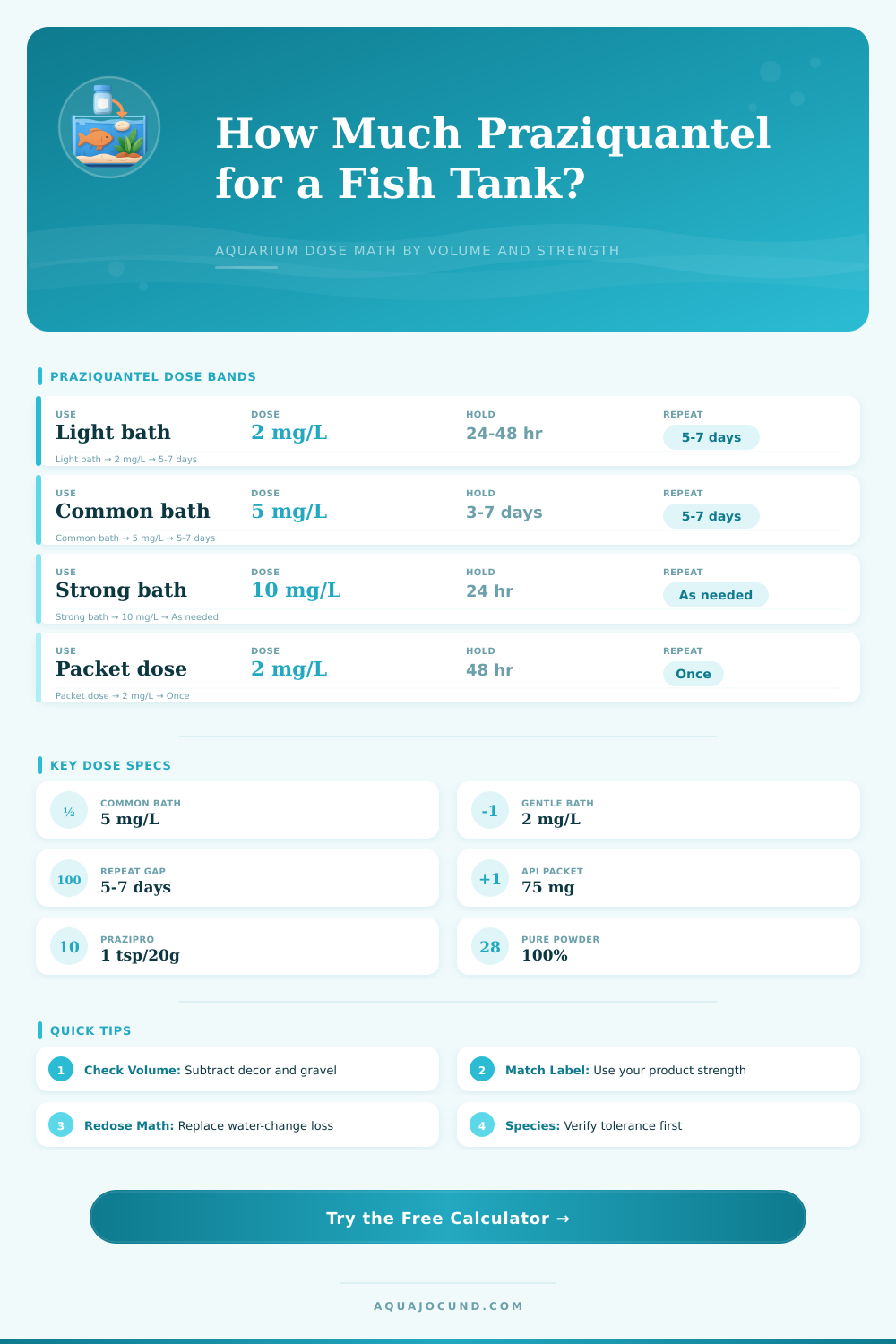
| Gentle Bath | 2 mg/L | 75.7 mg | 24-48 hours | Sensitive fish math |
| Light Fluke Bath | 2.5 mg/L | 94.6 mg | 48 hours | Low active dose |
| Common Bath | 5 mg/L | 189.3 mg | 3-7 days | Default calculator dose |
| Medium Bath | 7.5 mg/L | 283.9 mg | 24-72 hours | Higher concentration math |
| Strong Bath | 10 mg/L | 378.5 mg | 24 hours | Shorter bath calculations |
| Product Form | Strength Input | Calculator Output | Useful For | Rounding Note |
|---|---|---|---|---|
| Pure Powder | 100% active | grams of powder | Lab scale dosing | Round to scale precision |
| Custom Powder | % active | grams of blend | Premix or compounded powder | Use label assay percent |
| Liquid | mg per mL | mL of liquid | Suspension dosing | Shake product before measuring |
| Packet / Tablet | mg each | packet or tablet count | Pre-measured products | Whole-packet option available |
| PraziPro | 1 tsp per 20 gal | teaspoons and mL | Label-rate volume dosing | Based on water volume |
| General Cure | 75 mg packet | packets | Packet-based tanks | Also contains metronidazole |
| Tank Size | Net 90% Volume | Active Prazi | Pure Powder | General Cure Equivalent |
|---|---|---|---|---|
| 10 gallon | 9 gal / 34 L | 170 mg | 0.17 g | 2.3 packets |
| 20 gallon long | 18 gal / 68 L | 341 mg | 0.34 g | 4.5 packets |
| 29 gallon | 26.1 gal / 99 L | 494 mg | 0.49 g | 6.6 packets |
| 40 breeder | 36 gal / 136 L | 681 mg | 0.68 g | 9.1 packets |
| 55 gallon | 49.5 gal / 187 L | 937 mg | 0.94 g | 12.5 packets |
| 75 gallon | 67.5 gal / 256 L | 1278 mg | 1.28 g | 17.0 packets |
| 125 gallon | 112.5 gal / 426 L | 2129 mg | 2.13 g | 28.4 packets |
| 300 gallon tub | 270 gal / 1022 L | 5109 mg | 5.11 g | 68.1 packets |
| Water Changed | Remaining Dose | Replacement Dose | Use in Calculator |
|---|---|---|---|
| 10% | 90% | 10% of first dose | Small maintenance change |
| 25% | 75% | 25% of first dose | Default re-dose setting |
| 33% | 67% | 33% of first dose | Moderate dilution |
| 50% | 50% | 50% of first dose | Large water change |
| 75% | 25% | 75% of first dose | Near reset dose math |
💡 Volume Accuracy Tip
Praziquantel math depends on actual water volume, not tank nameplate volume. Use direct volume when you know it, or subtract displacement for rock, substrate, filters, and air gaps.
💡 Product Strength Tip
Different products express strength as percent active, mg per mL, mg per packet, or label teaspoons. Pick the matching product type before comparing the measured amount.
Praziquantel dosing depend upon accurate calculation of various variables. The first of these variables is the actual volume of water in an aquarium. To determine the actual water volume in the aquarium, you must calculate the total volume of the tank, and subtract the volume of the objects in the tank that displace some of that water (rocks, substrate, filter, etc.).
The actual water volume is less than the total volume of the tank by this amount. If the volume of the tank are not calculated correctly, the calculated concentration of praziquantel in the water will be incorrect. A volume that is too high will lead to a concentration that is too low in the water, while a volume that is too low will lead to a concentration that is too high in the water.
How to Dose Praziquantel in Your Fish Tank
Another of the variables that must be calculated is the strength of the praziquantel product that are to be used. Praziquantel products comes in a variety of strength and forms. Some products contain only praziquantel powder, while other products are liquid or other forms that contain a different amount of praziquantel per unit of product.
You must calculate the strength of the product to determine how much product is required to achieve the desired concentration of praziquantel in the aquarium. A praziquantel product calculator can obtain this information, which will ensure that the product is neither underdose (too little praziquantel will be added to the tank) nor overdosed (too much praziquantel will be added to the tank). The third of the variables to calculate is the effect of water changes on the concentration of praziquantel in the tank.
As water is change in the aquarium, the praziquantel will leave the tank with that water. Therefore, to maintain the desired concentration in the tank, you must add praziquantel to the water that is added during those water change. For instance, if twenty-five percent of the water is changed, twenty-five percent of the praziquantel that was in the aquarium will leave the tank with that water; thus, you must add praziquantel to the water that is added to the tank to replace the water that was changed.
These changes should be tracked in order to ensure that the concentration of praziquantel remains the same throughout the treatment period. Another variable to consider is the tolerance of the tanks fish to praziquantel. Due to the differences in the tolerance of the various fish species to praziquantel, it is necessary for the owner to ensure that the chosen dose of praziquantel is one that is sufficient to kill the parasite, but which does not harm the fish that live in the aquarium.
A single dose of praziquantel is often not enough to completely treat the tank of fish for the presence of praziquantel-sensitive parasite. Most parasite species contain eggs or encysted (dormant) parasite that a single dose of praziquantel will not be killed by. As such, you should add additional doses five to seven days apart from the initial dose.
The second and third doses will target the parasites that hatch or excyst in response to the initial dose. Calculating the total amount of praziquantel required for the tank during the treatment period will ensure that there is enough praziquantel available for each of the treatment round. The process of dosing praziquantel in an aquarium involve calculating each of the variables discussed above.
The actual volume of water in the tank must first be calculate. The dose of praziquantel that should be used can be calculated based off the known tolerance of the tanks fish to praziquantel. The strength of the praziquantel product must be determined to enable conversion of the dose into the amount of product.
The amount of praziquantel that has left the tank due to water changes must be calculated. Finally, each of these variables can be used to calculate the total amount of praziquantel that will be required for the treatment of the tank. Maintaining a consistent concentration of praziquantel in the tank is the primary goal of the dosing process.
Consistent concentration of praziquantel in the tank can be achieved through the use of these calculation.