🌱 Potassium Weekly Dose Calculator
Plan planted aquarium potassium from K2SO4, KNO3, KH2PO4, custom dry salts, or liquid stock while crediting source water, uptake, water changes, and split doses.
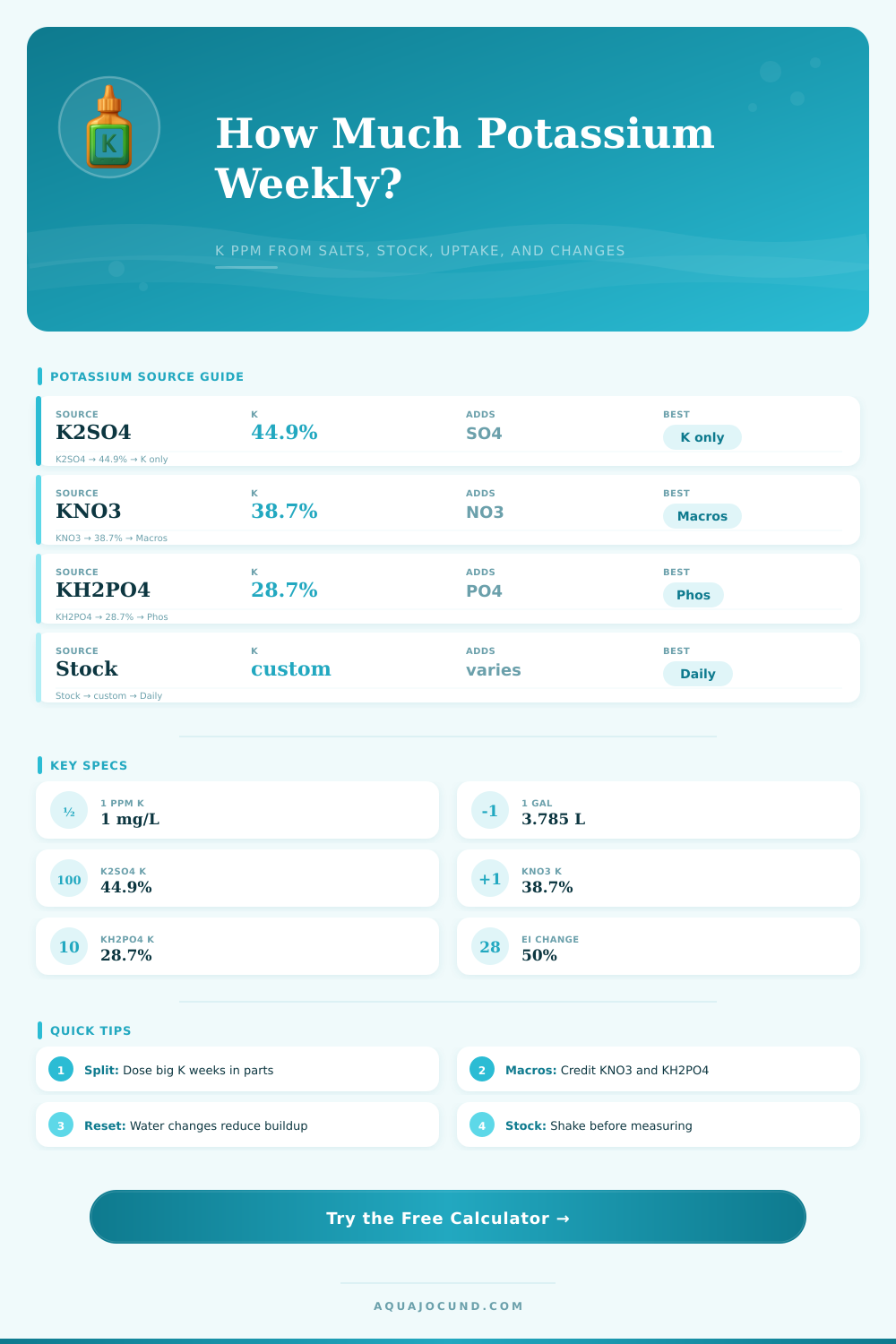
| Source | Potassium fraction | Companion ion | Use case | Watch point |
|---|---|---|---|---|
| K2SO4 potassium sulfate | 0.4487 g K per g salt | SO4 about 0.5513 g/g | K-only macro | Low solubility compared with nitrate salts; dissolve well. |
| KNO3 potassium nitrate | 0.3867 g K per g salt | NO3 about 0.6133 g/g | NO3 plus K | Nitrate may exceed lean targets if used only to chase potassium. |
| KH2PO4 monopotassium phosphate | 0.2873 g K per g salt | PO4 about 0.6986 g/g | PO4 plus K | Phosphate rises quickly; potassium contribution is secondary. |
| Liquid potassium stock | Custom mg K per mL | Depends on recipe | Fine dosing | Use actual stock strength or calculate from dry salt recipe. |
| Tank | Working water | 5 ppm K as K2SO4 | 10 ppm K as K2SO4 | 15 ppm K as K2SO4 |
|---|---|---|---|---|
| 5 gal nano | 4.3 gal / 16 L | 0.18 g | 0.36 g | 0.54 g |
| 20 long planted | 17 gal / 64 L | 0.72 g | 1.43 g | 2.15 g |
| 40 breeder | 34 gal / 129 L | 1.44 g | 2.87 g | 4.31 g |
| 75 gal display | 64 gal / 242 L | 2.70 g | 5.39 g | 8.09 g |
| 125 gal display | 106 gal / 401 L | 4.47 g | 8.94 g | 13.41 g |
| Dosing style | Typical K range | Water change | Uptake assumption | Split pattern |
|---|---|---|---|---|
| Low-tech weekly | 5 to 10 ppm | 25% to 40% | 0.2 to 0.8 ppm/day | 1 weekly dose |
| Lean planted | 8 to 15 ppm | 30% to 50% | 0.6 to 1.2 ppm/day | 2 to 3 doses |
| EI high-tech | 15 to 30 ppm | 50% weekly | 1.2 to 2.5 ppm/day | 3 macro doses |
| Shrimp-safe planted | 5 to 12 ppm | 20% to 35% | 0.2 to 0.7 ppm/day | Small split doses |
| Weekly K raise | Suggested splits | Reason | Good source |
|---|---|---|---|
| 0 to 5 ppm | 1 dose | Small correction after testing or light plant mass. | K2SO4 or liquid stock |
| 5 to 15 ppm | 2 to 3 doses | Keeps daily availability steady without a big single swing. | K2SO4, KNO3, or stock |
| 15 to 30 ppm | 3 to 6 doses | Matches EI-style macro routines and strong plant uptake. | K2SO4 plus macro salts |
| Over 30 ppm | Recheck inputs | Often caused by very high target, hidden K from macros, or low water change. | Stock solution only if confirmed |
Potassium is an easy nutrient to overlook if you want to forget about it for a while. Next time your tank turns black, you might of missed that your plants are turning a dull bronze color. Perhaps some algae has also crept up the leaf surface. Why? Because you dose phosphate and nitrate like a champ and starve your plant of the most critical building block… potassium.
Potassium is not only responsible for giving structure, but also drives photosynthesis. However it vanishes out of solution quicker then nearly every main nutrient. Once again, you plug in your parameters and the calculator do all the math for you. No need for converting or figuring coefficients. Just understand what exactly is being measured here.
How to Add Potassium Correctly
When most hobbyists hear “dosing” they picture adding a number to get to another number. I’ll begin with ten parts per million, so I’ll add X amount of salt to meet my goal of twenty. This may work for other things but not in aquatics. Every day your plants consumes some, and every week (or whatever frequency) your water change dilutes what’s remaining. The tool accounts for that weekly decay.
It lets you estimate how much your plants will consume each day then adjust based on your typical water change percent. That’s where folks go wrong. Dose to hit a target peak on Saturday morning but forget plants ate it all before Tuesday, which means they’re back at baseline. What matters isn’t just how much you choose to give, but also from where.
If all you want/need is potassium, the purest form is potassium sulfate. Yes, it has some sulfur in there too, but none of the nitrate or phosphate. It is simple enough. Many of us are already giving a solution containing potassium nitrate (for Nitrogen) or monopotassium phosphate (for Phosphorus). These solutions is high in potassium to begin with.
Don’t simply think of KNO3 as “just” a Nitrogen source and then chase your desired level of potassium by dosing another sulfate separately. More than likely you’ll overshoot and be at risk of becoming toxic. Look at the reference table on the page… It makes it clear. Account for what those other macros provide.
Another mistake I see people make is splitting their dose. If you have really heavy plants and lots of growth, you don’t want to dump your whole week’s worth of potassium all at once. This will produce a giant spike which can be stressful to livestock and cause osmotic shock. With the calculator, you can break up that week’s total into something that’s easier on them… Like several smaller doses spaced out throughout the week.
This more closely mimics natural availability and stops levels from swinging too wildly between very high and very low. Not a big deal but it makes a difference in terms of plant health. Consistent exposure is what they’re after (not feast/famine).
There’s also the matter of water quality. If you have hard water, certain types of soil makeup, etc., your tap water may already be higher in potassium than zero. And if you don’t account for that starting point then you’re actualy doubling up on whatever it is you start with. That’s where the input for source water potassium comes into play.
Instead of just adding more without knowing the current levels, it accounts for what is already there so you are not topping up something that is already present. This makes for precise dosing instead of slowly accumulating salts month after month until you get bad water clarity and stubborn algae issues.
Aggressive lighting and high-tech tanks means you will need to replenish more often. Using less intense lighting and low-tech tools means there is much less need to replenish. That’s where the presets (which aren’t rigid rules, just starting points) connect these two needs. For newbies, this can be a safe harbor away from drowning in complicated chemistry. Adjust from there based on what your own aquascape do.
So potassium in the end is all about balance, not brute force. It is not just about pouring as much salt as you can into the water column. You must keep a constant flow that keeps pace with your plant’s appetite but never overwhelms the system. And once you get it dialed-in, the colors return, the growth starts to stabilize and the bronze tint begins to fade. Then you know the math paid off.