🧪 Potassium Permanganate Dosing Calculator
Estimate aquarium KMnO4 grams, stock solution volume, ppm demand adjustment, treatment timing, and sensitivity limits from measured water volume.
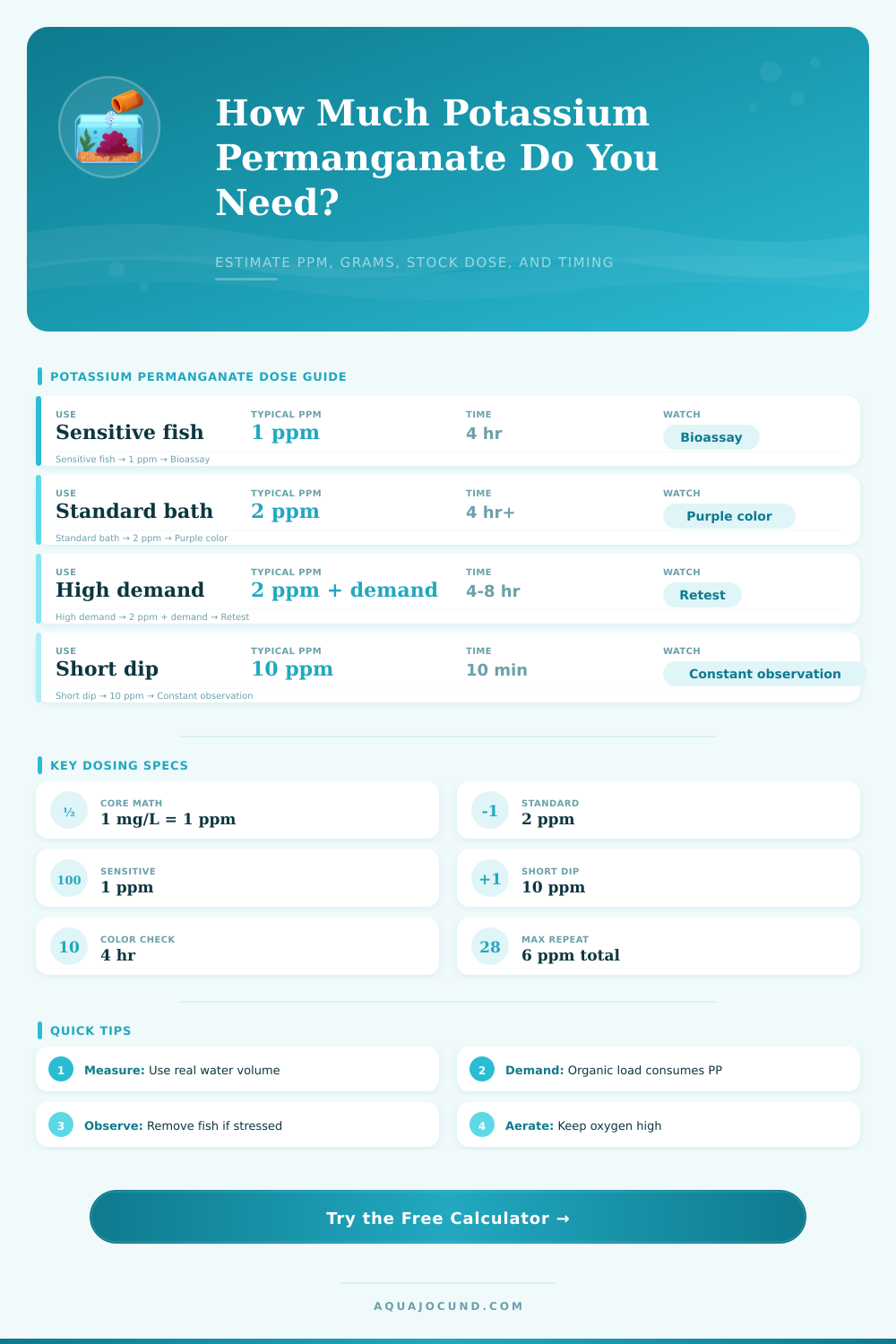
| Treatment Type | Calculator Target | Typical Contact | Best Use In Calculator |
|---|---|---|---|
| Sensitive first-use bath | 1 ppm | About 4 hours | Select sensitive mode and dose under observation |
| Standard long bath | 2 ppm | 4 hours or longer color hold | Clear quarantine or hospital tank |
| Demand adjusted bath | 2 ppm plus measured demand | 4-8 hour color hold target | Use when water turns brown quickly |
| Short dip | 10 ppm | 10 minutes | Separate container only with constant observation |
| Plant/equipment dip | 10 ppm | 10-30 minutes | No fish, shrimp, snails, or biofilter media |
| Livestock / System | Sensitivity Setting | Target Cap | Calculator Warning |
|---|---|---|---|
| Koi and goldfish in treatment vats | Robust | 2 ppm long bath | Organic load often drives demand |
| Discus and many scaled tropical fish | Standard | 2 ppm long bath | Observe breathing and balance |
| Lake cichlids, delicate gill fish, first exposure | Cichlid or sensitive | 1 ppm start | Use bioassay or lower first dose |
| Scaleless fish, rays, sharks, weak fish | Do not dose | 0 ppm | Specialist protocol required |
| Corals, shrimp, snails, planted biofilter media | Do not dose | 0 ppm | Oxidizer risk is not compatible |
| Plants or equipment without animals | Plants / equipment only | 10 ppm dip | Rinse and dechlorinate separately |
| Tank | Typical Dimensions | Net Water Used | 2 ppm Dry KMnO4 |
|---|---|---|---|
| 10 gallon | 20 x 10 x 12 in / 51 x 25 x 30 cm | 9 gal / 34 L | 0.069 g at 99% purity |
| 20 long | 30 x 12 x 12 in / 76 x 30 x 30 cm | 18 gal / 68 L | 0.138 g at 99% purity |
| 29 gallon | 30 x 12 x 18 in / 76 x 30 x 46 cm | 26 gal / 98 L | 0.198 g at 99% purity |
| 40 breeder | 36 x 18 x 16 in / 91 x 46 x 41 cm | 36 gal / 136 L | 0.275 g at 99% purity |
| 55 gallon | 48 x 13 x 21 in / 122 x 33 x 53 cm | 49 gal / 185 L | 0.374 g at 99% purity |
| 75 gallon | 48 x 18 x 21 in / 122 x 46 x 53 cm | 67 gal / 254 L | 0.513 g at 99% purity |
| 150 gallon vat | Custom tub or pond tank | 150 gal / 568 L | 1.148 g at 99% purity |
| Observation | Likely Demand | Calculator Adjustment | Action Before Redosing |
|---|---|---|---|
| Purple or pink holds 4 hours | Low to moderate | Use 0-0.5 ppm demand | Continue observation until endpoint |
| Turns tea-brown within 2-4 hours | Moderate | Add 1 ppm demand only if fish stable | Retest and improve aeration |
| Turns brown in under 1 hour | High organics | Use high demand preset for planning | Clean system before more PP |
| Cloudy, debris, heavy mulm | Very high | Avoid stacking dose blindly | Water change, remove organics, recalc |
| Fish gasp, roll, or panic | Stress response | Stop using dose estimate | Neutralize or move fish immediately |
Potassium permanganate is an oxidizer that people use in aquarium care in that potassium permanganate can remove the parasite, bacteria, and organic film that is contained within the aquarium. The active ingredient in potassium permanganate are purple-pink in color, and the rate at which that purple-pink color becomes brown indicate the strength of the potassium permanganate; the more rapid the potassium permanganate becomes brown, the more active the potassium permanganate appears to be. Additionly, if the water rapid turns to a brown color from the potassium permanganate, this indicates that the organic matter in the water has utilized the potassium permanganate, which can lead to the fish not receive the full strength of the potassium permanganate treatment.
In order to prepare the aquarium for the introduction of potassium permanganate, it is important to calculate the volume of the aquariums water. Additionally, due to the fact that some aquariums may contain gravel, driftwood, and filter media that can all displace some of the water in the aquarium, it is additionally important to account for the
How to Use Potassium Permanganate in an Aquarium