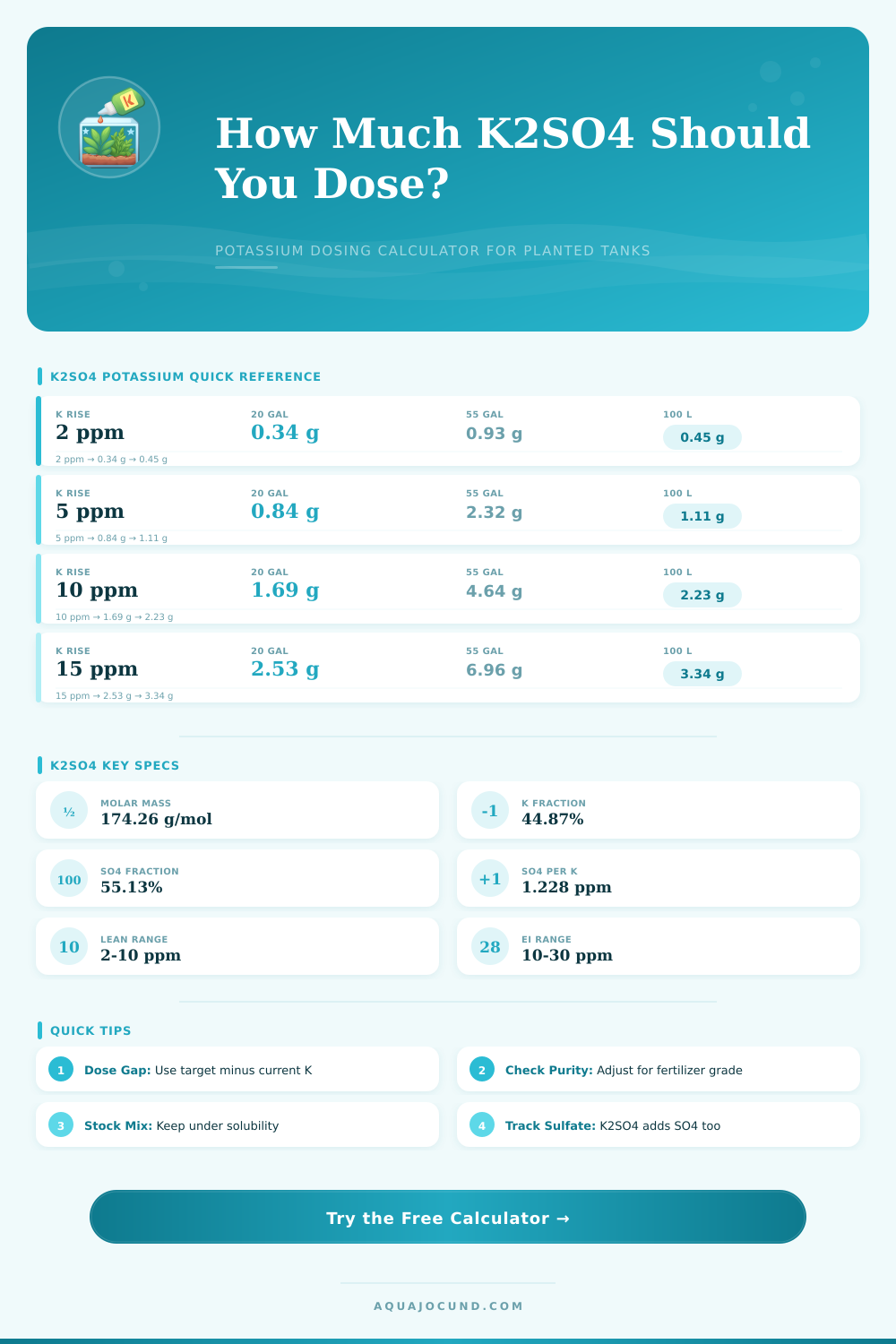
Potassium Dosing Calculator K2SO4
Calculate target K ppm, dry potassium sulfate grams, stock solution dose mL, and the sulfate contribution for planted aquariums.
| Dosing style | Typical K target | K2SO4 use case | Notes |
|---|---|---|---|
| Lean low tech | 2 to 5 ppm weekly | Small top-up only | Common when fish food and tap water add minerals. |
| Lean planted | 5 to 10 ppm weekly | Steady K support | Good for slower growth and lower water-change systems. |
| Moderate planted | 10 to 15 ppm weekly | Macro balance | Useful when nitrate source does not add much potassium. |
| EI style | 10 to 30 ppm weekly | Non-limiting K | Often split across the week with regular water changes. |
| Target K rise | 10 gal | 20 gal | 55 gal | 100 L |
|---|---|---|---|---|
| 2 ppm K | 0.17 g | 0.34 g | 0.93 g | 0.45 g |
| 5 ppm K | 0.42 g | 0.84 g | 2.32 g | 1.11 g |
| 10 ppm K | 0.84 g | 1.69 g | 4.64 g | 2.23 g |
| 15 ppm K | 1.27 g | 2.53 g | 6.96 g | 3.34 g |
| Tank | Volume | 5 ppm K dry dose | 10 ppm K dry dose |
|---|---|---|---|
| Nano shrimp cube | 5 gal / 19 L | 0.21 g | 0.42 g |
| Standard 10 gallon | 10 gal / 38 L | 0.42 g | 0.84 g |
| 20 long planted | 20 gal / 76 L | 0.84 g | 1.69 g |
| 40 breeder | 40 gal / 151 L | 1.69 g | 3.37 g |
| 75 gallon display | 75 gal / 284 L | 3.16 g | 6.33 g |
| 125 gallon planted | 125 gal / 473 L | 5.27 g | 10.55 g |
| Product type | Default purity | Approx tsp weight | Use in calculator |
|---|---|---|---|
| Aquarium fertilizer powder | 99% | 6.0 g/tsp | Default planted tank dry salt. |
| Hydroponic soluble grade | 98% | 6.2 g/tsp | Common macro fertilizer material. |
| Reagent or lab grade | 99.5% | 5.8 g/tsp | High-purity calculation reference. |
| Technical grade powder | 96% | 6.4 g/tsp | Use label purity if available. |
| Agricultural granular | 95% | 7.0 g/tsp | Weigh grams instead of spoon dosing. |
Potassium is one of the nutrients that plants requires to grow healthyly plants. Potassium will help maintain the green color of the plants and the growth rates of the plants. If the levels of potassium decreases in the water, the plants may develop pale spots on there leaves and experience slow growth rates.
In order for the plants in the planted tank to perform the function necessary to perform properly, the water column must contain enough potassium to supply the roots and leaves of the plants. Potassium sulfate, or K2SO4, can be use to increase the potassium levels in the aquarium. Potassium sulfate is beneficial to add to the planted aquarium water because it will add the necessary potassium to the water without adding nitrogen or phosphate to the water.
How to Use a Potassium Sulfate Dosing Calculator
A potassium dosing calculator allows for the determination of the amount of potassium sulfate that should be added to the aquarium to ensure that the plants receives the amount of potassium that they require. To use the calculator, the user will need to enter the volume of the aquarium, the current level of potassium in the aquarium, and the target level of potassium that they wish to add to the aquarium. The volume of the aquarium is important because the larger the aquarium, the more potassium will be require to supply the plants.
The current level of potassium in the aquarium will help to determine how much additional potassium will be required to reach the target level. The target level of potassium will help determine how much potassium to add to the aquarium in order to meet the goals that you have for the growth of your plants. Potassium sulfate contains both potassium and sulfate in each molecule.
Therefore, by adding potassium sulfate to the aquarium, the sulfate levels in the water will also increase. While sulfate is beneficial to the planted tank, if you are adding other sulfate salts to the aquarium, it is necessary to monitor the levels of sulfate in the water. The dosing calculator will display the amount of sulfate that will be added to the aquarium along with the amount of potassium.
This allows the user to decide whether they will use dry potassium sulfate to dose the aquarium, or if they will create a liquid stock solution. Stock solutions allow for the users to dose the aquarium in millilters of the solution, as opposed to dosing dry potassium powder. Many people choose to dose their aquariums with potassium once every week.
However, other individuals may wish to dose their aquarium every single day. Most potassium dosing calculators allows for the user to choose the schedule on which they wish to dose the aquarium. In a low-tech aquarium, less potassium will be required each week than in a high-light aquarium that utilize CO2 for the plants.
Consistencies in the dosing schedule will allow the plants to develop better roots and leaves, as opposed to adding too much or too little of the nutrient at any given time. The dosing calculator will provide you with a specific number for the amount of potassium sulfate to be added to the aquarium each period of time. The purity of the potassium sulfate is another important variable in the dosing schedule.
Potassium sulfate can be of two different purities; agricultural grade or aquarium grade. Aquarium grade potassium sulfate will contain 98 or 99% pure potassium sulfate. It is important to enter the purity level of the potassium sulfate that you plan to use in the dosing calculator.
If the percentage is not accounted for, you may add too little potassium sulfate to the aquarium. Too little potassium sulfate will prevent the plants from receiving the amount of potassium that is required to meet the target amount. Another alternative to adding dry potassium sulfate to the aquarium is to prepare a stock solution.
Creating a stock solution requires that you dissolve a certain amount of potassium sulfate in a certain amount of water. The dosing calculator will ask for the number of grams of potassium sulfate that you prepared the stock solution with, as well as the total number of milliliters of the solution that was made. Based off your desired target level of potassium, the calculator will tell you how many milliliter of that stock solution should be added to the aquarium.
It is important to understand the solubility of potassium sulfate. Potassium sulfate will not dissolve if more than approximately 111 grams of potassium sulfate is added to a liter of water. The dosing calculator will alert the user if they attempt to prepare a stock solution with too high of a concentration of potassium sulfate.
Aquariums naturally contain some amount of potassium. By testing the aquarium water, you can determine the current level of the nutrient. Based upon this test, you can dose the aquarium with only the amount of potassium that is needed to reach the target amount.
Alternatively, if you do not test the aquarium water, you can simply dose the aquarium with the amount of potassium that is required by the plants according to its lighting cycles and CO2 levels in the water. The amount of potassium that should be added to the aquarium will vary according to the lighting cycles and CO2 levels that are establish in that aquarium. To effectively use potassium sulfate to your benefit in your planted aquarium:
First, decide if you would like to introduce lean, moderate, or high-energy growth to your aquarium.
Each type of growth requires different amount of potassium to supply the plants with the nutrient that they require in order to develop healthy roots and leaves. Once you have determined the type of plant growth that you would like to introduce into the aquarium, enter the volume of the aquarium and the amount of rise in potassium that you would like to establish into the water using the dosing calculator. Make sure to check the amount of sulfate that will be added to the aquarium to ensure that the levels of sulfate remain appropriate for the aquariums plants.
Finally, decide whether you would like to dose the aquarium with the dry potassium sulfate, or if you would like to use the stock solution that was prepared in the amount of potassium that you determined from the dosing calculator. While the dosing calculator will perform the calculation for you, you will be responsible for establishing the goals that you would like for your aquarium and for establishing a consistent schedule of when to dose the aquarium with potassium sulfate.