Pond Winter Feeding Schedule Calculator
Plan cold-water feeding days from pond temperature, fish biomass, food type, and digestion window.
Winter feeding result
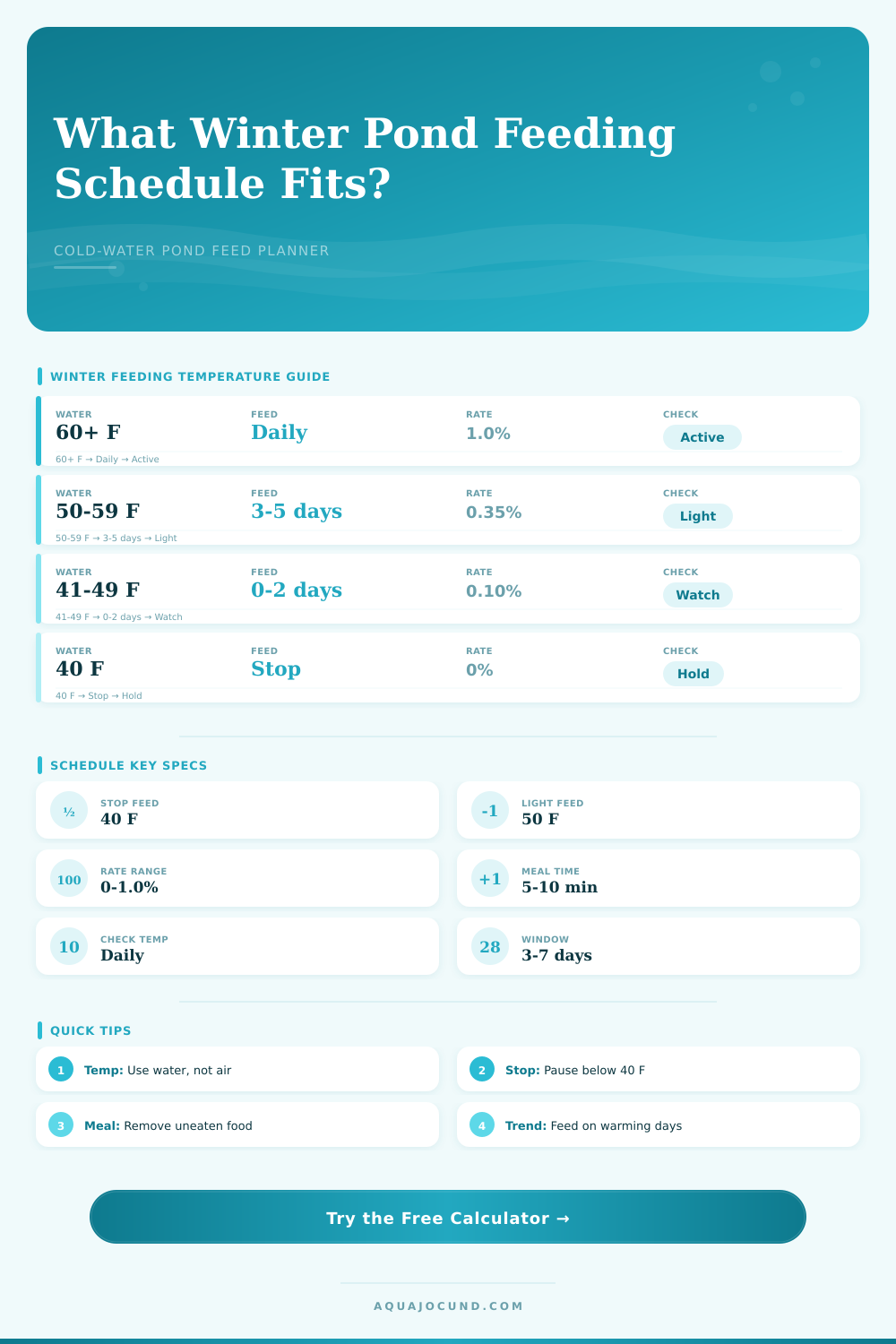
| Water temperature | Base rate | Typical days per week | Meal style |
|---|---|---|---|
| 65°F and warmer / 18.3°C+ | 1.20% body weight per day | 7 days | Normal feeding split into small meals |
| 60-64°F / 15.6-17.8°C | 0.85% body weight per day | 5-6 days | Light daily or nearly daily schedule |
| 55-59°F / 12.8-15.0°C | 0.50% body weight per day | 4-5 days | Small wheat germ meals |
| 50-54°F / 10.0-12.2°C | 0.25% body weight per day | 2-3 days | Only when fish come up actively |
| 45-49°F / 7.2-9.4°C | 0.10% body weight per day | 0-2 days | Observation meal on a warming trend |
| 41-44°F / 5.0-6.7°C | 0.03% body weight per day | 0-1 day | Usually skip unless local practice supports it |
| 40°F and colder / 4.4°C and colder | 0% | 0 days | Stop feeding and monitor water quality |
| Food type | Lowest practical water temp | Ration factor | Winter use |
|---|---|---|---|
| Wheat germ cold-water pellet | 45-50°F / 7.2-10.0°C | 1.00 | Default shoulder-season food |
| Sinking cool-season pellet | 45-50°F / 7.2-10.0°C | 0.90 | Useful when fish stay low in the water |
| Regular staple pellet | 55°F+ / 12.8°C+ | 0.75 | Reduce portions in cool water |
| Soft gel or soaked pellet | 50°F+ / 10.0°C+ | 0.85 | Short cleanup window, easy portion control |
| No feed during dormancy | Any cold-stress period | 0.00 | For frozen, falling, or inactive ponds |
| Pond example | Approx volume | Typical biomass | 50°F schedule estimate |
|---|---|---|---|
| Small patio goldfish pond | 250 gal / 950 L | 1-3 lb / 0.5-1.4 kg | 1-2 small meals weekly |
| Backyard mixed pond | 800 gal / 3028 L | 5-10 lb / 2.3-4.5 kg | 2 light meals weekly |
| Medium koi pond | 1500 gal / 5678 L | 12-25 lb / 5.4-11.3 kg | 2-3 controlled meals weekly |
| Large koi pond | 3500 gal / 13249 L | 30-70 lb / 13.6-31.8 kg | 1-3 meals by fish activity |
| Deep overwintering pond | 5000 gal / 18927 L | 40-100 lb / 18.1-45.4 kg | Usually pause below 45°F |
| Condition | Calculator adjustment | Why it matters | Schedule cue |
|---|---|---|---|
| Warming trend | 10% ration increase | Fish are more likely to digest a light meal | Place feed days after warmer afternoons |
| Falling cold front | 30% ration reduction | Digestion slows quickly as water cools | Skip feed before sharp temperature drops |
| Partial ice or leaf cover | 15% ration reduction | Observation and cleanup are harder | Feed only when fish are visible |
| Heavy ice or low gas exchange | Stop feed recommendation | Waste load is risky in low oxygen water | Prioritize open water and aeration checks |
| Lean fish before winter | 10% ration increase above safe base | Only helpful when water is warm enough | Use small meals, not large catch-up meals |
In late November something happens to pond owners. They start feeling anxious. It’s getting really cold outside and all of a sudden their koi are just floating around on the surface like a bunch of lazy slobs. Your gut is saying “Feed ’em!” They’re hungry…they want some food! Your intuition says, “Stop feeding! It’s winter!” Where does the truth lie? The truth lies somewhere in the middle of these two reactions.
In the shoulder seasons, we aren’t talking about feeding cold water fish to meet their nutritional needs. We’re talking about managing the digestion process. Feed them when their gut enzymes isn’t awake and active, and guess what? Not only are you not helping them survive, your giving them a biological time bomb that will kill them from the inside out.
How to Feed Koi in Winter
You can input your fish biomass and pond temperature into the calculator above and it will do the math for you. No need to convert to kg or coefficients. You still has to do some work before you can click the button.
First lesson: Air temp doesn’t necessarily translate to water temp. You may think its 60 degrees out because the air is sunny and feels balmy on your skin. But if there’s three-feet of water between you and the bottom, the fish haven’t felt the warmth yet. And that’s what most folks fail to realize. Why do they eat? Because it’s sunny out? No. They feed because it’s sunny out, not because the water is warm enough for their metabolism.
If you read through the inputs you’ll see that temperature is weighted quite heavily. That’s because a cold blooded animal’s metabolism (i.e., digestion) are directly linked to water temperature. Their digestive system slows considerably below fifty degrees. They almost comes to a halt below forty degrees. These cutoffs inform the size of rations suggested by the tool.
For example, if your water temperature is around fifty degrees, it will probably recommend smaller meals on an intermittent schedule. It might also suggest wheat germ instead of protein-dense pellets like flakes or pellets. Why? Wheat germ is easier to digest and provides energy without needing a metabolism that produces heat. A fish can’t produced heat when the water is cold.
Also take note of the fish condition setting. Maybe your fish became thin during the winter and now you feel pressured to feed them more to try to get them back into good shape. To account for this, the calculator allow a bit higher ration. But again, it does so conservatively. No winter catch-up meal exists. And there’s always risk when feeding past fullness and forcing fish to eat undigested meals. Better they go a little light than have their guts infected with something. That is why the tool caps the percent body weight you can feed. No matter how much you want to help them, it will keep you well within the safety zone.
The second important consideration is weather trends. Rapidly dropping temperatures can be much worse for fish than slow cooling. A sudden cold front is more dangerous then a steady cold spell. But if the temperature dropped quickly, the fish quits moving. They stay down and don’t even come up to feed. They’ll have food in their stomachs from a previous feeding which becomes as hard as a rock. You can enter rapid cooling trends into the calculator, and it will either skip a feeding day (for you) or reduce the recommended ration. Better to skip a day of feeding than put too much waste in the pond where it decays and robs oxygen from the water.
When the water turns cold and the days shorten, it’s time to switch gears from feeder to monitor. You’re not growing them anymore, now you’re keeping them alive till next spring. That schedule comes from the output. In most cases, this will be fewer than one feeding per day. It may be only several times a week, or even zero by the time you drop down into the 40s. Go with it, trust the reduction. It’s not punishment. It’s biology.
Give the calculator the responsibility for exact ounces and grams and use your eyes to watch. A minute or two at most should see all the food consumed; if it lasts longer than that, youve already overfed for the conditions. Patience, that’s what winter in the pond is all about. Days. Weeks. Maybe even longer between tossing pellets into the pond.
The fish gets thin. They’ll look quiet. But don’t fret, they’re just resting up. It’s your responsibility to make sure the water stays at a warm enough temp for them to survive and that you keep it clean. When spring returns and the water warms, they’ll come out full of energy to burn. Until then, less is realy more.