Pond Top-Up Water Volume Calculator
Estimate evaporation, splash and seepage allowance, weekly refill volume, hose runtime, and percent of pond volume.
📌 Pond presets
📐 Pond size
☀️ Loss factors
⏱️ Refill timing
Calculation breakdown
📊 Top-up reference specs
🌊 Evaporation profile table
| Profile | Daily depth estimate | Best fit | Calculator factor |
|---|---|---|---|
| Cool / shaded | 0.04 in / 1.0 mm | Covered patio, shaded garden, cool week | 0.45x |
| Mild mixed shade | 0.08 in / 2.0 mm | Typical ornamental pond with partial sun | 0.90x |
| Warm sunny | 0.14 in / 3.6 mm | Summer pond with broad sun exposure | 1.55x |
| Hot, dry, windy | 0.22 in / 5.6 mm | Windy edge, exposed courtyard, dry air | 2.45x |
| Humid tropical sun | 0.16 in / 4.1 mm | Warm humid pond with strong sun | 1.80x |
| Indoor pond room | 0.03 in / 0.8 mm | Protected indoor display with lower airflow | 0.35x |
💦 Splash and seepage allowances
| Allowance | Daily volume used | Typical sign | Calculation note |
|---|---|---|---|
| None measured | 0 gal/day | Still pond, clean dry edging | Evaporation only |
| Trace allowance | 0.05% of pond/day | Minor splash near skimmer or plants | Good default for quiet ponds |
| Light splash | 0.10% of pond/day | Small fountain or windy lip | Adds a modest daily reserve |
| Moderate splash | 0.25% of pond/day | Falls, stream, or damp stone edge | Often visible near moving water |
| High splash / porous edge | 0.50% of pond/day | Wet rocks, heavy spray, capillary edge | Recheck if this persists |
| Custom daily amount | User-entered amount | Measured bucket or meter result | Overrides percent allowance |
📏 Common pond sizes
| Pond style | Dimensions | Approx. volume | Typical weekly top-up |
|---|---|---|---|
| Patio bowl | 4 ft x 3 ft x 1.2 ft / 122 x 91 x 37 cm | 80-110 gal / 300-420 L | 6-14 gal / 23-53 L |
| Small goldfish pond | 8 ft x 5 ft x 1.8 ft / 244 x 152 x 55 cm | 400-520 gal / 1510-1970 L | 20-55 gal / 76-208 L |
| Medium koi pond | 12 ft x 8 ft x 3 ft / 366 x 244 x 91 cm | 1600-2100 gal / 6060-7950 L | 55-160 gal / 208-606 L |
| Waterfall pond | 14 ft x 9 ft x 2.5 ft / 427 x 274 x 76 cm | 1700-2300 gal / 6435-8706 L | 110-300 gal / 416-1136 L |
| Large garden pond | 22 ft x 14 ft x 3.5 ft / 671 x 427 x 107 cm | 6000-7800 gal / 22700-29500 L | 220-620 gal / 833-2347 L |
⏲️ Refill flow timing table
| Measured flow | 50 gal / 189 L | 100 gal / 379 L | 250 gal / 946 L |
|---|---|---|---|
| 1 gal/min / 3.8 L/min | 50 min | 1 hr 40 min | 4 hr 10 min |
| 2 gal/min / 7.6 L/min | 25 min | 50 min | 2 hr 5 min |
| 3 gal/min / 11.4 L/min | 17 min | 33 min | 1 hr 23 min |
| 5 gal/min / 18.9 L/min | 10 min | 20 min | 50 min |
| 8 gal/min / 30.3 L/min | 6 min | 13 min | 31 min |
If you see a waterfall gurgle air, or if the fish is staring at the sky, chances are good that pond water level has dropped. That’s no cause for panic. Rarely will the answer be as bad as situation appears. Most of the time all that’s needed is an understanding of where the water went.
And guess what? It doesn’t simply dissapears. Unless it leaks into the ground or sprays onto adjacent rocks, or evaporates into the atmosphere, it has to go somewhere. Get the numbers down pat and you’ll quit guessing and begin planning. All you have to do is enter your dimensions and local conditions into the calculator above; let it crunch the numbers, and spend less time converting volume.
How to Fix Low Pond Water Levels
First off, measure the size of your pond based off the average water depth (not necessarily the maximum depth). Why? Because the deepest part of your pond won’t factor into the surface area from which the sun evaporate water. Then the tool use your width x length measurements as the starting point for a base volume (with adjustments for liner folds, plant shelves, and rock displacing water).
This is where folks get hung up; they figure out the volume of a hypothetical empty box and then feel like the real water isn’t right. Enter the usable water level adjustment for physical fact of things.
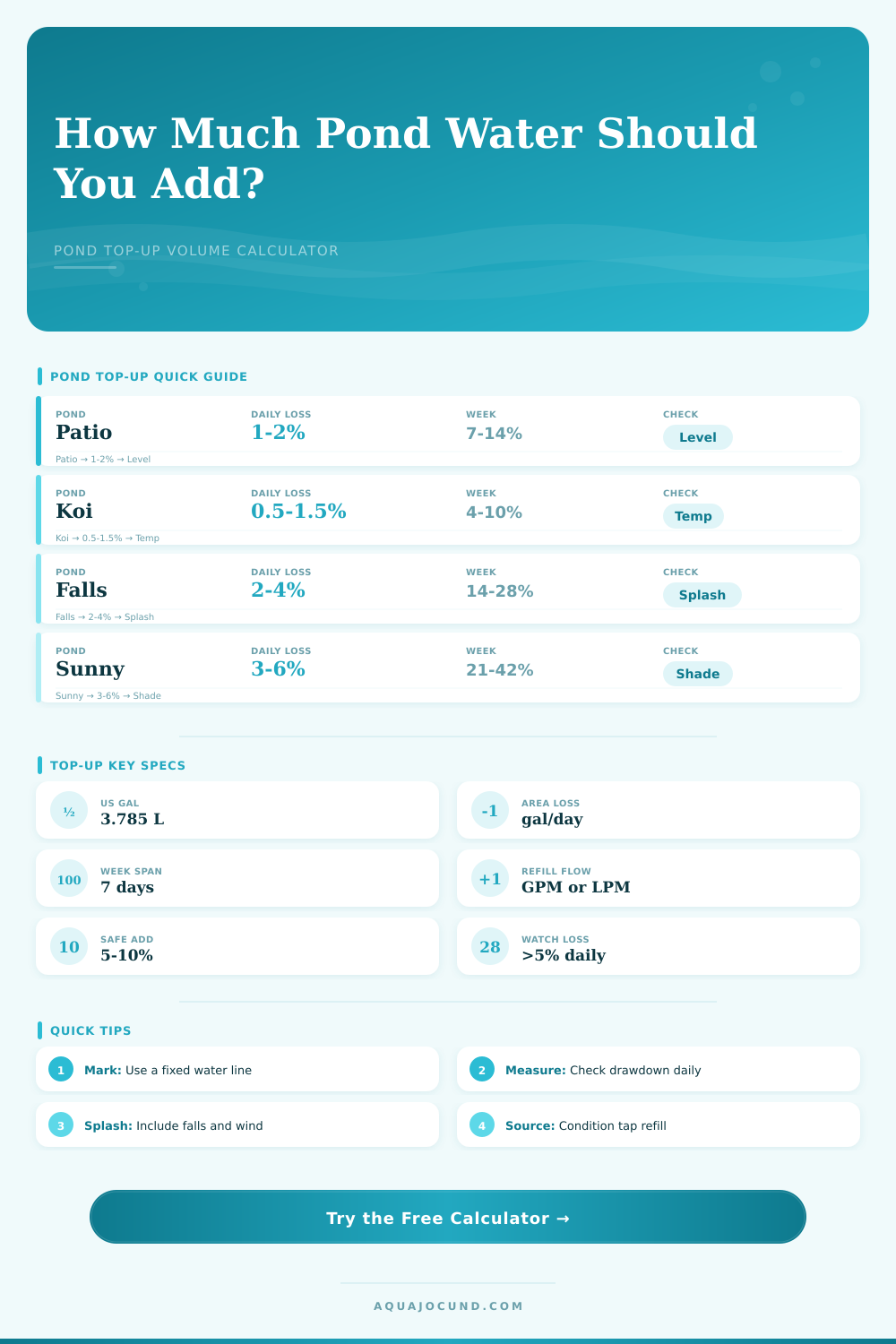
Most owners underestimate influence of climate. In a week’s time, a sunny garden pond pummeled by breezes loses far more than a shaded patio bowl do in summer. That’s illustrated in the reference table on the page, where you can see that a hot, dry, and windy day result in a much greater loss of water compared to a mild mixed shade day.
So don’t assume that the overall forecast applies; select the one that best fits where your pond is. If yours is beneath a pergola, for instance, choose the shade cloth column. If it’s located in the center of a gravel courtyard, that will increase those numbers, because of wind factor.
Two silent thieving forces steals water from ponds: splash and seepage. That beautiful waterfall turns water into mist. Evaporation happens at a higher rate then with still water. Seepage is harder to notice and more difficult to see; it is indicated by a wet area close to where the liner meet the ground.
Adjust the splash mode to anywhere from trace to high splash on the calculator. Moderate splash should of be the starting point if you’re not sure; it’s worse to overestimate the refilling requirement a little than run out of water in your hose trying to track down an imaginary leak.
How much water; Refilling too quickly will also cause problems. Never refill at more than 10% of the pond’s capacity at any one time. This shocks the good bacteria colony that keep the pond clean and disrupts the chemical composition for the fish. The tool lets you know exactly how long to let the hose run based on your hose flow rate so you won’t make the typical mistake of leaving it running for hours. Even though the pond may look much lower than usual, it could take only ten minutes to fill back up.
And lastly, place a marker (stone, a discreet stake) where your water normally sits. You’ll notice if things get out of whack when you check this spot every day, week, or month. If the water’s milder but you’re losing twice as much each day, it’s not because the air is suddenly evaporating faster, it’s probably leaking from your plumbing or liner. Watch for these trends. Consistent changes over time are far better than heroic moves during a drought. Fish remain calm, water remains clear, and you stay calm too.