💧 Oval Pond Volume Calculator
Estimate oval pond gallons, liters, liner sheet size, edge length, and pump turnover from real pond dimensions.
| Profile | Average Depth Factor | Best Use | Volume Effect |
|---|---|---|---|
| Shallow saucer | 0.55 x max depth | Wildlife edges, beach entry | Lowest water volume |
| Plant shelves | 0.65 x max depth | Water lilies and marginal baskets | Common garden pond estimate |
| Sloped oval bowl | 0.72 x max depth | Mixed fish and planted oval ponds | Moderate capacity |
| Steep sided | 0.82 x max depth | Koi ponds with limited shelves | Higher capacity |
| Formal vertical oval | 0.92 x max depth | Raised walls, hard-shell forms | Near full geometric volume |
| Oval Pond | Waterline Size | Typical Depth | Approx Volume | Typical Use |
|---|---|---|---|---|
| Small patio oval | 6 ft x 4 ft | 18 in | 150-190 gal | Plants, small goldfish group |
| Wildlife garden oval | 8 ft x 5 ft | 20 in | 240-320 gal | Wildlife, oxygenators, marginal plants |
| Starter fish oval | 10 ft x 7 ft | 30 in | 620-780 gal | Goldfish, small koi only temporarily |
| Medium koi oval | 12 ft x 8 ft | 36 in | 1050-1350 gal | Light koi load, strong filtration |
| Large garden oval | 16 ft x 10 ft | 42 in | 2200-2900 gal | Koi, deep refuge, better stability |
| Display koi oval | 20 ft x 12 ft | 48 in | 4200-5400 gal | Koi collection, high flow filtration |
| Pond Use | Turnover Target | Flow Example | Notes |
|---|---|---|---|
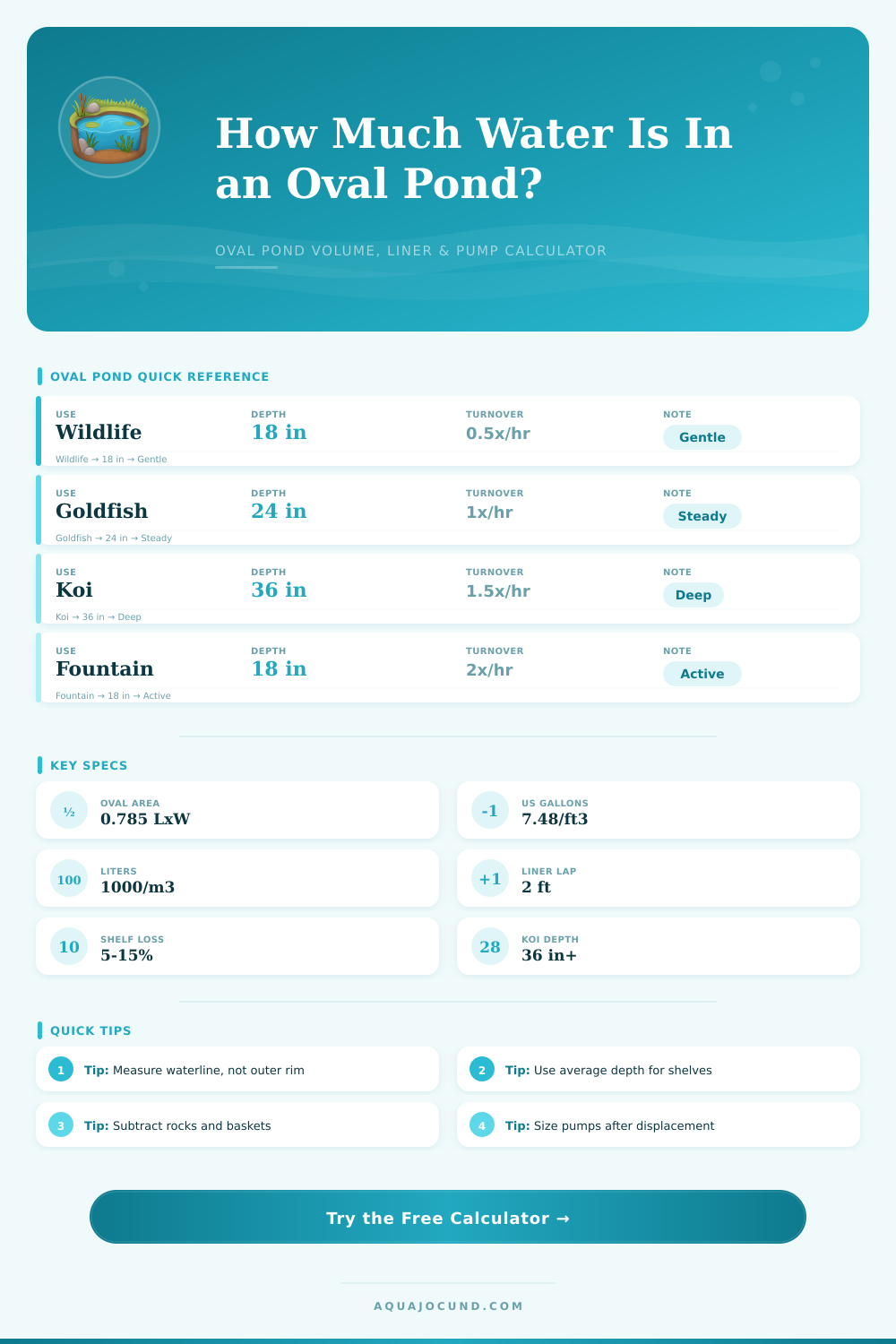
| Wildlife pond | 0.5x volume per hour | 500 gal pond = 250 gph | Gentle movement protects calm zones |
| Water garden | 0.75x volume per hour | 500 gal pond = 375 gph | Good for plants and modest fish loads |
| Goldfish pond | 1x volume per hour | 500 gal pond = 500 gph | Common baseline for small fish ponds |
| Koi pond | 1.5x volume per hour | 1000 gal pond = 1500 gph | Use with proper biological filtration |
| Formal fountain | 2x volume per hour | 500 gal pond = 1000 gph | Supports active water features |
| Allowance Item | Rule of Thumb | Why It Matters | Calculator Use |
|---|---|---|---|
| Length sheet | Length + 2 x depth + 2 ft overlap | Covers bottom, sides, and edge lap | Shown in liner result card |
| Width sheet | Width + 2 x depth + 2 ft overlap | Prevents tight corners and exposed edges | Shown in liner result card |
| Underlayment | Match liner footprint | Protects liner from roots and stones | Use same sheet dimensions |
| Edge material | Oval perimeter + 5-10% | Allows trimming and overlapping edging | Included in breakdown |
| Rock displacement | 5-15% for typical builds | Large stone and baskets reduce water volume | Input field subtracts this amount |
Measure the filled oval at the waterline. If you measure the excavation at the outer rim, subtract the freeboard and any coping overhang before trusting the gallon estimate.
Use the adjusted volume for dechlorinator, beneficial bacteria, medications, and salt. Large rocks, plant baskets, and shallow shelves can remove more water than they appear to.
Calculating the volumes of the oval pond is essential for determining how much material to purchase and what size filtration system are required for the pond. Many people may assume the volume of an oval pond is simply the areas of a circle stretched out to form the dimensions of the pond. However, oval ponds have a specific geometry that makes it difficult to calculate the volume of pond waters.
Furthermore, if people attempt to calculate the volume of the pond using the dimension of the rectangle that completely encloses the pond, the measurements will likely result in a miscalculation of the volume of the pond. If the individual miscalculates the volume of the pond, two possibility exist: either the individual will purchase too many pond materials for the pond, or they will purchase an filtration system for the pond that is too small to effectively circulate the water within the pond. Stagnant pond water that is not appropriately circulated will result in the water within the pond becoming green water.
How to Calculate the Volume of an Oval Pond
To accurately calculate the volume of the oval pond, it is first necessary for the individual to understand the difference between the edge of the pond and the waterline within the pond. Ponds are often measured by taking the dimensions of the edge of the pond, but the water does not ever reaches the edge of the pond; the depth between the waterline and the edge of the pond is called the freeboard of the pond. Furthermore, another consideration is the depth of the pond; many ponds has slopes to their sides rather than vertical edges to the pond.
If the individual ignores the depth of the pond and assumes the pond has vertical edges to the pond, the individual will imagine the amount of water to be greater than the actual amount of water that exist within the pond. An additional factor that affects the volume of the pond is the concept of displacement. The water within the pond is not empty; there are various object that live within the pond and take up the volume within the pond.
Any object that is placed within the water creates a displacement of the water; the object and water cannot fill the same volumes. If the individual ignores the displacement of the objects within the pond when calculating the volume of the water, it is likely that the water volume is miscalculated. If the individual adds medication to the pond based off calculations of the total number of gallon of water within the pond, but that the actual volume of the pond is less due to the displacement of objects, the individual will give the medication to the fish in excess of what is required to treat the issue of the fish.
Another consideration when calculating the volume of the pond is when determining the appropriate size of pump to install into the pond. The turnover rate of the pond is equal to the number of times the volume of the pond pass through the filtration system each hour. The turnover rate of a wildlife pond is much lower than the turnover rate of a koi pond, as koi produce a significant amount of waste.
If the turnover rate is too low with respect to the size of the pond, the ammonia level will increase within the pond. Therefore, an individual must calculate the proper size of pump to ensure that the pond maintains healthy levels of ammonia. Finally, when ordering the pond liner for the pond, the individual must account for the depth of the pond.
The individual must measure the depth of the pond twice; the pond liner will have to go down one side of the pond and up the other side of the pond. Furthermore, the individual has to purchase extra liner to allow for the pond liner to overlap with the remainder of the pond liner. The overlapping of the pond liner will allow for the pond liner to be secured to the coping stone.
If the pond liner isnt the appropriate length, the liner will not be able to hold the ponds water. Therefore, by calculating both the volume of the pond and the dimension of the pond liner necessary to line the pond, the individual will ensure that the pond will function in the way that they have designed it to function.