💧 Pond Turnover Rate Calculator
Compare pond volume, effective pump flow, fish load, waterfall demand, and target turnover in one calculation.
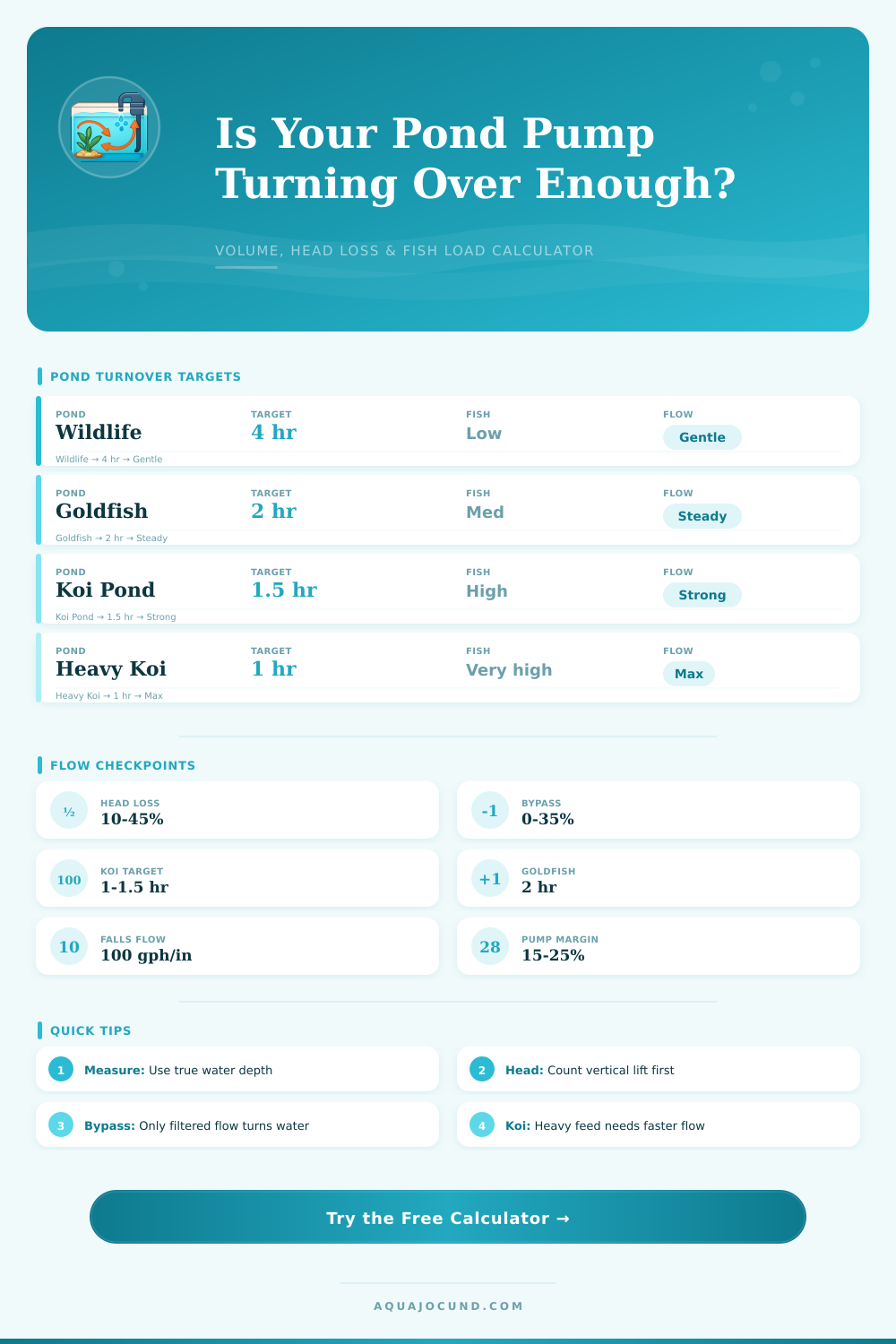
| Pond Type | Base Target | Typical Fish Load | Best Use | Flow Note |
|---|---|---|---|---|
| Wildlife pond | 4 hr | None to very low | Frogs, plants, natural edges | Keep flow gentle |
| Plant pond | 3 hr | Light | Lilies, marginal plants, small fish | Avoid plant disturbance |
| Goldfish pond | 2 hr | Moderate | Common garden pond | Good daily baseline |
| Mixed ornamental | 1.75 hr | Moderate-high | Goldfish plus a few koi | Watch filter capacity |
| Koi pond | 1.5 hr | High | Dedicated koi pond | Use filtered flow |
| Heavy koi pond | 1 hr | Very high | Large koi and heavy feeding | Split circuits help |
| Flow Factor | Common Range | Calculator Input | Why It Matters |
|---|---|---|---|
| Vertical head | 2-8 ft | Head height | Pumps lose flow as lift increases |
| Elbows and valves | 5-32% | Pipe drag | Restrictions reduce real delivered flow |
| Filter resistance | 5-25% | Filter condition | Dirty media lowers turnover |
| Bypass flow | 0-35% | Bypass percent | Only filtered water counts for bio turnover |
| Waterfall branch | 300-3000 gph | Waterfall flow | May require a larger rated pump |
| Fish Load | Target Multiplier | Typical Signs | Recommended Action |
|---|---|---|---|
| Plants / very light fish | 0.8 | Clear water, little feed | Gentle turnover is usually enough |
| Normal stocking | 1.0 | Regular feeding, stable clarity | Use base pond-type target |
| Moderate koi or goldfish | 1.25 | Daily feeding and visible waste | Increase filtered flow |
| Heavy koi feeding | 1.5 | Large koi, frequent feed, high solids | Size pump and filter generously |
| Waterfall Style | Rule Of Thumb | Example Width | Suggested Flow |
|---|---|---|---|
| Quiet sheet | 50 gph per inch | 12 in spillway | 600 gph |
| Garden cascade | 100 gph per inch | 18 in spillway | 1800 gph |
| Strong visual falls | 150 gph per inch | 24 in spillway | 3600 gph |
| Wide koi falls | 200 gph per inch | 36 in spillway | 7200 gph |
For biological turnover, use the flow that actually passes through the filter. A decorative bypass or split waterfall can look strong while the filter circuit remains undersized.
Use the pump curve whenever you have it. The calculator estimates losses, but the rated pump label is usually measured at zero head with clean plumbing.
Pond turnover rate is the measurement of the length of time it takes for the entire volume of the pond to pass through the pond filter once. Understanding the pond turnover rate is important in that this rate will determine how effective the ponds filter can remove waste from the pond while adding dissolved oxygen to the water. Circulation must be provided to the pond to ensure that the water circulate to the bottom of the pond, to prevent waste from accumulating in one location within the pond, and to provide a continuous stream of water to the pond filter.
If a pond dont circulate with sufficient rates, the pond may develop cloudy water within the pond, or the fish living within the pond may become stressed. The rate at which a pond must turn over is based off the type of pond and the amount of organic material that lives and exists within that pond. For instance, a pond that is shallow and use for wildlife habitat and contains mostly plants will have a slower turnover rate than a pond that contains koi fish and that contains organic material; the koi fish create more organic waste and are fed each day.
How to Find Your Pond Turnover Rate
Additionally, the amount of organic material that is added to the pond will also impact the required turnover rate of that pond. The calculator will use the dimensions of the pond as well as the specifications of the pond pump to calculate the turnover rate of the pond. The user will enter the length, width, and depth of the pond into the calculator to calculate the total volume of the pond.
The user will adjust the rating of the pump for the losses of water due to vertical lift, pipe friction, filter resistance, water bypass, and any other factors that may reduce the amount of water that falls through the pond filter. Water that does not pass through the pond filter does not contribute to the biological turnover of the pond. The load of fish within the pond is also a factor that may impact the target turnover rate of the pond.
A pond with a light load of fish will have a gentler turnover rate than a pond with a heavy load of fish or fish that are fed more frequently. Should someone add additional fish to the pond or food provide to the pond fish, it is possible that the turnover rate of the pond may need to be adjusted to prevent the solid waste from the fish from accumulating within the pond. The calculator includes a multiplier that reflects these change in the fish load within the pond.
Another factor to consider is the head loss and the bypass percentage of the pond. These percentages will reduce the actual flow of water in the pond. People often ignore these factors when calculating the turnover rate of a pond since they are not often reflected on the pump label.
For instance, adding a UV filter, using a dirty filter pad, or adding elbows to the waters path can all reduce the flow of water by as much as 15 or 20%. Additionally, any water that is diverted to a waterfall or divided between two pond will also reduce the amount of water that passes through the pond filter. Waterfall flow is also another factor that may impact the volume of water required within the pond.
Waterfalls require more water than the pond filter circuit. Therefore, either two separate pumps can be used for each of these features, or one large pump can be used that incurs higher cost with regard to the electricity required for the pump to perform. Many people make mistake in calculating the turnover rate of their pond.
One of the most common is to select a pond pump based only upon the highest number that is printed on the pump box. Based only on the number on the pump box, it is likely that the amount of waste that must be removed from the pond will overwhelm the pond filter. Another mistake is to only measure the depth of the pond at its deepest point.
Measuring the depth of the pond at only this deepest point will inflate the volume of the pond; using this incorrect volume will make the turnover rate appear to be easier to achieve than it is. Seasonal changes can also impact the turnover rate of a pond. During the warmer months, the water will contain less dissolved oxygen than in colder months, as the fish will be more active in the warmer temperatures, thus creating more waste.
Therefore, the turnover rate for the pond in the summer may not be adequate for fall or winter. Any changes in temperature will require a review of the turnover rate calculations. Additionally, clogged filter media will likewise impact the actual turnover rate of the water in the pond.
The tables that are provided within the calculator help to determine the target turnover times for each type of pond and fish load. Overall, the goal of the calculator is to give an understanding of how close the pond system is to the required turnover rate for that specific pond. It should allow for an understanding of the necessary adjustments that must be made to the system in order to return to the target turnover rate.
If the initial sizing of the pond pump allows for some margin for losses in the system due to head loss, bypass, and the growth of fish in the pond, the system will remain effective for a longer period of time. The calculator allows for the user to become aware of these different trade-offs and to make decisions based upon these calculations rather than guesses as to the adjustments that are necessary.