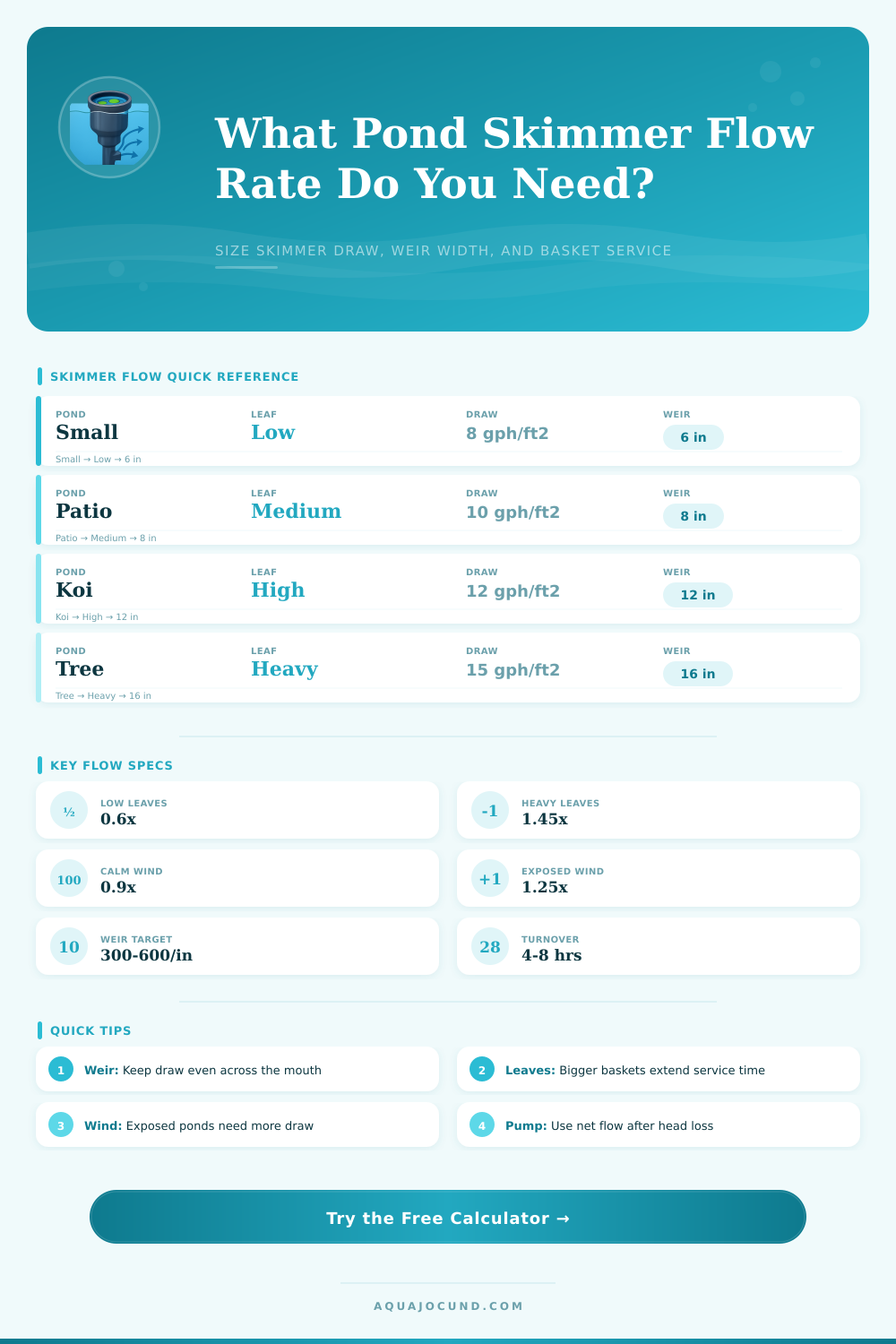
🌊 Pond Skimmer Flow Rate Calculator
Estimate skimmer pump flow, weir loading, basket service interval, and pond turnover contribution.
| Condition | Multiplier | Typical Draw | Basket Planning | Use Case |
|---|---|---|---|---|
| Very Low Leaf Load | 0.65 | 8 gph/sq ft | Long interval | Formal pond, open patio |
| Low Leaf Load | 0.85 | 8-10 gph/sq ft | Normal interval | Few marginal plants |
| Moderate Leaf Load | 1.00 | 10-12 gph/sq ft | Check weekly | Typical water garden |
| High Leaf Load | 1.20 | 12-15 gph/sq ft | Large basket | Near shrubs or one tree |
| Heavy Leaf Load | 1.45 | 15+ gph/sq ft | Frequent service | Canopy or autumn drop |
| Weir Width | Low Flow | Balanced Flow | Upper Flow | Notes |
|---|---|---|---|---|
| 6 in / 15 cm | 1200 gph | 2400 gph | 3600 gph | Small garden ponds |
| 8 in / 20 cm | 1600 gph | 3200 gph | 4800 gph | Common compact skimmer |
| 10 in / 25 cm | 2000 gph | 4000 gph | 6000 gph | Medium water gardens |
| 12 in / 30 cm | 2400 gph | 4800 gph | 7200 gph | Koi and larger ponds |
| 16 in / 41 cm | 3200 gph | 6400 gph | 9600 gph | High debris surfaces |
| Pond Type | Surface Area | Volume | Suggested Weir | Typical Skimmer Draw |
|---|---|---|---|---|
| Patio Lily Pond | 40 sq ft / 3.7 sq m | 300 gal / 1135 L | 6 in / 15 cm | 350-700 gph |
| Courtyard Goldfish | 90 sq ft / 8.4 sq m | 900 gal / 3407 L | 6-8 in / 15-20 cm | 800-1300 gph |
| Water Garden | 180 sq ft / 16.7 sq m | 1800 gal / 6814 L | 8-10 in / 20-25 cm | 1800-3000 gph |
| Medium Koi Pond | 280 sq ft / 26 sq m | 4000 gal / 15142 L | 10-12 in / 25-30 cm | 3200-5200 gph |
| Large Koi Pond | 520 sq ft / 48.3 sq m | 9000 gal / 34069 L | 12-16 in / 30-41 cm | 6000-10000 gph |
| Turnover From Skimmer Flow | Meaning | Typical Result | Adjustment |
|---|---|---|---|
| Under 4 hours | Strong circulation | Good surface pull | Check weir and fish comfort |
| 4-8 hours | Balanced contribution | Common target | Works for many garden ponds |
| 8-12 hours | Light contribution | May still skim well | Confirm debris reaches mouth |
| Over 12 hours | Weak circulation share | Possible dead zones | Add draw, jets, or second skimmer |
A pond skimmer only functions correct when the apropiate volumes of water reaches the mouth of the pond skimmer. The volume of water that should pass through the pond skimmer are based off the surface area of the pond, the amount of debris in the pond, and the amount of wind exposure that the pond has. Many pond owners will buy a pond skimmer pump based on the number of gallon that the pump can move.
However, they will often forget that any debris that is floating on the pond will move sideways across the pond surface prior to the floating debris move downward into the skimmer. Therefore, pond skimmers must create a gentle pull across the entire surface area of the pond. If they dont do so correctly, the debris may load into the basket of the pond skimmer each day, or the pond skimmer may cause the ponds debris to become trapped in one corner of the pond.
How to Size and Use a Pond Skimmer
The surface area of the pond will determine the pond skimmers baseline. Every square foot of the ponds surface area require a specific amount of draw from the pond skimmer to successfully move the ponds debris. For instance, the pond skimmer will have a lower flow rate if it is located on a sheltered patio than if it is under a maple tree that sheds its leaf.
In open yards, the wind will push the ponds debris away from the pond skimmer. Therefore, owners will have to increase the target flow rate that passes through the pond skimmer. Calculators can be used to test these changes, and they will mathematicaly change the recommended flow rate for the pond skimmer.
The width of the weir gate is another factor that determines the success of a pond skimmer. If the weir gate is narrow but the pond pump have a high flow rate, the skimmer will pull air into the system. With the same logic, if the weir gate opening is too wide for the pond pump with a low flow rate, the pump will not effectively move the pond debris from the corners of the pond.
The pond skimmer calculator will let the pond owner know if the debris load per inch of weir gate is outside of the recommended parameter. Based on this message, the pond owner will be able to determine if the pond skimmer will effectively function during the season or if the weir should be widened before the pond season begins. The basket size of the pond skimmer and the season in which the pond experiences debris have a relationship to one another.
The pond will experience a significant amount of leaves and pollen during certain month of the year. In autumn, the basket may become full with the leaves between visits to the pond. However, the same small basket may last several week during spring.
Using the pond skimmer calculator, the pond owner can determine how often the basket will become full of debris. The calculator will show you the service interval for your pond skimmer in terms of hour or in days. The results will allow you to see if using a larger basket will save you time, or if moving the pond skimmer closer to the source of the leaves will be more beneficial.
Turnover contribution is a factor that many people do not consider when establishing their pond system. If the pond skimmer turns over the water in the pond every six hour, for instance, it will only pull the top few inches of the pond. The remainder of the pond must be circulation through the returns or the bottom drains of the pond.
If the turnover time for the pond is high, the pond skimmer is likely performing some light cleaning duty for the pond only. The pump may serve the filter and the waterfall in the pond. Such a system is acceptable if the surface of the pond is kept clean.
However, if the turnover time is short for the pond, the pond skimmer likely is responsible for the majority of the circulation of the pond. In this case, the comfort of the fish must be consider, as well as the potential for the returns to fight against the pond skimmers circulation of the pond. Pond systems are rarely built to the theoretical measurements stated for the equipment.
Any pipe that are used to circulate the water in the pond will lead to a loss of head for the pump, especially at the points in which the water changes direction within the pond. Additionally, any pump that is rated for a head of zero will not reach that measurement when connected to the plumbing of the pond. To account for this potential loss, the calculator asks for the actual flow of the pond pump, not the flow that is represented for the pump model.
The flow can be tested by placing a bucket at the outlet of the pond skimmer and measuring the amount of time that it takes to fill that bucket. By entering that measurement into the calculator, the user can determine if any changes are needed to the system. Many pond owners do not realize the potential for a mismatch between the pump and the pond skimmer until the leaves begin to cover the portion of the pond that is the most distant from the pond skimmer.
While the surface of the pond may appear to be agitated due to the functioning of the pond skimmer, the leaves will still settle on the leaves on the far side of the pond. Adding to the weir of the pond or adding a second pond skimmer are solutions that often work best for this problem. A return that works against a narrow mouth of a pond skimmer will tend to suck in air, whereas the extra water from the increased flow will accomplish the desired result of moving the leaves.
Both the total flow target and the flow of each pond skimmer can be viewed with the calculator to allow pond owners to consider their option. The goal for any pond system is not to strive for the maximum flow that the pump can produce. Rather, the circulation of the pond should be even throughout the pond, and the surface should remain clear of leaves between service visits.
The rest of the system should have enough reserve for the filter or other feature in the pond. By entering the actual flow of the pond in the calculator, pond owners can ensure that the pond skimmer will accomplish its job, and that the balance of the remaining parts of the pond system will remain intact.