💧 Pond Pump Head Height Calculator
Estimate total dynamic head, required flow, pipe friction, fittings, and pump curve targets for ponds, filters, streams, and waterfalls.
✅ Pump Sizing Result
| Inside Diameter | 500 gph | 1000 gph | 2000 gph | 4000 gph | Best Use |
|---|---|---|---|---|---|
| 3/4 in | 1.8 ft/100 | 6.6 ft/100 | 23.8 ft/100 | 86+ ft/100 | Small fountains only |
| 1 in | 0.5 ft/100 | 1.8 ft/100 | 6.4 ft/100 | 23+ ft/100 | Small ponds and short runs |
| 1-1/2 in | 0.1 ft/100 | 0.3 ft/100 | 1.1 ft/100 | 4.0 ft/100 | Most waterfall returns |
| 2 in | 0.0 ft/100 | 0.1 ft/100 | 0.3 ft/100 | 1.2 ft/100 | Koi ponds and long runs |
| 3 in | 0.0 ft/100 | 0.0 ft/100 | 0.0 ft/100 | 0.2 ft/100 | Gravity and high-flow systems |
| Feature Style | Flow Rule | 12 in Spillway | 24 in Spillway | Visual Result |
|---|---|---|---|---|
| Trickle stream | 75 gph per inch | 900 gph | 1800 gph | Soft movement over stones |
| Gentle sheet | 100 gph per inch | 1200 gph | 2400 gph | Thin continuous curtain |
| Medium waterfall | 150 gph per inch | 1800 gph | 3600 gph | Fuller sound and coverage |
| Strong waterfall | 200 gph per inch | 2400 gph | 4800 gph | Heavy whitewater effect |
| Pipe Size | 90 Elbow | 45 Elbow | Ball Valve | Union | Calculator Assumption |
|---|---|---|---|---|---|
| 3/4 in | 2 ft | 1 ft | 5 ft | 1 ft | 2.1 ft each fitting |
| 1 in | 2.7 ft | 1.4 ft | 6 ft | 1.2 ft | 2.7 ft each fitting |
| 1-1/2 in | 4 ft | 2 ft | 8 ft | 1.8 ft | 4 ft each fitting |
| 2 in | 5.5 ft | 2.8 ft | 10 ft | 2.5 ft | 5.5 ft each fitting |
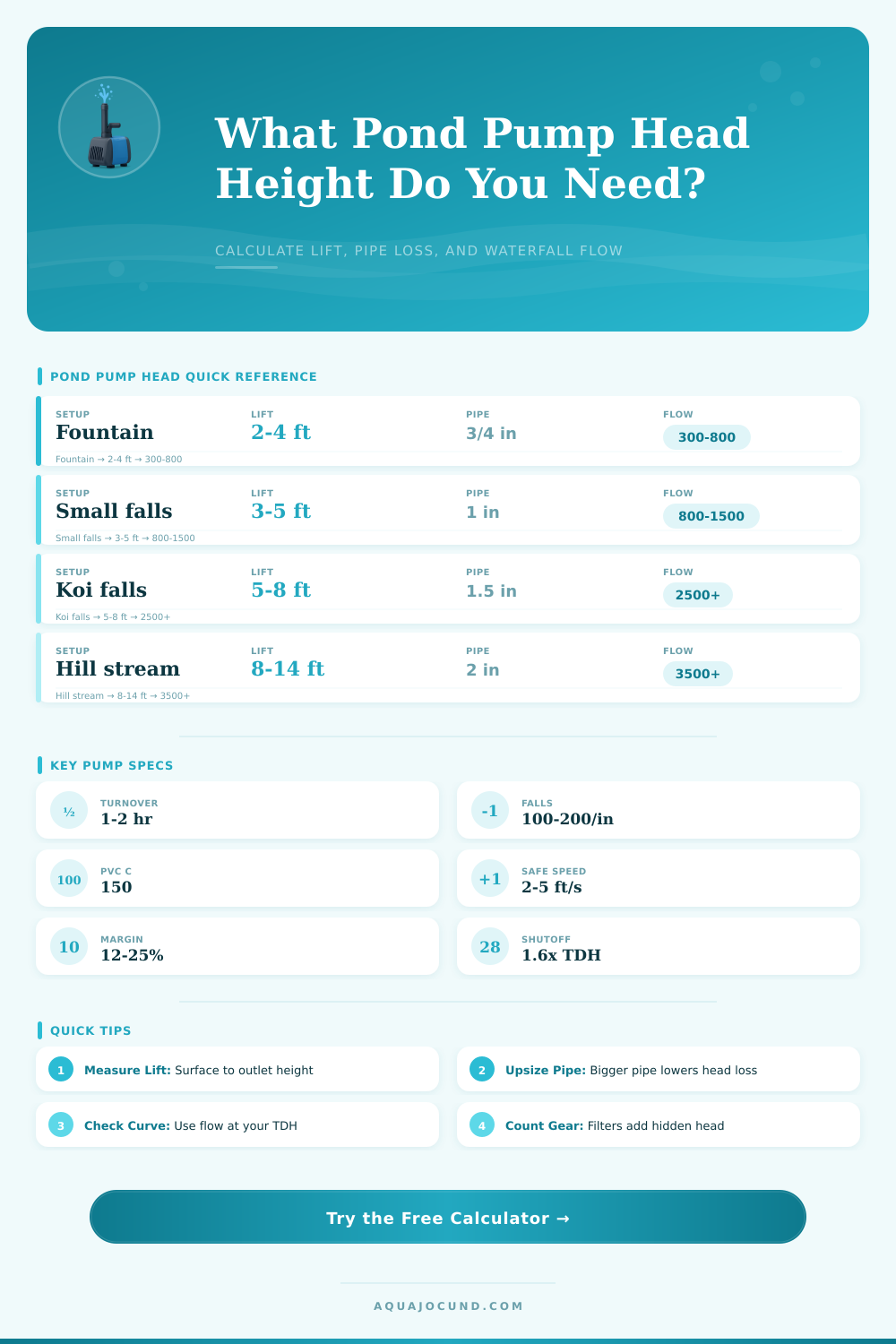
| Pond Scenario | Typical Lift | Target Flow | Pipe Size | Head Sizing Note |
|---|---|---|---|---|
| Small fountain bowl | 1-3 ft | 150-500 gph | 1/2-3/4 in | Flow control matters more than friction |
| 500 gal patio pond | 3-5 ft | 500-1000 gph | 3/4-1 in | Check small tubing loss on long routes |
| 1500 gal koi pond | 4-7 ft | 1500-3000 gph | 1-1/2 in | Filter pressure often dominates |
| Wide waterfall | 5-9 ft | 3000-6000 gph | 2 in | Use pump curve at actual TDH |
| Long garden stream | 6-12 ft | 2500-5000 gph | 2 in | Pipe length and valves add quickly |
Static lift is only the start. The pump still has to overcome pipe friction, elbows, filter restriction, UV units, check valves, and the reserve needed to keep flow from collapsing as the system gets dirty.
Do not size by the box headline alone. A pump advertised as 3000 gph may deliver far less at 8 ft of total dynamic head, so compare the result here with the manufacturer's flow-at-head curve.
When building a pond, calculating the correct pump size is essential to ensure that the water from the pond flow correctly. Many individual make the mistake of selecting a pond pump based on the maximum flow rate indicated on the pump box. For instance, if the flow rate of a pump are 3,000 gallons per hour, an individual might believe that the pump will always move 3,000 gallon of water per hour.
However, pumps do not always move the maximum amount of water due to the head height that the pump must overcome. The head height for a pond pump is the total amount of resistance that the pump must overcome to move the water from the pond to the point of water exit. The head height for pond pumps consist of the vertical lift of the pump, the friction loss of the water moving through the tubing, and the resistance created by various fittings in the system.
How to Choose the Right Pond Pump
The vertical lift of a pump is the distance from the water’s surface in the pond to the highest point where the water will exit the pond. Additionally, friction loss occur when the water rubs against the walls of the tubing. The longer the tubing and the narrower the diameter of the tubing, the more frictionly loss will occur.
If an individual use a narrow pipe to move the water from the pond, the water will travel faster through that section of the pipe. As a result, there will be an increased amount of friction loss. This friction loss will act as a bottleneck to the system, reducing the amount of water the pump can move through the system.
Various fitting in a pond system also create resistance for the water to overcome. For instance, each elbow or joint in the system will create turbulence in the system. A single ninety-degree elbow can create the same resistance than several feet of the system having no fittings.
Therefore, each elbow in the system will increase the head height that the pump must overcome. Another factor that will reduce the flow of water is the various pieces of equipment in the pond system. For instance, a skimmer will create less resistance than a pressurized bead filter or a UV sterilizer.
Both of these equipment piece will increase the head load of the system. This equipment will reduce the amount of water that the pump can move. This resistance will be hidden from observation in the system, but it is still present.
Additionally, as the filter media collect debris from the water, the resistance will increase. Therefore, it is necesary to account for this head load so that there is a safety margin if the filter media does become dirty. If an individual combine all of the different variables that contribute to the head height of a pond system, such as the vertical lift of the pump, the friction loss in the system, the resistance created by the system’s various fittings, and the head load of the system’s equipment, an individual will arrive at a number that is the total dynamic head of the system.
The total dynamic head of a pond system is the total amount of feet of resistance the pump must overcome to move the water through the system. Instead of looking at the flow rate of the pump when purchasing the pump, the individual should look at the pump curve for the pump. The pump curve for a pump will indicate how many gallon of water a pump will move at specific heights of head height for that pump.
For instance, if an individual calculates that the total dynamic head is 10 feet, then that individual must find the flow rate of the pump at 10 feet of head height. The pump will move less water at 10 feet of head height than when the head height are 0 feet. The width of the waterfall that is part of the pond system is another factor that will dictate the amount of water that is required to create the desired visual effect in the pond.
For instance, a wide spillway will require a higher flow rate of water to create the same visual effect as a narrow spillway. Therefore, an individual must calculate the flow rate based off the width of the waterfall the system will create. By balancing all of the factors that contribute to the head height of the system, such as the width of the waterfall, the pipe diameter, the vertical lift of the pump, and the equipment load in the system, an individual will be able to select the correct pump for the pond system.
Selecting the correct pump for the pond system will ensure that the pump provide enough flow to the systems various elements while operating the pump at an efficient rate. Youll also need to make sure youre choosing a pump that can handle the actualy demands of the setup. It could of been a easier process if the head height wasnt so complicated, but it’s just part of the job.
All of the furnitures in the area should be moved before you start. Dont forget that the pump curve is more better than just guessing. A lot of people dont realize how much friction loss happens.
Most people thinks the pump will work, but it wont. Selecting the right pump is more important than almost anything else.