🐟 Pond Fish Feeding Rate Calculator
Estimate feed by fish biomass, species, temperature, season, pellet protein, and waste load.
Calculation Breakdown
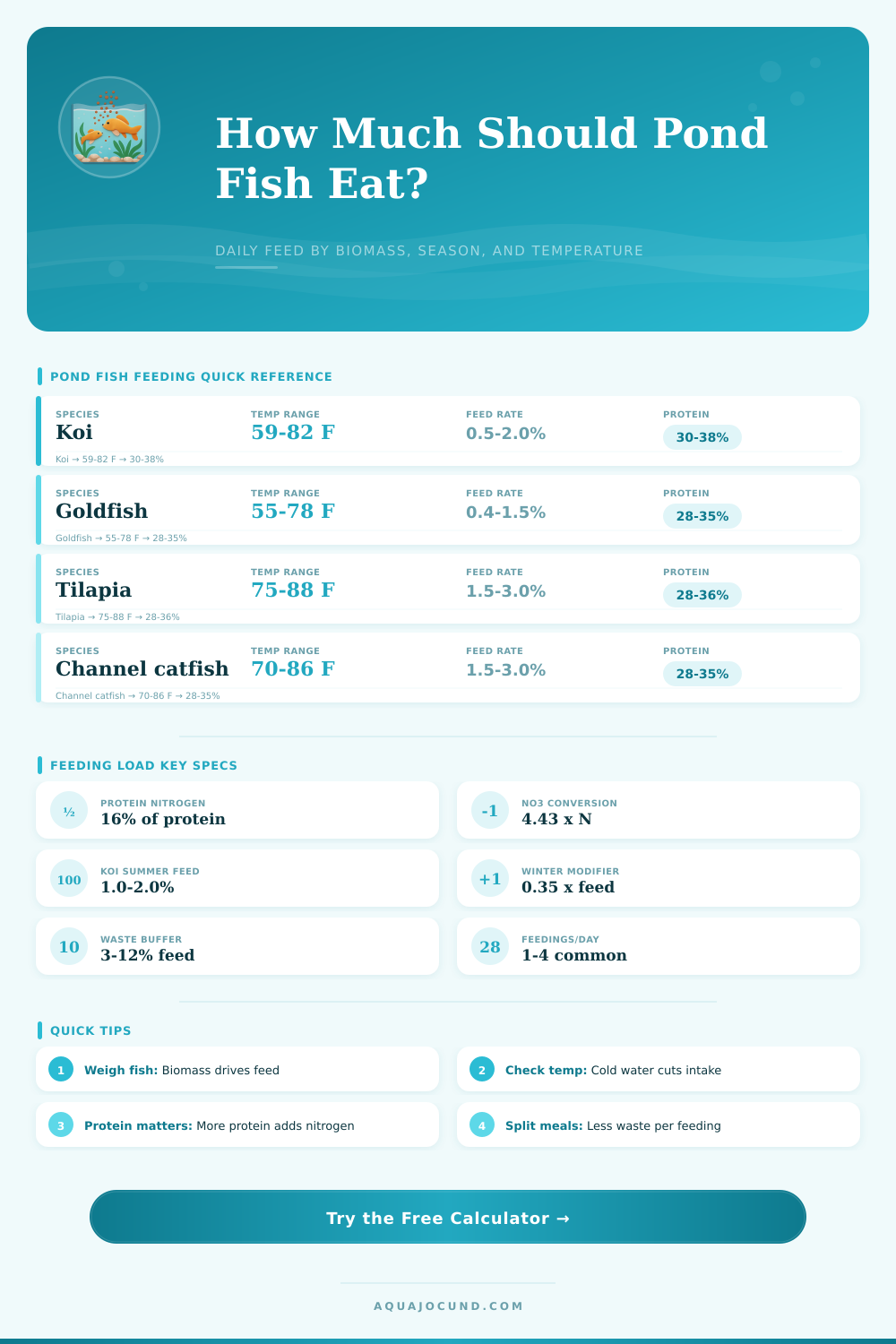
| Species | Best temp | Typical feed % | Protein guide | Common feedings/day |
|---|---|---|---|---|
| Koi | 59-82°F / 15-28°C | 0.5-2.0% | 30-38% | 1-4 |
| Goldfish | 55-78°F / 13-26°C | 0.4-1.5% | 28-35% | 1-3 |
| Tilapia | 75-88°F / 24-31°C | 1.5-3.0% | 28-36% | 2-5 |
| Channel catfish | 70-86°F / 21-30°C | 1.5-3.0% | 28-35% | 1-2 |
| Trout | 50-65°F / 10-18°C | 1.0-2.5% | 38-45% | 2-5 |
| Common carp | 64-82°F / 18-28°C | 1.0-2.2% | 25-32% | 1-3 |
| Bluegill / sunfish | 68-84°F / 20-29°C | 1.0-2.5% | 32-40% | 1-3 |
| Mixed ornamental | 60-80°F / 16-27°C | 0.5-1.5% | 28-36% | 1-3 |
| Pellet type | Protein used | Best fit | Nitrogen effect |
|---|---|---|---|
| Wheat germ pond pellet | 28% | Cool seasons, koi, goldfish | Lower load per lb of feed |
| Maintenance pond pellet | 32% | Adult ornamental fish | Moderate load |
| Growth pond pellet | 36% | Active growing season | Moderate-high load |
| Koi color pellet | 38% | Warm season koi | Higher load |
| Floating catfish feed | 32% | Catfish ponds | Moderate load |
| Tilapia grower pellet | 34% | Warmwater growout | Moderate-high load |
| High protein trout pellet | 42% | Trout and coolwater growth | Highest load in this table |
| Pond scenario | Biomass | Feed rate | Daily feed | Typical split |
|---|---|---|---|---|
| Koi display, light stock | 25 lb / 11.3 kg | 1.0% | 0.25 lb / 113 g | 2 meals |
| Koi summer growth | 60 lb / 27.2 kg | 1.8% | 1.08 lb / 490 g | 3 meals |
| Goldfish garden pond | 12 lb / 5.4 kg | 0.9% | 0.11 lb / 49 g | 1-2 meals |
| Tilapia growout pond | 220 lb / 99.8 kg | 2.4% | 5.28 lb / 2.39 kg | 3-5 meals |
| Catfish farm pond | 500 lb / 226.8 kg | 2.0% | 10.0 lb / 4.54 kg | 1-2 meals |
| Trout raceway / pond | 80 lb / 36.3 kg | 1.6% | 1.28 lb / 581 g | 3-5 meals |
| Condition | Multiplier | Use when | Effect on feed |
|---|---|---|---|
| Below active range | 0.25× | Fish are sluggish or near seasonal fasting | Large reduction |
| Cool edge of range | 0.55× | Fish feed, but digestion is slow | Reduced ration |
| Best feeding range | 1.00× | Species is in its normal active temperature band | Full planned ration |
| Hot stress range | 0.65× | Water is above the species comfort range | Reduced ration |
| Spring season | 0.85× | Appetite is returning after cold water | Gentle ramp up |
| Summer season | 1.00× | Active feeding period | Baseline ration |
| Fall season | 0.75× | Preparing to taper feeding | Moderate reduction |
| Winter season | 0.35× | Cold water maintenance period | Strong reduction |
Feeding fish in your backyard pond requires you to determine the correct amount of food to provide the fishes each day. While the size of the fish in the pond or the size of the pond itself may be a contributing factor to the amount of food that should be provided to the fish each day, there are actualy a variety of factors that contribute to the feeding of the fish. If you dont take into consideration each of these factors, you may feed the fish either too much or too little food.
Providing too much food to the pond can lead to the growth of algae or the increase in nitrate levels in the water. Providing too little food to the pond can lead the fish to not get the necessary nutrition to maintain there condition. One of the factors that should be considered is the temperature of the waters in the pond.
How to Feed Fish in Your Pond
Factors that relates to the temperature of the water include the metabolism of the fish, the activity of the fish, and the rate at which they digest the food. For instance, if the temperature of the water is low (such as in the low fifties), the fish will move slow and digest their food slowly. As a result, the fish will require less food if the temperature of the water is low.
However, if the temperature of the water increase, the metabolism of the fish will increase along with the amount of food that is required to fuel there increased metabolism. If the temperature becomes too high for the fish, however, there appetite will tend to decrease. Thus, the temperature of the water in the pond is one of the factors that should be considered when feeding the fish.
Another factor that should be considered is the time of year in which the fish are being fed. In the spring and summer, the appetite of the fish increases, but in the fall and winter, the appetite of the fish decrease. If an individual chooses to feed the fish a fixed amount of food each day, ignoring the change in the appetite of the fish throughout the year, the fish can be overfed during the fall and winter months and underfed during the spring and summer months.
Thus, using a calculator that considers the time of year can help to avoid feeding the pond either too much or too little food to the fish. Another factor that should be considered is the protein level of the food that is provided to the fish. Food that contains a higher level of protein will contain more nitrogen than food that contains a lower level of protein.
The fish will eventually consume the nitrogen from the food and it will become nitrate in the pond. Thus, providing food with a higher protein level (which increases the amount of nitrogen in the pond) will lead to increased nitrate levels in the water compared to feeding the fish with food that contains a lower protein level. Therefore, feeding the fish with food that contains a lower protein level may be preferred for those who wish to reduce the amount of waste in their pond and the frequency with which the pond must be changed.
Another factor that should be considered is the biomass of the fish in the pond. The biomass of the fish is the total weight of the fish in the pond. If an individual does not accurately calculate the amount of biomass of the fish in the pond, the fish can be underfed or overfed.
For instance, if a group of koi fish weighs twenty-five pounds in the spring, the group may weigh thirty-five pounds in the summer. Thus, if an individual calculates the biomass based off old information, the fish will be underfed. Periodically weighing a sample of the fish in the pond will enable an individual to calculate the accurate biomass of the fish in the pond.
Another factor that should be considered is the amount of uneaten food and waste from the fish. If you observe the food in the pond, some of it may remain uneaten by the fish. Additionally, the fish will not be able to digest all of the food that is provided to them.
As a result, there will always be a percentage of waste from the fish. Thus, in order to accurately calculate the amount of waste in the pond, an individual should use a calculator to account for this percentage of fish wastes. Another factor in the feeding of the fish is the volume of the pond itself.
A small volume of water will allow for the increase of nitrate levels at a faster rate than a large volume of water. Thus, the volume of the pond is one of the factors that should be considered when determining how much food to provide to the fish each day. Common mistakes are made in the feeding of the fish in ponds.
For instance, individuals may choose to treat one factor in the feeding of the fish as a fixed factor. Factors that may be ignored in this fashion include the temperature of the water in the pond, the amount of biomass in the pond, and the volume of the pond itself. If these factors are ignored or ignored in relation to one another, an individual may experience problems in relation to the feeding of the pond.
Overfeeding the fish in the pond will lead to the growth of algae or cloudy water in the pond. Underfeeding the pond will lead to slow growth in the fish in the pond. Thus, an individual should of used a reference table to determine if the feeding rate for the fish in the pond is within the expected parameters of the species of fish that is contained within the pond.
In providing food to the fish in the pond, the goal is to ensure that the fish are provided with the amount of food that will maintain their condition and encourage them to grow. One factor that should be avoided is feeding the fish with extra pellets of food. If an individual calculates the amount of food to be fed to the fish each day according to the current temperature of the pond, the current season in which the pond is established, and the amount of waste that exists in the pond, an individual will find a target amount of food for the fish to consume each day.
Feeding the fish with this amount of food will ensure that there needs is met while avoiding overwhelming the ponds ability to process the waste from the fish.