⛏ Pond Excavation Soil Volume Calculator
Estimate in-place cut volume, loose spoil after soil swell, truckloads, haul weight, and footprint area before digging a pond basin.
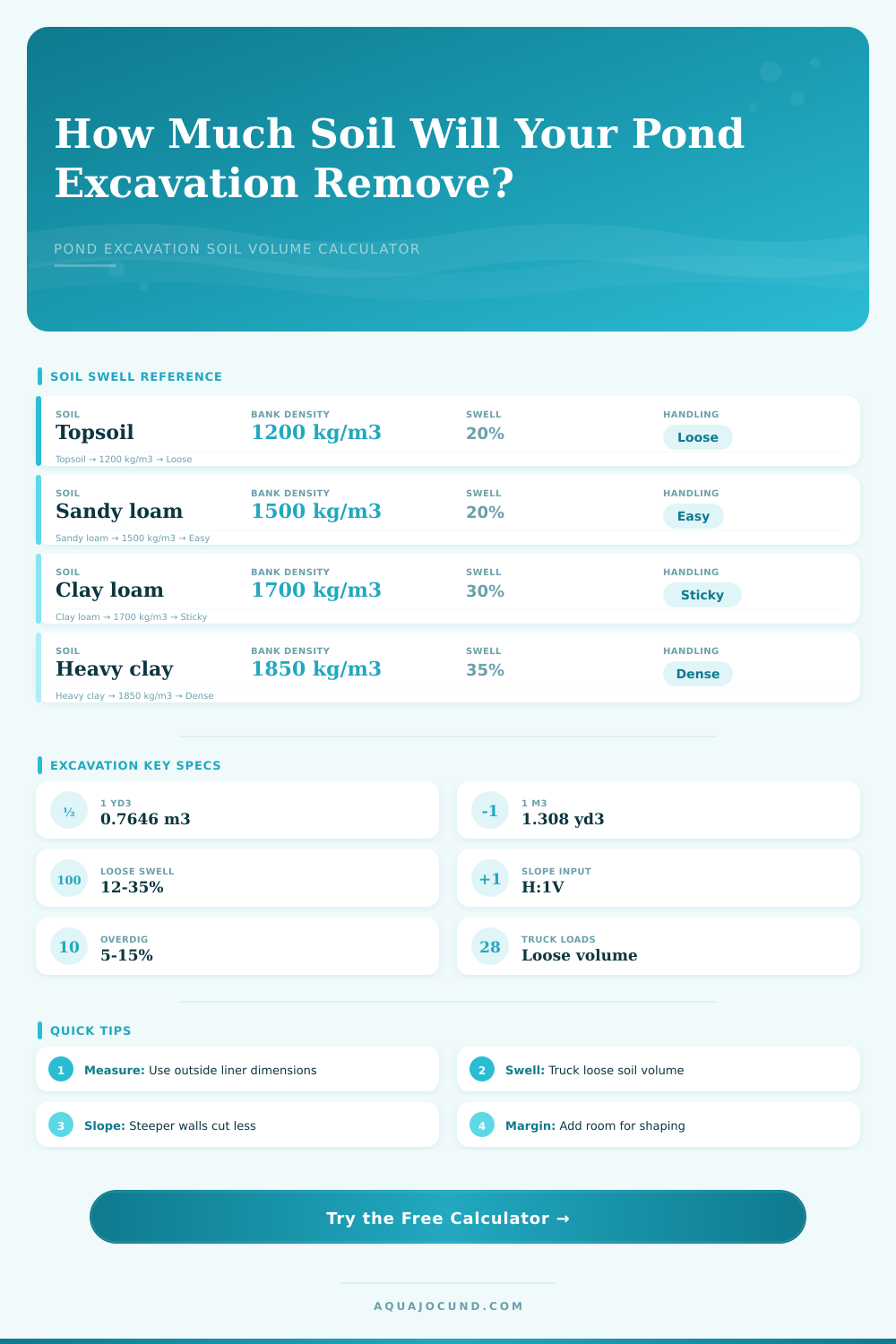
| Soil Type | Bank Density | Loose Swell | Excavation Note |
|---|---|---|---|
| Topsoil / organic loam | 1200 kg/m³ | 20% | Light material; roots and sod can increase pile bulk. |
| Dry sand | 1600 kg/m³ | 12% | Low cohesion; use gentle slopes when unsupported. |
| Damp sand | 1760 kg/m³ | 15% | Heavier than dry sand with modest bulking. |
| Sandy loam | 1500 kg/m³ | 20% | Common pond garden soil with moderate spoil swell. |
| Silt loam | 1450 kg/m³ | 25% | Can loosen sharply when handled wet. |
| Clay loam | 1700 kg/m³ | 30% | Good shape holding, but higher loose spoil volume. |
| Heavy clay | 1850 kg/m³ | 35% | Dense loads; watch truck weight before filling by volume. |
| Gravelly soil | 1900 kg/m³ | 15% | High weight per bucket with lower volume swell. |
| Pond Example | Top Dimensions | Depth | Approx. In-Place Cut | Loose Spoil at 20% Swell |
|---|---|---|---|---|
| Patio bowl | 6 ft round / 1.8 m | 1.5 ft / 0.46 m | 1.2 yd³ / 0.9 m³ | 1.4 yd³ / 1.1 m³ |
| Wildlife oval | 10 x 7 ft / 3.0 x 2.1 m | 2 ft / 0.61 m | 3.0 yd³ / 2.3 m³ | 3.6 yd³ / 2.8 m³ |
| Starter koi pond | 12 x 8 ft / 3.7 x 2.4 m | 3 ft / 0.91 m | 7.3 yd³ / 5.6 m³ | 8.8 yd³ / 6.7 m³ |
| Formal rectangle | 14 x 8 ft / 4.3 x 2.4 m | 3 ft / 0.91 m | 9.6 yd³ / 7.3 m³ | 11.5 yd³ / 8.8 m³ |
| Large garden pond | 18 x 12 ft / 5.5 x 3.7 m | 3.5 ft / 1.07 m | 18.4 yd³ / 14.1 m³ | 22.1 yd³ / 16.9 m³ |
| Factor | Common Range | Calculator Input | Why It Matters |
|---|---|---|---|
| Side slope | 0.25:1 to 2:1 | Run per 1 depth | Gentle slopes remove more soil but are easier to line and stabilize. |
| Planting shelf | 0-2 ft / 0-0.6 m wide | Shelf width and depth | Shelves reduce deep-basin cut while adding shallow ledge area. |
| Overdig allowance | 5-15% | Allowance dropdown | Accounts for trimming, liner wrinkles, coping edge, and uneven ground. |
| Swell factor | 12-35% | Loose soil swell | Loose excavated soil occupies more space than the original bank volume. |
| Haul planning | By loose volume and weight | Truck capacity plus density | Clay and gravel can reach weight limits before the bed looks full. |
First there’s the vision of the pond (fish swimming in deep end); lily pads everywhere. Then there are the purchases, the decorative rocks, the pump, and the liner. Rarely do you think about the soil.
After all, it’s just dirt, right? Wrong. When you gets down to digging, you realize that soil can have some serious weight and can shift around. The landscape project turn into a logistical nightmare. What started out as a simple pond-building venture quickly turns into an exercise in moving earth from point A to point B to a point C (the disposal site). And most people forgets that fact. They overestimate the volume of the hole, but grossly underestimate volume of the pile. That’s where the difference come in.
Why Soil Gets Bigger When You Dig It
When you dig up soil, it EXPANDS. That’s the physical fact that surprise so many people. Time and gravity has compacted the dirt in your yard. After you break it loose, it will expand to take up more space. They call this swell. It’s simple enough logic; the calculator does the math. For example, if you have a cubic yard of clay in the ground, once it’s dug out it may become one and a third cubic yards. Sand swells less. Clay swells more. Topsoil falls somewhere in between.
So if you don’t allow for the expansion of soil in your calculations, you’ll end up with a bigger-than-expected pile, and require more truckloads then you’d planned.
It all depends on shape of pond. Dirt saved: Vertical wall. It is not easy to line. It will crumble without solid ground. A better slope is safer and more better for wildlife. More dirt removed.
Here’s how the tool adjust for that. The slope on the sides varies. A steeper slope mean less volume but harder work. A shallower slope means more volume, which is easier but requires more total area to be excavated. Then there are shelves; those flat spots where you want to grow things. That makes a complex geometric shape. Fewer cuts in deep basin. But there is a larger total area of excavation. There’s a give-and-take about making a shallow basin versus a narrow basin. The tool builds in the options so you don’t have to figure it out.
The budget usually busts here: Hauling. The mini-excavator will do the digging for you. But you’re gonna have to haul the dirt out. And you’ll want to haul it on a small trailer (obviously). So you’d better know how much the dirt expands and how many trips that’s going to add up to. A six cubic yard trailer may look good. But what if you’ve got thirty percent swell on some heavy clay? You might fill it to the top but hit weight limit first. Clay is VERY dense when wet. It can snap a trailer axle right off if you don’t pay attention.
Know your soils. Each one has an expected swell and density shown in the reference table. Plan accordingly based off this information. Don’t just guess at weight.
There is an overdig allowance. No dig’s ever perfect. You’ll trim some corners, smooth others. You’ll find some rocks that will require digging around. Ten to fifteen percent more than the finished volume isn’t being pessimistic. It’s realistic. It eliminates the need for a second truckload at some future date. The additional dirt is part of the plan.
Calculate the exterior dimensions (width of shelf plus overhang of liner). Don’t cheat yourself regarding the type of soil. If uncertain: figure it to be heavier and more swellier than anticipated. Running out of capacity mid-dig is far harder then building for excess. You should of planned for extra space.
Building a pond is work, and it’s also about design. The beauty comes from water and the plants. Thank the dirt for making all this possible, because without respecting the ground, nothing here would work. This is no light soil; it swells up, and it’s so heavy. Know your plan first, get the math correct before starting to dig. And then have fun with it.