💧 Pond Dye Dose Calculator
Estimate pond acre-feet, initial dye amount, first-application split, and maintenance refresh dose from pond dimensions and dye strength.
✅ Pond Dye Dose Results
| Dye Type | Calculator Rate | Output Unit | Typical Tint | Best Use |
|---|---|---|---|---|
| Standard Liquid Blue | 1 qt per acre-ft | quarts and gallons | Blue | General pond shading |
| Standard Liquid Black | 1 qt per acre-ft | quarts and gallons | Black-blue | Reflective or natural-looking ponds |
| Double Strength Liquid | 0.5 qt per acre-ft | quarts and gallons | Blue or black | Lower liquid handling volume |
| Super Concentrate | 0.25 qt per acre-ft | quarts and ounces | Strong tint | Small measured applications |
| Soluble Powder Packet | 1 packet per acre-ft | packets | Blue or black | Clean handling and broad casting |
| Small Pond Packet | 4 packets per acre-ft | packets | Blue | Water gardens and small basins |
| Pond Size | Average Depth | Acre-Feet | Gallons | Standard Liquid Dose |
|---|---|---|---|---|
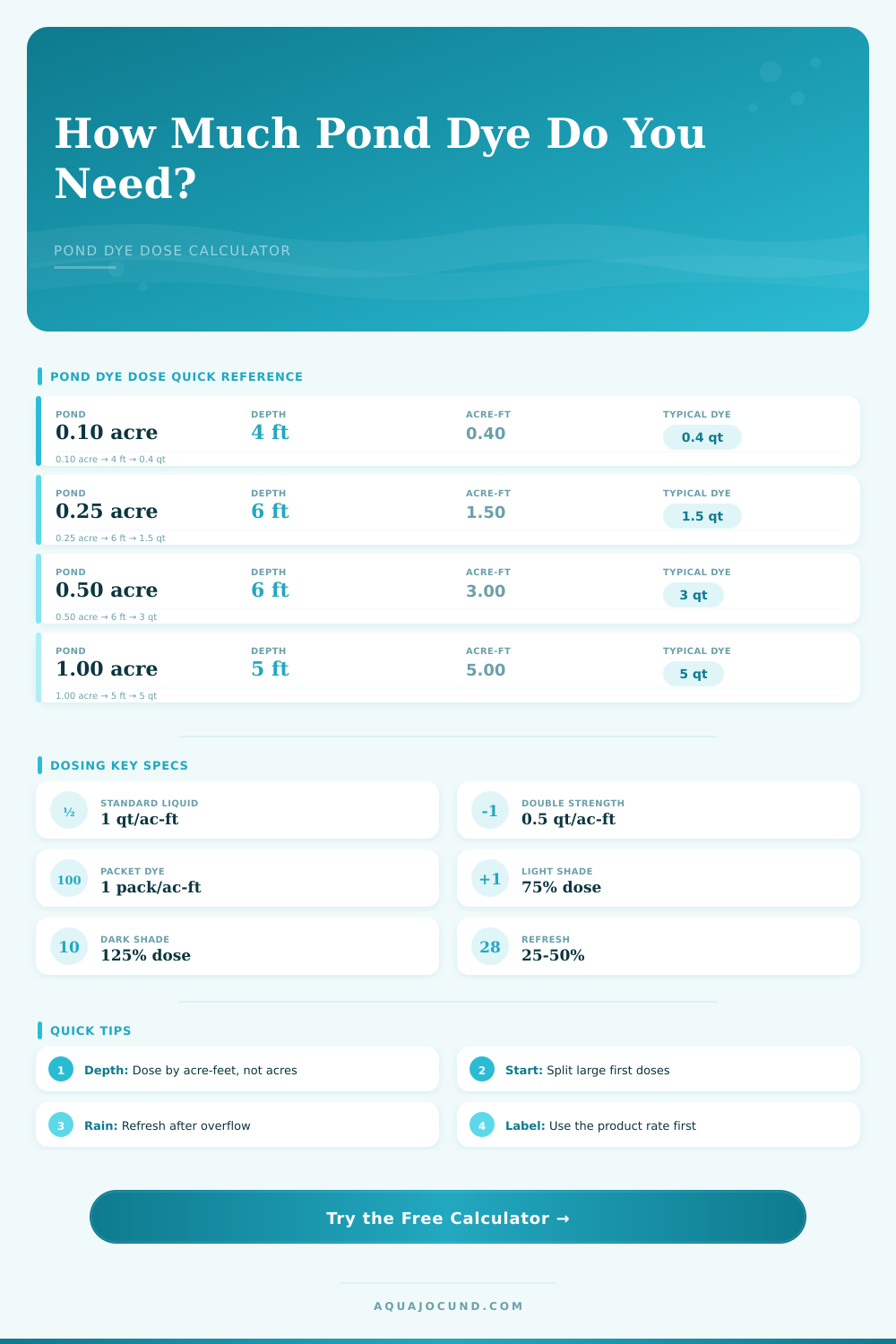
| 0.05 acre | 3 ft | 0.15 | 48,878 gal | 0.15 qt / 4.8 fl oz |
| 0.10 acre | 4 ft | 0.40 | 130,340 gal | 0.40 qt / 12.8 fl oz |
| 0.25 acre | 6 ft | 1.50 | 488,777 gal | 1.5 qt / 0.38 gal |
| 0.50 acre | 6 ft | 3.00 | 977,553 gal | 3 qt / 0.75 gal |
| 1.00 acre | 5 ft | 5.00 | 1,629,255 gal | 5 qt / 1.25 gal |
| Condition | Dose Factor | Refresh Share | Use When |
|---|---|---|---|
| Light tint | 0.75x label rate | 25% | Decorative water with modest shading goal |
| Standard tint | 1.00x label rate | 25% to 40% | Most garden ponds after volume is estimated |
| Dark tint | 1.25x label rate | 40% | Clear water where deeper color is desired |
| After heavy inflow | 1.00x current target | 50% | Storm water, overflow, or partial water change |
| Unknown depth | Start split dose | Recheck color | When the pond bottom profile has not been surveyed |
| Method | Surface Area | Volume | Best Match |
|---|---|---|---|
| Rectangle | Length x width | sq ft x average depth | Formal ponds and straight-edge basins |
| Oval | Length x width x 0.785 | surface area x average depth | Rounded garden ponds |
| Round | Pi x radius squared | surface area x average depth | Circular wildlife ponds or tanks |
| Known surface area | Entered acres or hectares | area x average depth | Surveyed ponds and mapped water bodies |
| Known volume | Estimated from volume and depth | entered gallons or liters | Metered fills, lined ponds, and small basins |
That’s what you thought: Your garden pond has a green tinge; time to add some dye to restore its aesthetic appeal. No, ponds are not paint cans. They’re volumes of living water. They change as seasons change, rain falls and water evaporates.
Adding dye is exact chemistry. Overdo it, and you stress fish or waste money. Underdo it, and the algae just sticks around.
How to Use Pond Dye Correctly
After plugging in your pond dimensions and depth, the calculator do the math for you. You don’t have to guess at conversions. Numbers are power, and understanding them give us control.
Surface area isn’t nearly as important of an input as volume. A puddle and a big lake can have the same surface area, but a puddle doesn’t hold nearly as much water. Total gallons matter when it comes to dye concentration not square feet. This is why the tool require average depth. It takes a two dimensional map and converts it to a three dimensional reality. And that’s where most folks mess up. Their depth. They think it’s deeper than it actualy is.
Strength of dye is also important. Dyes comes in dilute and concentrated forms. For example, dilutes can be used to make a big pour. Concentrates will take less volume but they pack a punch. The calculator takes your choice into account when calculating how much is needed. A super-concentrate poured at normal rate makes it so dark that it’s inky. Standard dye poured at concentrate rates leave the water barely tinted.
Science meets practice in the form of timing and application strategy. Do not apply the entire calculated dose all at one time. Apply it as a split application (the calculator says so). Pour what you are going to apply the first time and allow for water circulation. This helps you avoid overcorrecting.
Remember that ponds don’t mix well. There is layers due to currents, wind, and temperatures. The dye will not sit evenly. Dumping in the whole thing may result in clear strips and dark pockets. By splitting up your dose you have an opportunity to make adjustments before applying the rest.
You’ll have to maintain it after you apply it The color won’t last indefinitely. Ultraviolet light break down the color molecules. Concentration decreases as water gets diluted by rain. If you know how often your pond needs an application, the tool give a refresh dose to match. It’s not an exact science but rather an educated guess. A major weather event reset things. Your pond may be located where a hard rain requires frequent top offs. Check the table for varying conditions that affect how often you should of top it off.
The dye acts like a barrier to sunlight and prevents algae from conducting photosynthesis. The algae notice this when color wears off. You want just enough light to penetrate, but not so much that it shocks ecosystem. You are doing a balancing act between visual appeal and light penetration.
It’s a start. It is a confident one at that.
From here, you observe the water. Adjust for random rain events. Tweak the refresh rate according to seasonal changes.
The math takes you to the door. Your observation takes you in. Begin with the numbers. When it tells you so, let your pond tell you when you’re done.