💧 Pond Depth Calculator
Estimate fish-safe depth, pond volume, plant shelves, deep-zone area, and liner cut size from real pond dimensions.
✅ Pond Depth Recommendation
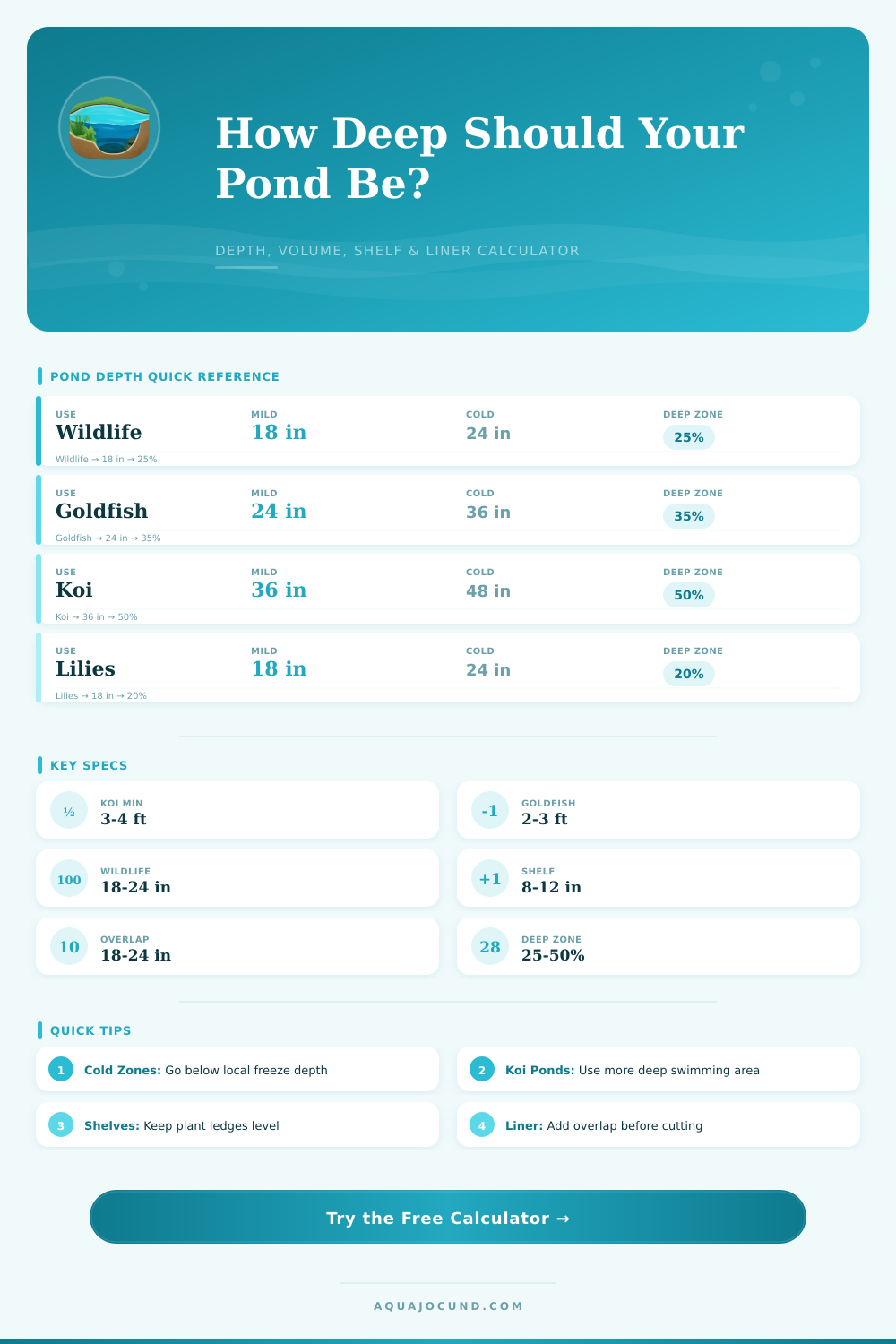
| Pond use | Mild minimum | Cold minimum | Deep zone target | Notes |
|---|---|---|---|---|
| Wildlife pond | 18 in / 45 cm | 24 in / 60 cm | 20-30% | Include shallow ramps and planted edges. |
| Goldfish pond | 24 in / 60 cm | 36 in / 90 cm | 30-40% | More depth gives summer and winter stability. |
| Koi pond | 36 in / 90 cm | 48 in / 120 cm | 45-60% | Koi need swimming depth and stable oxygen. |
| Water lily pond | 18 in / 45 cm | 24 in / 60 cm | 15-25% | Use shelves or blocks to set baskets at the right depth. |
| Formal reflecting pond | 18 in / 45 cm | 30 in / 75 cm | 20-35% | Uniform edges are easier to skim and light. |
| Mixed fish and plants | 30 in / 75 cm | 42 in / 105 cm | 35-50% | Balances fish refuge with shelf planting space. |
| Climate setting | Typical ice risk | Depth add-on | Fish refuge guidance |
|---|---|---|---|
| Mild winter | Little or no ice | 0 in / 0 cm | Meet the base use depth. |
| Cool winter | Thin seasonal ice | 6 in / 15 cm | Keep a pump or aerator opening if fish overwinter. |
| Cold winter | Regular ice cover | 12 in / 30 cm | Plan a real deep zone below expected ice. |
| Severe winter | Long deep freeze | 18 in / 45 cm | Use local frost depth as the final check. |
| Shape / profile | Surface factor | Average-depth factor | Best use |
|---|---|---|---|
| Rectangle or square | 1.00 | 0.72-0.88 | Formal ponds, straight liner folds, block walls. |
| Oval | 0.785 | 0.68-0.84 | Efficient liner use with softer edges. |
| Round | 0.785 | 0.70-0.86 | Raised tubs, quarantine ponds, small fountains. |
| Kidney / natural curve | 0.72 | 0.62-0.80 | Informal garden ponds with shelves. |
| Terraced shelves | Shape based | 0.58-0.72 | Plant-heavy ponds with multiple basket levels. |
| Gentle beach slope | Shape based | 0.48-0.62 | Wildlife access and naturalized edges. |
| Material | Depth flexibility | Edge allowance | Calculation note |
|---|---|---|---|
| EPDM flexible liner | Excellent | 18-24 in / 45-60 cm | Add twice the depth plus overlap to length and width. |
| PVC flexible liner | Good | 18 in / 45 cm | Avoid sharp shelf corners and protect from stone edges. |
| Preformed shell | Fixed | Manufacturer rim | Use actual molded volume and shelf depths. |
| Concrete or block | Excellent | Design specific | Volume is closer to measured internal dimensions. |
For fish ponds, the deepest zone should be a usable refuge, not a tiny sump. Koi especially benefit when nearly half the surface area is deep enough for steady swimming.
Measure the final excavation after shelves are dug. Soil walls, shelf steps, and edge leveling can change the liner cut size more than the sketch suggests.
The depth of the pond is a critical factor in the management of the backyard pond. The depth of the pond will determine how stable the temperature of the water is within the pond. If the pond is too shallow for the climate in which the pond is to be build, the temperature of the water will change rapid if the sun hits the surface of the water.
The rapid change in the temperature of the water will stress the fishes that live in the pond. Therefore, you must plan the depth of the pond to provide stability in the temperature of the pond’s water for the fish that live in it. Different animals requires different types of environments within the pond.
How Deep to Make Your Pond
For example, frogs may only need a shallow area within the pond for which they can walk on the ramp to the water. However, fish such as koi fish require a deep area for the fish to swim and to find areas within the pond where they can find stability in the water temperature. If the pond is too shallow, it will be difficult to manage the water temperature.
However, if the pond is too deep for the needs of the fish, then the pond liner may strain with the depth of the pond, or the water pump may not be able to move the water correct. Within the pond, there should be areas that are shallow and deep within the pond. The shallow areas allows the plants to grow, absorb the nitrates from the water, and provide cover for the small fish that live in the pond.
The depth of these shallow areas can indicate how much of the pond will be used for filtration of the pond versus the health of the fish that live in the pond. Furthermore, you must also be calculate the deep areas of the pond to determine the total volume of the pond. The climate in which the pond will be built is another factor that will impact the depth of the pond.
The climate will determine the depth of the pond for which the fish will live. In areas with mild climates, ponds can be shallow. In areas with cold climates, though, the pond will have to be very deep to provide enough room for the fish to survive the winter months.
In the winter, fish enter a state of torpor, during which their metabolism slows to allow their bodies to rest. Their bodies require the water in which they live to remain above freezing for their survival. When the ice reaches the bottom of the pond, the fish will have no place to which to migrate.
Therefore, the depth of the pond should of be deeper than the frost line in which the pond will be build. The depth of the pond is another factor to consider in the measurement of the pond liner. The depth of the pond must be considered for each side of the pond, as well as for the depth of the liner needed for the perimeter of the pond.
If the depth of the pond is not accounted for when measuring the size of the pond liner, the pond liner may be too short for the pond. A pond liner that is too short for the pond will result in the pond leaking water. The depth of the pond also impact the size of the pond liner; the profile of the pond will impact the depth of the liner needed.
Finally, the shape of the pond will impact both the volume of the water within the pond and the type of water pump that can be selected for that pond. Different shapes of ponds will have different volumes. For instance, a rectangular pond will contain a different volume of water then an oval pond or a curved pond.
The volume of the pond can be calculated using a rectangle to calculate the volume of the pond; however, this may result in incorrect calculation of the total volume of the water that the pond will contain. If the volume of the pond is calculated incorrect, a pump may be purchased for the pond that is too large for the ponds size. If the volume of the pond is correctly calculated, though, a pump and filtration system can be purchased for the pond that is of the correct size for the ponds needs.
Using the correct size for the pond will keep the water within the pond clear and will save electricity cost for the pond owner.