🌊 Pond Bottom Drain Size Calculator
Estimate drain diameter, number of drains, gravity flow, pipe velocity, and settlement volume from pond size and debris load.
✅ Drain sizing result
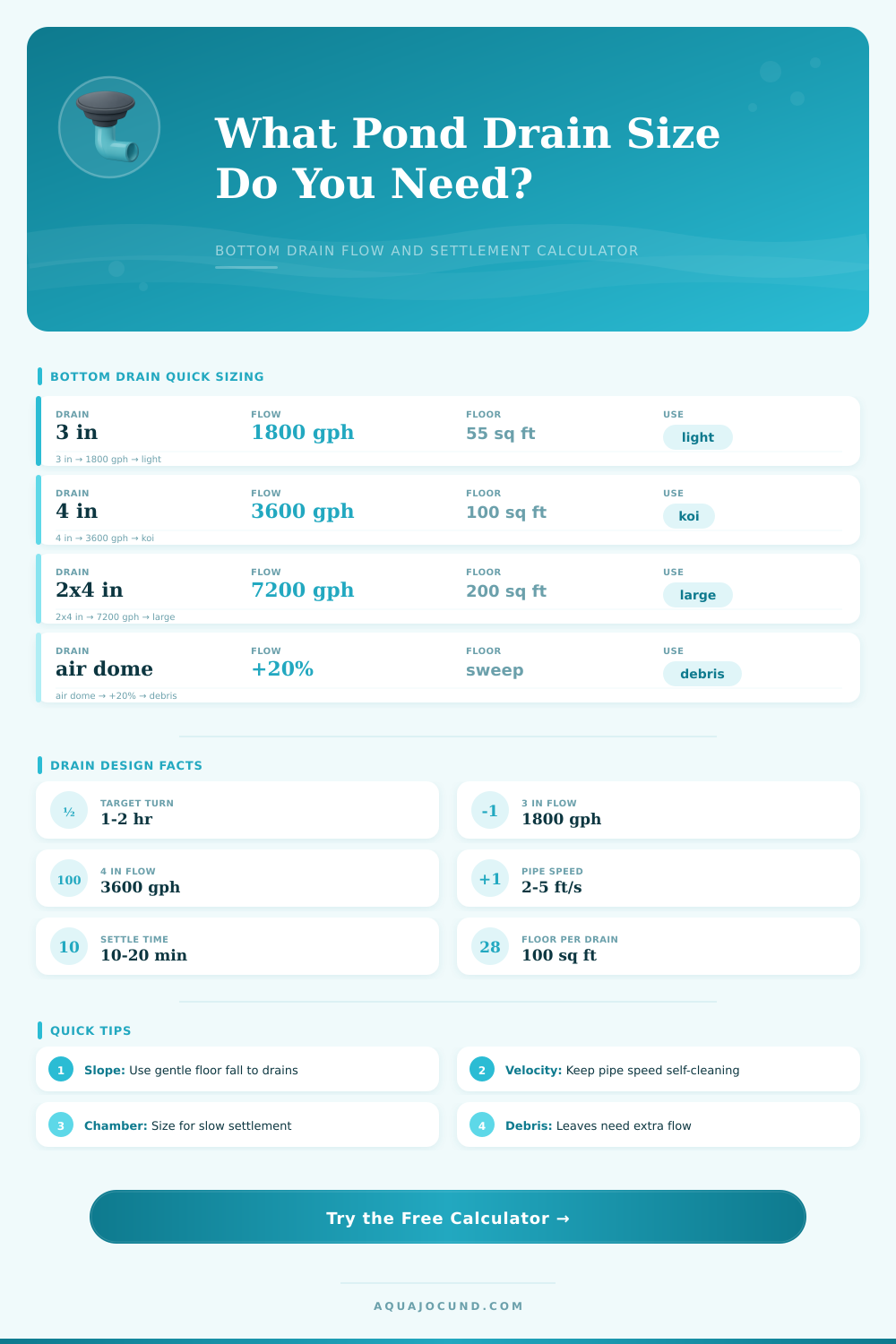
| Drain size | Practical gravity flow | Usual floor coverage | Velocity note |
|---|---|---|---|
| 2 in | 600 to 900 gph | Small ponds, retrofits | Clogs easier with leaves |
| 3 in | 1500 to 2200 gph | Up to about 55 sq ft | Good for modest ponds |
| 4 in | 3000 to 4200 gph | Up to about 100 sq ft | Common koi standard |
| 6 in | 7500 to 10000 gph | Large formal ponds | Needs large chambers |
| Pond | Dimensions | Volume | Typical drain plan |
|---|---|---|---|
| Patio goldfish | 8 ft x 5 ft x 2.5 ft | 750 gal | One 2 or 3 in drain |
| Garden koi | 12 ft x 8 ft x 4 ft | 2870 gal | One 4 in drain |
| Formal rectangle | 16 ft x 10 ft x 4.5 ft | 5390 gal | Two 4 in drains |
| Large koi | 22 ft x 12 ft x 5 ft | 9870 gal | Three 4 in drains |
| Oval display | 18 ft x 11 ft x 4 ft | 4650 gal | Two 4 in drains |
| Design item | Target range | Why it matters | Calculator use |
|---|---|---|---|
| Pipe velocity | 2 to 5 ft/s | Low speed settles in pipe; high speed adds drawdown | Flags slow or fast flow |
| Settlement dwell | 10 to 20 minutes | Longer dwell drops heavier solids | Sizes chamber volume |
| Floor coverage | 55 to 100 sq ft/drain | Limits dead zones on the pond bottom | Checks drain count |
| Turnover | 1 to 2 hours | Sets total water movement through filtration | Sets base flow need |
| Gravity drawdown | 1 to 4 inches | More drawdown can carry more gravity flow | Estimates pipe capacity |
A pond that maintains a layer of debris on the pond bottom usually have a drainage problem. Using a high-quality pond filter will help move waste out of the pond, but if the pond bottom is still, the waste will settle on the pond bottom and encourage the growth of algae. Pond bottom drains are create to move waste from the pond bottom towards a settlement chamber.
Understanding the types of waste that a bottom drain must move will allow for the correct sizing of that bottom drain. One of the first decision that must be made in creating a bottom drain system for a pond is the amount of water that is desire to turn over within the pond and the rate at which the pond is desire to empty of that water. For most ponds, the recommendation is to turn over the total volume of water in the pond once every one to two hours.
How to Size and Place Pond Bottom Drains
The amount of fish that live in the pond and the amount of debris that collect in that pond will make it dificult for the pond to empty at such a rate. For example, ponds that are located under trees will experience a greater amount of debris falling into the pond then ponds that are not under trees growing above the pond. Additionally, ponds that are located near lawn that are mowed on a regular basis will experience a higher volume of debris than ponds that are not near any lawns.
To account for these variables, pond calculator can be used to ensure that the size of the drain pipe will not be too small for the specified pond. Because the bottom drain will rely upon the gravity of the pond and the settlement chamber to move the waste and water through the pond, the gravity that is created between the pond and the pond chamber will influence the sizing and the number of drain that are located in the pond. Pumps can be programmed to regulate the rate at which the pond drain, but the bottom drain relies upon the difference in water level between the pond and the settlement chamber.
The more that the water levels differ, the more water that can pass through the drains. If you place elbows into the drainage system or if the length of the drains are lengthened, the capacity of those drains will decrease. Tools can be used to calculate the effect that adding elbows or decreasing the length of the drains will have upon the pond and the number of drains that are located within the pond.
In addition to the relationship between the water flow in the pond and the size of the drains, the floor coverage of the pond is also a critical factor in the determination of the proper number and placement of the bottom drains. Even if a bottom drain is sized to handle all of the water in the pond, there may be areas of the pond that dont receive the movement of water that is created by the bottom drain. Most individual want at least one bottom drain for every 100 square feet of the floor of the pond.
This general rule is created due to the fact that gentle slope will not move debris past a certain distance from the drains. Therefore, any area of the pond that is not covered by at least one bottom drain should be avoided to ensure that the pond floor is properly drained. The size of the settlement chamber is another component that must be provide for the bottom drain system.
The chamber needs to be sized in a way that allows for the heavy particle in the pond floor to settle at the bottom of that chamber. The recommended size for most ponds is for the particles in the pond to pass through the bottom drain system and settle in the chamber once every twelve minutes. This amount of time allow for most of the normal garden pond debris to settle.
However, ponds that have heavy leaf load or silt in the pond will require longer dwell times for the particles to settle. The size of the bottom drains will influence the length of time that the water reside within the settlement chamber, meaning that larger drains or increased fish load will require a larger settlement chamber. You should size the settlement chamber at the same time as the sizing of the drains themselves.
The velocity of the water that moves through the bottom drain system must remain within a specific range to ensure that the system function correctly. If the velocity of the water is too slow, the waste particles will begin to settle within the drain itself. If the velocity of the water is too fast, however, the water will create turbulence as it enters the settlement chamber, which will cause it to pass over the heavy particles and remove only the lighter debris.
For these reasons, the target velocity for the water moving through the drain is between two and five feet per second. A calculator can be used to determine the velocity of the water that should move through the drains prior to any digging of the bottom drain trench. Most ponds will not feature bottom drains that feature perfect shape and sizes in the same way that they are depicted in the planning books for ponds.
The addition of fish, slopes, plants, shelves, and roots will create additional detours for the drain of water to take as it moves through the pond. These feature are important to understand because they will impact the length of the drains and the number of elbow in the drain system; both of which can reduce the number of gallons of water that pass through the drains. A diagram of the actual route that the drains will take through the pond can be made using a tape measure to ensure that the actual route of the drains is understood prior to the excavation.
Another factor to consider prior to installing the bottom drains is any future change that may be made to the pond. For example, if additional fish are to be added to the pond in the future, or if the trees that are located above the pond are to grow in size, more waste and debris will be introduced into the pond. A margin for error can be created in the sizing of the drains to allow for these change in the pond.
The calculators that determine the sizing of the drains can be used to examine the impact that additional fish or debris will have upon the size of the drains that are installed. Regardless of the calculations that are made for the sizing of the drains, the numbers will be of no use to the pond keeper unless they match the actual behavior of the pond itself. Therefore, the initial calculations can be made using the dimension of the pond and the settings for the loads of waste that are introduced into the pond.
Following the calculations are made, the pond must be walked to ensure that the calculations are accurate. If the velocity numbers are within the appropriate range and the floor coverage is even, the sizing of the drains is likely the correct size. If, however, any of the numbers are outside of the appropriate range, the tool that calculates the size of the drains can be used to adjust the factor of the pond that impact the sizing of those drains.
Through the process of calculating the size of the drains and walking the pond site to ensure that the calculations are accurate, the pond keeper can ensure that the drains will properly move the ponds bottom and keep the ponds water clear.