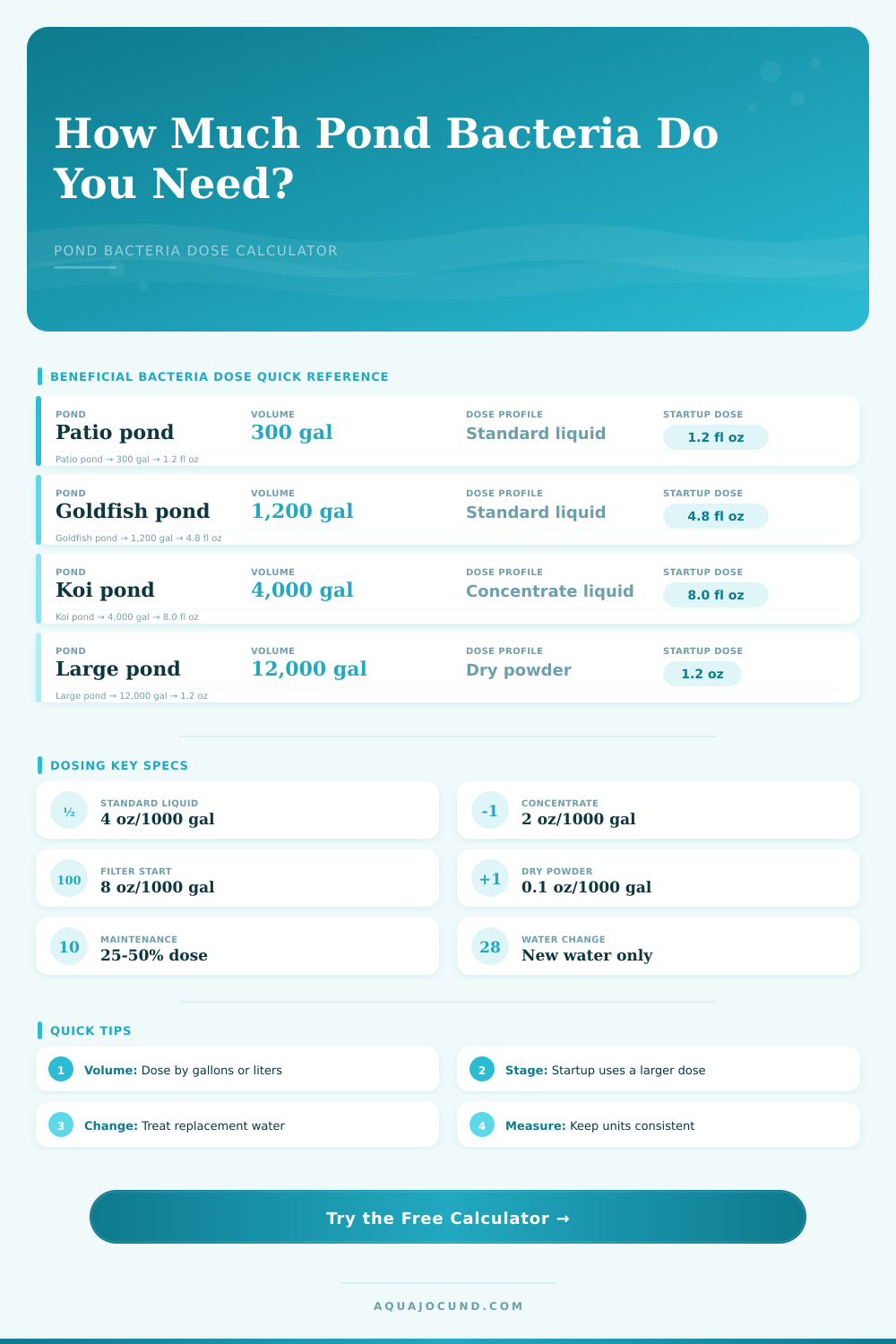
Pond Beneficial Bacteria Dose Calculator
Estimate pond volume, treatment dose, maintenance amount, and container coverage from generic label-rate profiles.
Beneficial bacteria dose estimate
| Generic profile | Base rate | Metric equivalent | Calculator use |
|---|---|---|---|
| Standard liquid | 4 fl oz per 1000 gal | 31.3 mL per 1000 L | General liquid bacteria dosing |
| Concentrate liquid | 2 fl oz per 1000 gal | 15.6 mL per 1000 L | Higher-strength liquid labels |
| Filter-start liquid | 8 fl oz per 1000 gal | 62.5 mL per 1000 L | New media or cleaned filter dose |
| Maintenance liquid | 1 fl oz per 1000 gal | 7.8 mL per 1000 L | Small repeating maintenance doses |
| Cold-water liquid | 4 fl oz per 1000 gal | 31.3 mL per 1000 L | Same volume math with cold factor |
| Sludge-focus liquid | 6 fl oz per 1000 gal | 46.9 mL per 1000 L | Organic-load planning dose |
| Dry powder | 0.10 oz per 1000 gal | 0.75 g per 1000 L | Low-dose powder measuring |
| Dry granule | 1 oz per 1000 gal | 7.49 g per 1000 L | Granular pond bacteria dosing |
| Pond example | Dimensions | Approx volume | Standard startup dose |
|---|---|---|---|
| Small patio pond | 6 ft x 4 ft x 2 ft / 1.8 m x 1.2 m x 0.6 m | 359 gal / 1359 L | 1.4 fl oz / 42 mL |
| Goldfish garden pond | 10 ft x 8 ft x 3 ft / 3.0 m x 2.4 m x 0.9 m | 1795 gal / 6795 L | 7.2 fl oz / 212 mL |
| Round feature pond | 10 ft diameter x 3 ft / 3.0 m diameter x 0.9 m | 1762 gal / 6670 L | 7.0 fl oz / 208 mL |
| Koi pond | 16 ft x 10 ft x 4 ft / 4.9 m x 3.0 m x 1.2 m | 4788 gal / 18125 L | 19.2 fl oz / 566 mL |
| Large oval pond | 28 ft x 18 ft x 4 ft / 8.5 m x 5.5 m x 1.2 m | 11850 gal / 44855 L | 47.4 fl oz / 1402 mL |
| Application stage | Volume basis | Factor | Capacity meaning |
|---|---|---|---|
| New pond or startup | Full pond volume | 1.00x | One full label-rate dose |
| Heavy organic load | Full pond volume | 1.25x | Oversized measurement for high load |
| Routine maintenance | Full pond volume | 0.35x | Smaller repeating dose |
| After filter cleaning | Full pond volume | 0.50x | Partial reseed quantity |
| Water-change makeup | Replacement water only | 1.00x of new water | Dose tied to changed volume |
Green soup is what most pond owners begin with and end up with. Add some fish, throw in the pump and wait for it to get clear. It doesn’t work that way the first time.
What’s typically wrong isn’t your lack of effort; it’s that you don’t understand how biology work. A clear pond has an engine called beneficial bacteria and we tend to treat it as a one-shot deal. We feed ’em, give ’em space and then forget about them. That’s because they’re live critters. They require constant feeding, space and support to break down their waste (ammonia & nitrites).
Stop Guessing. Dose Your Pond Correctly.
The calculator above will do the number-crunching for you. Enter the desired strength of your product. Enter your pond size. It’ll tell you the exact amount of food required by your specific pond volume. No more guesswork = no more cloudy water or stressed fish.
There is a single rule for all doses regarding how much to use. Underestimating your pond volume lead to an underfed bacterial colony, while using products that are too strong carries a risk of overfeeding. How much is that? You can enter your dimension and shape into the tool which helps if you are building from scratch, but nothing is better than using measurements. Have you ever timed how long it takes to fill your pond with a hose? If so, then you have the best number of all… Use it!
The calculator translates this volume into the precise quantity of bacteria needed to efficiently colonize both water column and your filter media. It also considers whether you are using a concentrated formula or a liquid. This prevents you from overdosing with a product that is too strong for current balance, and it stops you from wasting money on a product that is too weak for your load.
The difference between them? Timing. You need more at startup to get the cycle going on a new pond before fish waste accumulate to toxic levels, whereas an existing one just needs maintenance doses. You need less on an established pond when maintaining the level because of water changes or other filtration that kill some of the bacteria. The tool tells those times apart. It multiplies accordingly based off the biology of what’s happening.
The tool accounts for temperature too, the silent killer of bacterial efficiency. When it gets cold, bacteria slow down. Their metabolism slows and they work less effective, so they need to be adjusted to compensate. Not accounting for temperature often means having clear water turn murky as the season changes. The tool makes up for that, allowing you to stay stable throughout the seasonal change without endless experiments with your numbers.
You should of also know how many containers you have. What’s the dose per bottle? You’ll want to know when you purchased it, because starting over from zero in the midst of a startup process can cause the nitrogen cycle to crash and create an ammonia spike that will kill your fish. The estimator tell you how much the container you’re using holds in terms of doses so you can anticipate when more may be needed. It also recommends diluting larger doses. This is an intelligent strategy to keep the bacterial population consistent without making wild fluctuations that tend to crash and burn. A healthy, resilient colony are one with consistency.
Many folks approach their pond as they would a home: you clean it then hope it stays clean. That’s like treating it like a sink when it’s actualy an ecosystem. A pond needs constant biological support.
The chart on that page spells it out clearly. Which format do I buy? How does that translate to how much I use? That’s not a question of what brand. It’s how much active ingredient you’re applying in relation to your own pond volume. When you understand that relationship, guesswork becomes management. Instead of reacting to algae growth, you prevent it because the biological workforce has been fed and maintained well enough.
Good water isn’t accidental. It’s the outcome of consistently feeding the right amount of the right bacteria at the right time…season after season.