🧪 Pond Algaecide Dose Calculator
Estimate pond volume, label-rate amount, first measured split, refill adjustment, and product-on-hand treatment capacity.
✅ Pond Algaecide Dose Results
| Basis | Imperial Entry | Metric Entry | Calculator Output |
|---|---|---|---|
| Liquid per 1,000 volume | fl oz per 1,000 gal | mL per 1,000 L | Liquid volume |
| Liquid per large pond volume | qt per acre-ft | L per 1,000 m3 | Liquid volume |
| Granular per large pond volume | lb per acre-ft | kg per 1,000 m3 | Dry weight |
| Packet count per 1,000 volume | packets per 1,000 gal | packets per 1,000 L | Packet count |
| Active ppm calculation | target ppm plus product percent | target ppm plus product percent | Product volume from active mass |
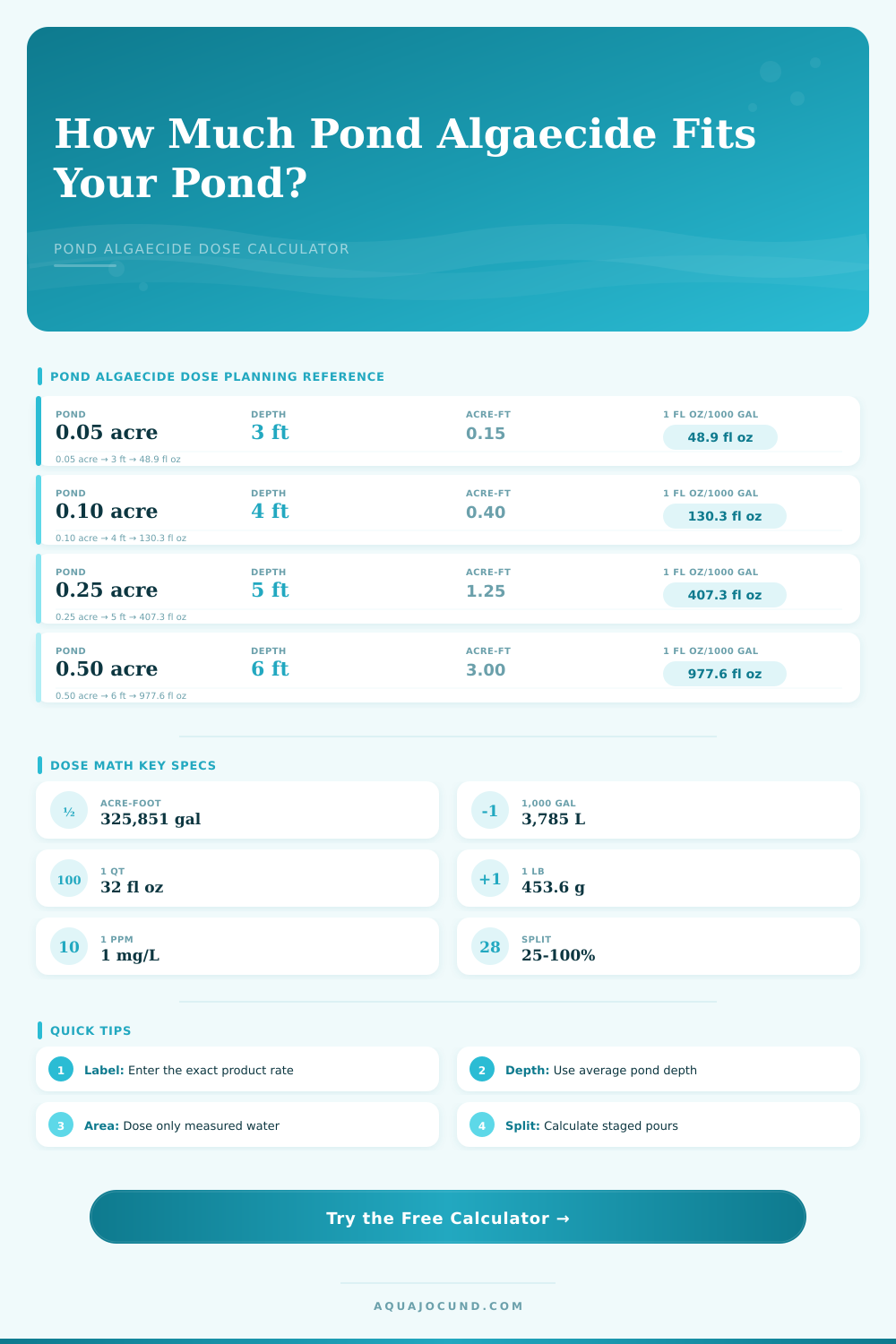
| Pond Size | Average Depth | Acre-Feet | Gallons / Liters | At 1 fl oz per 1,000 gal |
|---|---|---|---|---|
| 0.03 acre | 3 ft | 0.09 | 29,327 gal / 111,038 L | 29.3 fl oz |
| 0.05 acre | 4 ft | 0.20 | 65,170 gal / 246,747 L | 65.2 fl oz |
| 0.10 acre | 4 ft | 0.40 | 130,340 gal / 493,494 L | 130.3 fl oz |
| 0.25 acre | 5 ft | 1.25 | 407,314 gal / 1,542,170 L | 407.3 fl oz |
| 0.50 acre | 6 ft | 3.00 | 977,553 gal / 3,700,918 L | 977.6 fl oz |
| Method | Surface Area Formula | Volume Formula | Use Case |
|---|---|---|---|
| Rectangle | length x width | surface sq ft x average depth | Formal lined ponds and straight edges |
| Oval | length x width x 0.785398 | surface area x average depth | Rounded garden ponds |
| Round | 3.141593 x radius squared | surface area x average depth | Circular ponds and round basins |
| Known area | entered acres or hectares | known area x average depth | Mapped or surveyed ponds |
| Known volume | estimated from volume and depth | entered gallons or liters | Metered fills and lined systems |
| Input | What It Multiplies | Example | Result Meaning |
|---|---|---|---|
| Measured water coverage | Total pond volume | 50% | Dose amount for half of the measured water volume |
| First measured split | Calculated label-rate amount | 75% | Amount to measure for the first staged portion |
| Recent refill | Calculated label-rate amount | 25% | Amount matching newly replaced water volume |
| Measurement margin | Dose after coverage factor | 1.05x | Rounding factor for pond measurements |
How much algaecide should I put in my pond? This is a valid question that could result in under-dosing (waste of money) or over-dosing (hurting fish). Brand doesn’t matter as much as getting the right dosage. Just input your label rate and dimensions and the calculator will do all the math for you. No need for you to try to convert between gallons, liters, and acre-feet yourself.
A shallow pond doesn’t contain as much water as a deep pond that has the same surface area. It’s all about the volume, not the surface area. You don’t have to know how many gallons are in your pond, but you do want to know its volume in order to find chemical load. Average depth is what the tool will ask for, along with width and length… To arrive at a proper total. You do not need a sonar mapping device. You just need an honest estimate of shallow edges and deepest point. Flat-bottomed ponds makes average depth easy. Ponds with shallow banks and a deep center requires being conservative on the depth estimate.
How to Calculate Pond Volume for Algaecide
Under-dosing occurs when your pond treatment fail. The most common reason treatments fail is due to underestimating volume. The other way people mess up on algaecide measures is to confuse the two kinds of bases for measuring algaecides: some algaecides is measured per acre-foot, and some are measured per thousand gallons. This means that if you mix them up you’ll either under- or over-treat your water, since an acre-foot have more than 300,000 gallons of water. You’ll choose the base matching your product from a list, and the rest of the math will be sorted out for you. The resulting number will also be in units that you can actualy measure.
For small ponds, split dosing is important but often overlooked. If you dump the whole dose all at once, that can quickly spike chemical concentration and may rob oxygen or otherwise stress animals in the water. By splitting your dose, use half now and wait a day or two, then use the other half. That’s more gentle on the environment and tends to break down any existing algae bloom. You can set a split percentage with the tool which will give you a clean first-step number without having to do mental division.
Water exchanges dilute what is already there, so if you’ve changed any water out and refilled, that changes required dose. It may also change if your pond was drained and refilled, or if a lot of rain has increased volume. Not accounting for water exchange creates the appearance that the algaecide failed when in reality it was simply diluted. Treating the true volume accounts for how much of the water is new by using a percent.
It’s limited in that this isn’t a biological diagnostic but rather a math tool. In other words, it doesn’t say what treatment to use on what kind of algae; just the amount of chemical to dose into a given volume. It also doesn’t take into consideration water hardness (certainly true with copper based treatments) which can binds with the treatment and reduce its effectiveness. A cold, bright day is better for treatment than a hot, sunny afternoon. You can’t manage what you don’t measure; precision will protect the balance of your pond while preventing waste.
The first key to understanding how to keep a pond is volume, and when you get that part right, the rest tends to fall into place. It is a small detail but it matters.