💨 Pond Air Pump Size Calculator
Estimate the pump LPM, CFM, diffuser count, pressure, and safety margin for koi, goldfish, wildlife, and planted ponds.
| Water Depth | Back Pressure | Suggested Pump Headroom | Typical Use |
|---|---|---|---|
| 1 ft / 0.3 m | 0.43 psi / 3.0 kPa | +10% output | Patio bowls, shallow rings |
| 2 ft / 0.6 m | 0.87 psi / 6.0 kPa | +15% output | Goldfish ponds |
| 3 ft / 0.9 m | 1.30 psi / 9.0 kPa | +20% output | Garden ponds, koi edges |
| 4 ft / 1.2 m | 1.73 psi / 12.0 kPa | +28% output | Koi pond center drains |
| 5 ft / 1.5 m | 2.17 psi / 15.0 kPa | +35% output | Deep koi ponds |
| 6 ft / 1.8 m | 2.60 psi / 17.9 kPa | +45% output | Large formal ponds |
| Load Type | Baseline Air Rate | Best Diffuser Style | Extra Margin Trigger |
|---|---|---|---|
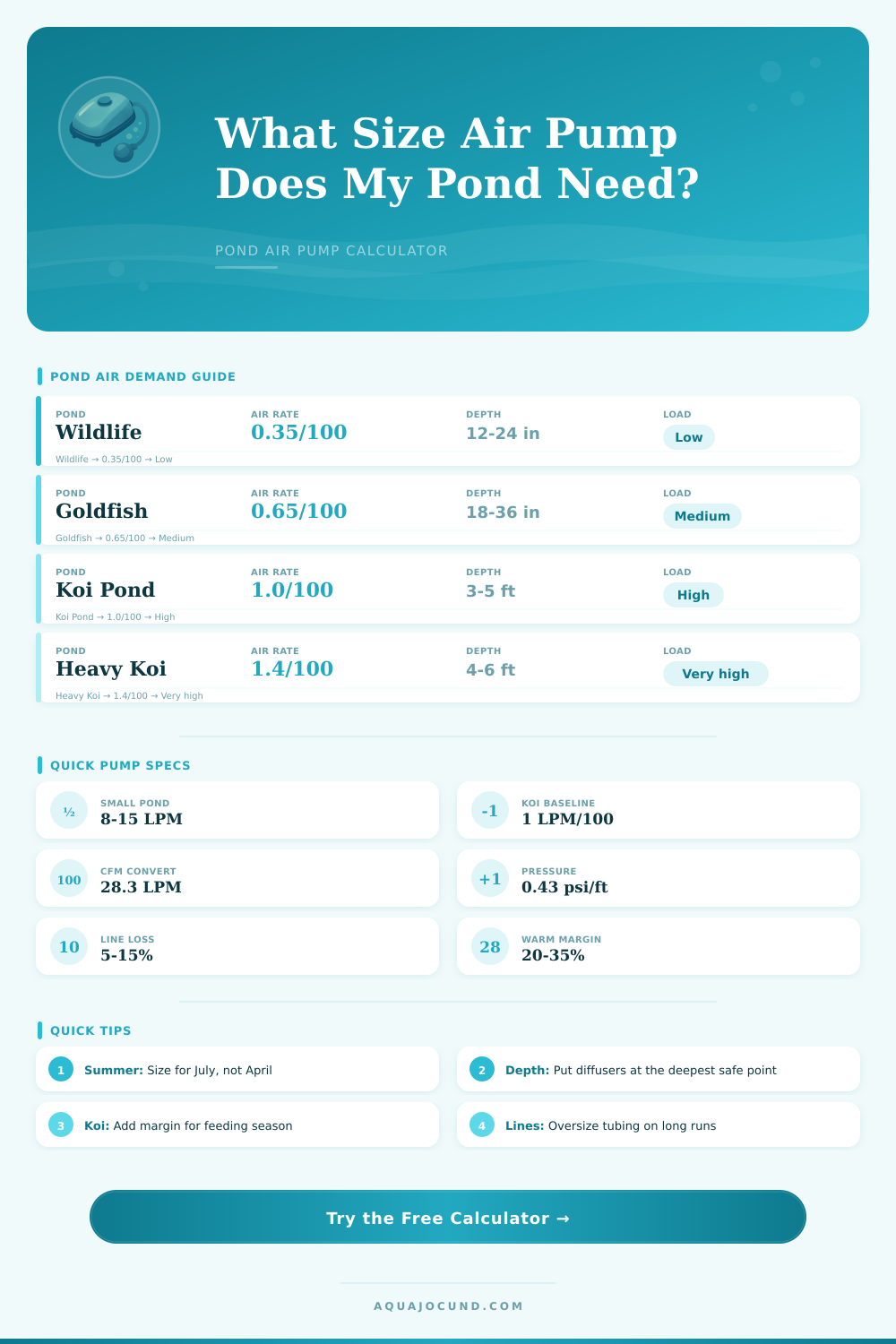
| Wildlife or plant pond | 0.35 LPM per 100 gal | Shallow ring or small stone | Dense algae or summer heat |
| Light goldfish pond | 0.50 LPM per 100 gal | Fine air stone | Warm still nights |
| Goldfish community | 0.65 LPM per 100 gal | Membrane disc | Heavy plants or high feeding |
| Koi pond | 1.00 LPM per 100 gal | Membrane disc or air dome | Water above 78°F / 26°C |
| Heavy koi pond | 1.40 LPM per 100 gal | Air dome, multiple discs | Large fish and strong feeding |
| Quarantine or fry | 0.90 LPM per 100 gal | Fine stone or sponge filter | Medication or crowding |
| Pond Scenario | Approx Dimensions | Volume | Baseline Pump Range |
|---|---|---|---|
| Patio goldfish pond | 5 ft × 4 ft × 1.7 ft | 250 gal / 946 L | 5 to 10 LPM |
| Wildlife pond | 8 ft × 6 ft × 1.7 ft | 450 gal / 1,703 L | 4 to 8 LPM |
| Garden goldfish pond | 10 ft × 8 ft × 2 ft | 1,200 gal / 4,542 L | 10 to 18 LPM |
| Starter koi pond | 12 ft × 8 ft × 2.5 ft | 1,500 gal / 5,678 L | 18 to 30 LPM |
| Medium koi pond | 14 ft × 10 ft × 3 ft | 2,800 gal / 10,599 L | 35 to 60 LPM |
| Deep koi pond | 18 ft × 12 ft × 4 ft | 5,000 gal / 18,927 L | 65 to 110 LPM |
| Component | Recommended Range | Why It Matters | Calculator Effect |
|---|---|---|---|
| 3/8 in airline | Under 20 ft / 6 m | Fine for small pumps | Low line loss |
| 1/2 in airline | 20 to 60 ft / 6 to 18 m | Better for pond runs | Moderate line loss |
| 5/8 in airline | 60 ft+ / 18 m+ | Helps larger pumps breathe | Lower restriction |
| Check valve | One per outlet | Prevents back siphon | Adds small restriction |
| Manifold | Match diffuser count | Balances air between zones | Supports multiple discs |
| Weighted line | Pond floor runs | Keeps tubing placed neatly | Improves diffuser position |
Rate the pump for the diffuser depth, not just the pond volume. A pump that looks large on the label can lose useful output when it is pushing air to 4 to 6 feet of water depth.
Use more than one diffuser on wide ponds. One strong boil in the middle is less useful than balanced air near the deepest zone and low-circulation corners.
Oxygen levels in a pond are crucial to the survival of fish in that pond. Fish need dissolved oxygen to breathe. Warm water hold less dissolved oxygen than cold water.
If the pond contain many fish or experiences algae blooms, there will be high demand for dissolved oxygen in the pond, which will reduce the amount of dissolved oxygen that is available for the fish. The amount of dissolved oxygen that is available in the pond must be sufficient to ensure that the fish dont attempt to gulp air from the surface of the pond. An air pump will provide oxygen to the pond.
Choose the Right Air Pump for Your Pond
However, the air pump wont provide a constant amount of oxygen to the pond. The amount of oxygen that the air pump release is dependent upon the water pressure in the pond. The deeper the pond, the more higher the water pressure.
Because water pressure exerts a force upon the air pump, greater effort is required to push the air through the water. Every foot that the water is deep creates resistance against the air pump. An air pump that works efficient in shallow water may not effectively deliver air to the pond if the pond is too deep.
Consequently, you should not choose an air pump based off only upon the amount of air that the pump releases. The depth of the pond may reduce the amount of air that reaches the fish. The number of fish in the pond is one of the main factors that determine the amount of oxygen that is required of the pond.
The more fish that live in the pond, the more oxygen that is required of the pond. Furthermore, feeding the fish food that is high in protein will also increase the amount of oxygen that is required of the pond. Therefore, a pond that contains many fish that are provided with high protein food will require more dissolved oxygen than a pond that contains few fish that are fed a low protein food.
The air pump should be sized according to the number of fish in the pond on the hottest days of the year when the fish require the most oxygen. If the air pump is sized to provide enough oxygen for the fish during average temperatures of the year, it may not provide enough oxygen for the fish during a heatwave. The method in which the oxygen is delivered into the pond is also important.
If only one air stone is added to a large pond, the air stone will only create bubble in one area of the pond. Additionally, the bubbles will not circulate the water in the corners and midsections of the pond. Consequently, aeration systems are create with multiple diffusers to allow for the distribution of oxygen to the entire volume of water in the pond.
If aeration systems use multiple diffusers, the oxygen will create a current that circulates the water from the bottom of the pond to the top of the pond. There are different type of diffusers. Membrane discs create fine bubbles that remain in the water for a longer period of time.
Fine bubbles allow the oxygen to dissolve into the water. Coarse bubbles rise to the surface of the pond more quickly, so less oxygen dissolves into the water with coarse bubbles compared to fine bubbles. Another factor to consider creating an efficient aeration system is line loss.
Air is a compressible gas. Additionally, any distance between the air pump and the diffusers create resistance against the air. Furthermore, any number of connections between the air pump and the diffusers will reduce the amount of air that reaches the diffusers.
If the air pump is located a distance from the pond, or if it is placed at a high elevation above the pond, there will be more resistance against the air pump to push air to the diffusers. Thus, more air will be required at the diffusers to maintain the aeration system. If the volume of air that the air pump releases is not enough to compensate for the line loss in the system, the air pump may not be able to efficiently deliver enough air to the pond.
An aerator system may also include a safety margin to provide for unexpected changes in the pond. For instance, if there is a heatwave during the year, the fish require more oxygen to breathe. Additionally, if more fish are added to the pond, more oxygen is also required.
By including a safety margin for additional air supply, the fish will be able to recieve the additional oxygen without having to purchase a new air pump. Additionally, enough dissolved oxygen should be provided for the beneficial bacteria in the pond. The beneficial bacteria is necessary to keep the pond and water clear of waste and other substances.
Therefore, by balancing each of these factors the fish will be able to live in a stable environment. A successful aeration system should include the following elements:
Balance the volume of the air pump to the size of the pond. Balance the depth of the pond to the volume of the air pump.
Balance the method in which the air is released into the pond to the size of the pond. Include a safety margin for unexpected changes in the pond environment. Include a sufficient amount of dissolved oxygen to support the beneficial bacteria populations in the pond.