💧 Pond Acre Feet Calculator
Estimate pond volume in acre-feet, gallons, liters, and watershed refill depth from pond dimensions and depth profile.
| Measure | Equivalent | Metric Equivalent | Use In Calculator |
|---|---|---|---|
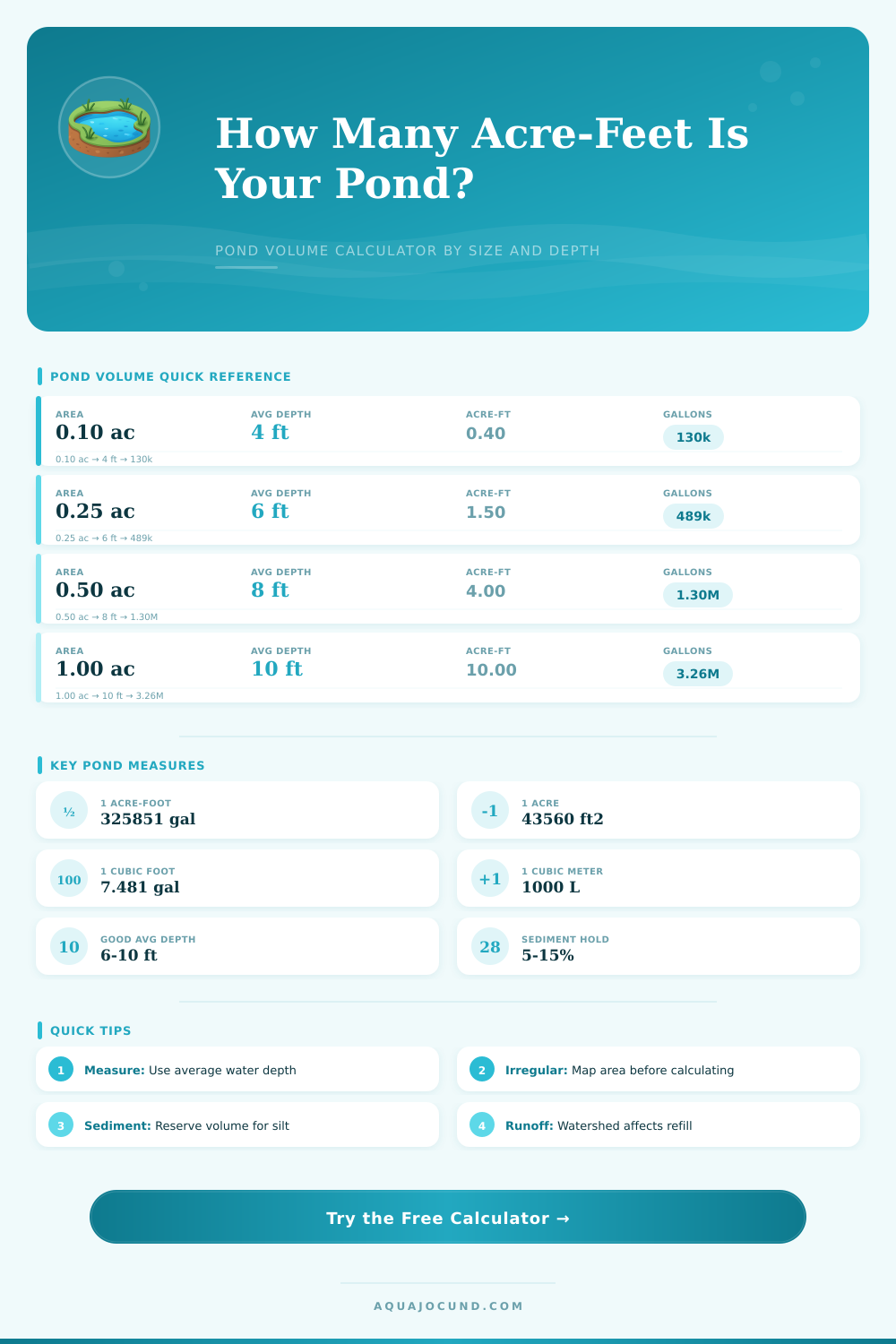
| 1 acre-foot | 325,851 gallons | 1,233.48 m³ | Main pond volume unit |
| 1 acre | 43,560 ft² | 0.4047 hectares | Surface area base |
| 1 cubic foot | 7.4805 gallons | 28.3168 liters | Dimension conversion |
| 1 hectare-meter | 8.107 acre-feet | 10,000 m³ | Large metric ponds |
| 1 million gallons | 3.069 acre-feet | 3,785 m³ | Storage planning |
| Pond Shape | Surface Formula | Best Measurement | Accuracy Note |
|---|---|---|---|
| Rectangle | L × W | Bank-to-bank length and width | Good for lined or excavated ponds |
| Oval | L × W × 0.785 | Longest and widest spans | Often fits natural ponds well |
| Round | π × r² | Average diameter | Best for circular display ponds |
| Irregular | L × W × 0.70 | Bounding box or map trace | Use mapped acres when possible |
| Known area | Entered directly | GPS, GIS, or survey area | Most reliable for large ponds |
| Surface Area | Average Depth | Volume | Approx. Gallons | Typical Use |
|---|---|---|---|---|
| 0.10 acre | 4 ft | 0.40 acre-ft | 130,000 gal | Koi, display, garden pond |
| 0.25 acre | 6 ft | 1.50 acre-ft | 489,000 gal | Farm pond or wildlife pond |
| 0.50 acre | 8 ft | 4.00 acre-ft | 1.30M gal | Bass, bluegill, irrigation reserve |
| 1.00 acre | 10 ft | 10.00 acre-ft | 3.26M gal | Fishing pond or water storage |
| 2.00 acres | 8 ft | 16.00 acre-ft | 5.21M gal | Large lake, stormwater, irrigation |
| Pond Use | Target Avg Depth | Helpful Volume Range | Planning Note |
|---|---|---|---|
| Koi / Ornamental | 3-5 ft | 0.02-0.50 acre-ft | Stable depth reduces temperature swings |
| Bass / Bluegill | 6-10 ft | 2+ acre-ft | More water improves summer oxygen refuge |
| Wildlife Pond | 2-6 ft | 0.25+ acre-ft | Mix shallow edges with deeper pockets |
| Irrigation | 8-14 ft | Varies by demand | Account for drawdown and evaporation |
| Stormwater | 3-8 ft | Design-specific | Keep freeboard outside storage volume |
| Livestock | 5-8 ft | Seasonal demand | Fence banks and protect water access |
For the cleanest acre-foot estimate, measure average depth from several transects. A pond with broad shelves may hold much less water than its maximum depth suggests.
Keep sediment reserve separate from usable storage. Older ponds can lose a meaningful share of volume to silt before the surface area looks smaller.
An acre foot is a unit of measurement that is used to calculate the volume of water that are present within a given area. An acre foot is the amount of water that would be required to cover one acre of land to a depth of one foot. Because one acre foot is equal to over three hundred thousand gallons of water, it is a unit of measurement that can be utilized to understand the volume of water that is present within a pond.
Additionally, it is often necessary to utilize this unit of measurement for ponds because the area of the pond are not often the best method of calculating the volume of water that is within the pond. For instance, while it may be easy to calculate the volume of a pond by determining the area of the pond and multiplying that by the depth of the pond, that calculation is likely to be incorrect. Most ponds have a depth that vary throughout the pond; it is not common for ponds to be have a relatively constant depth from one part of the pond to another.
How to Measure the Volume of a Pond
Thus, calculating the volume of water within the pond by calculating the area of the pond multiplied by the depth of the pond is likely to yield a measurement that is too higher than reflect the actual volume of water within the pond. Another of the factor that can reduce the volume of water that is within a pond is the sediment that can settle within that pond. Such sediment may include silt, decaying leaves, and the runoff from the land surrounding the pond.
These element often settle at the bottom of the pond, and reduce the amount of water that can be contained within that pond. For instance, if a pond is ten feet deep, but two feet of that pond is filled with sediment, the depth of the pond is only eight feet in relationship to the amount of water that can be contained within it. Thus, it is often necessary to account for sediment within the pond in calculating the total volume of water that is within the pond.
Finally, it is also necessary to consider the watershed that surrounds that pond. The volume of water that falls within that watershed can contribute to the amount of water that is within the pond. For instance, clay soils will allow the water from rainfalls to slide into the pond, but sandy soils will allow the rainwater to soak into the ground and not fall into the pond.
Understanding the watershed will allow you to properly predict the amount of rain that is necessary to refill the pond. Understanding the watershed transforms the management of the pond into a predictable system. The depth of the pond impacts the inhabitant of the pond.
Some of the inhabitants of ponds include fish and plants. If the pond is to contain fish like bass or bluegill, then there must be deep refuge zones in the pond to allow for the fish to avoid overheating during the summer months. In the opposite, a shallow pond may allow for many fish to live in the same area, but the shallow pond may become a biological dead zone due to the heat from the sun in August.
Ponds like koi ponds and wildlife ponds require different depths for the pond to have different zones for different features. For instance, shallow zone are required for plants to live in the pond, but deep zones in the pond allow the fish to avoid overheating during the summer. There must be a balance in the pond in regards to the volume of the pond and what live in the pond.
The volume of the pond should of be managed in such a way that it does not become a swamp. You can use a calculation tool to calculate the volume of your pond. This calculation tool will perform the mathematical calculations for you.
All you need to do is plug in the area of the pond that you mapped and the depth of the pond into the calculation tool. The pond management program will display for you the impact that silt buildup or drawdown of the water will have on your pond. This allows you to understand the number of gallons that your pond will contain.
This number in gallons will allow you to calculate the number of days of irrigation your pond will have remaining. Additionally, the number of gallons will allow you to calculate the number of fish your pond can contain without the water levels becoming too low in relation to the amount of oxygen level in the pond. Planning your pond requires you to understand the true acre footage of the pond.
Understanding the true acre footage of your pond will allow you to manage your pond effectivly.