Planted Tank Lean Dosing Calculator
Estimate capped weekly nitrate, phosphate, and potassium additions from tank volume, plant mass, light level, CO2 support, current tests, and dose frequency.
🌿Lean Dosing Presets
📐Tank, Plant, and Nutrient Limits
Lean Weekly Dosing Plan
⚙Dosing Style Comparison Grid
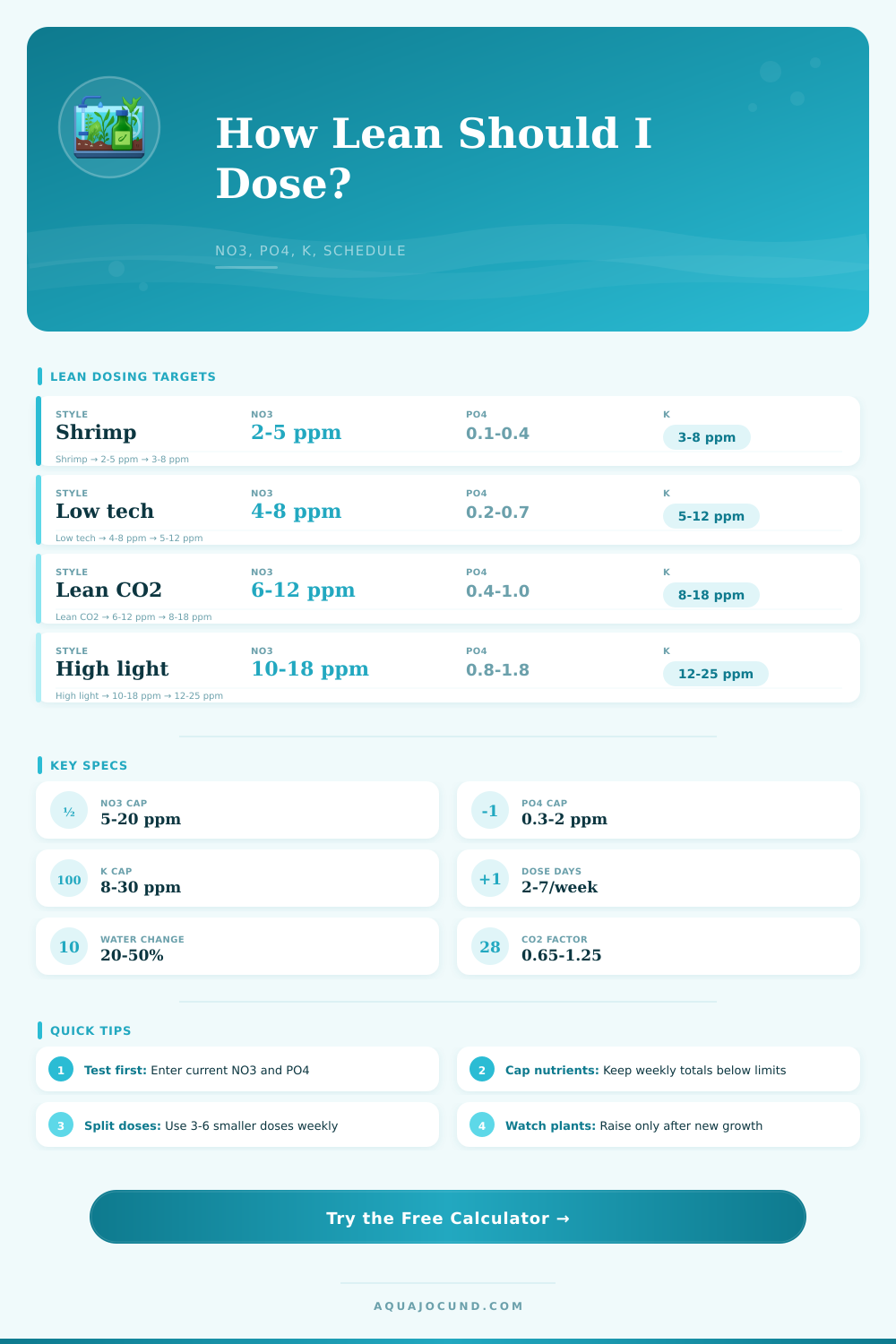
📊Lean Nutrient Target Ranges
| Dosing style | Weekly NO3 | Weekly PO4 | Weekly K |
|---|---|---|---|
| Shrimp-safe lean | 2-5 ppm | 0.10-0.40 ppm | 3-8 ppm |
| Low-tech lean | 4-8 ppm | 0.20-0.70 ppm | 5-12 ppm |
| Balanced lean CO2 | 6-12 ppm | 0.40-1.00 ppm | 8-18 ppm |
| Carpet push lean | 8-15 ppm | 0.60-1.40 ppm | 10-22 ppm |
| High-tech capped lean | 10-18 ppm | 0.80-1.80 ppm | 12-25 ppm |
🧪Dry Salt Nutrient Conversion
| Source | Main nutrient | Nutrient fraction | Planning note |
|---|---|---|---|
| Potassium nitrate KNO3 | NO3 plus K | 61.3% NO3, 38.7% K | Adds potassium while raising nitrate |
| Monopotassium phosphate KH2PO4 | PO4 plus K | 69.8% PO4, 28.7% K | Small amounts move phosphate quickly |
| Potassium sulfate K2SO4 | K only | 44.9% K | Use after KNO3 and KH2PO4 potassium |
| Trace mix or chelated micros | Iron and traces | Product-specific | Dose separately when macro caps are tight |
📅Weekly Schedule Reference
| Dose days | Best fit | Per-dose size | Water change cue |
|---|---|---|---|
| 2 per week | Low light and slow growth | Larger, simple doses | 20-30% weekly is usually enough |
| 3 per week | Most lean community tanks | Moderate split doses | 30% weekly keeps caps predictable |
| 5 per week | High light or CO2 tanks | Small frequent doses | 40-50% helps reset test drift |
| 7 per week | Automated doser systems | Very small daily dose | Keep one maintenance reset day |
📏Common Tank Lean Starting Points
| Tank size | Dimensions | Volume | Typical lean start |
|---|---|---|---|
| 5.5 gallon | 16 x 8 x 10 in / 41 x 20 x 25 cm | 21 L | 2-4 ppm NO3 weekly |
| 10 gallon | 20 x 10 x 12 in / 51 x 25 x 30 cm | 38 L | 3-6 ppm NO3 weekly |
| 20 long | 30 x 12 x 12 in / 76 x 30 x 30 cm | 76 L | 5-10 ppm NO3 weekly |
| 40 breeder | 36 x 18 x 16 in / 91 x 46 x 41 cm | 151 L | 6-12 ppm NO3 weekly |
| 75 gallon | 48 x 18 x 21 in / 122 x 46 x 53 cm | 284 L | 8-15 ppm NO3 weekly |
| 125 gallon | 72 x 18 x 21 in / 183 x 46 x 53 cm | 473 L | 10-18 ppm NO3 weekly |
Nutrient dosing is the mystery recipe for most new aquascapers. They see somebody’s post on a forum thread from 3 years ago that keeps his stem plants green, he copied those milliliter amounts into his tank too. But the other person probably use different light strength, injects a different amount of CO2, and has a different tank size. So their concentration in the water column are different, which is fine for them but turns into an algae issue in your tank.
Lean dosing with a structured approach save money and time. No guesswork here: you’re calculating what plant can eat given its environment. Starving your plants with lean dosing? No such thing. It provide only as much of each element as they require, leaving no leftovers for opportunistic algae.
How to Balance Plant Food for a Healthy Tank
Algae feed on extra nutrients, especially when the balance between nitrate, phosphate, and potassium is off. A simple way to think about it is that potassium is used for structural integrity and water regulation, while nitrates and phosphates must also be kept in balance to avoid algae. So a balanced mix include all three, there’s a formula for this, but computerized calculator does the tricky math after you describe your tank conditions.
You enter the existing levels of nitrates and phosphates because tap water and fish food has some nutrient contribution. If you fail to account for those baseline levels, you will inadvertantly overdose your tank and cause a green water outbreak. This is most frequent cause of an outbreak. What drives that is actual availability of CO2 and light.
You need carbon and energy to use them. Add all the fertilizer you want, if there’s not enough light or injected CO2, nothing happen. That’s why the tool shifts its recommendations based off this interaction.
Because invertebrates like shrimps are sensitive to ammonia fluctuations and nitrate spikes, a safe tank for them will requires ultra-low nitrates (often <5 ppm added weekly). However, a high-tech carpet tank with steady CO2 will be able to take more without triggering algae as long as the ratios stays balanced. This is where reference table on the page makes it clear: the upper limits move up as tech gets higher.
The third macro is typically ignored: potassium. Plants needs it to regulate water and maintain structure. That’s why it runs low when your plants are growing. Most hobbyists pay attention to phosphate and nitrate levels, however they let their potassium levels drop, which results in brown leaf edges and tips or transparent leaves. The calculator monitors potassium separately so you always has enough to help control algae.
And part of that strategy is splitting up dosing. Applying small amounts multiple times a week maintain a constant concentration. This avoids feast-or-famine cycles that stress plants and promote algal blooms.
This also requires using test kits. Don’t depend on what it look like or how you feel. Ignoring background inputs like fish food and tap water can lead to accidental overdosing. What do I mean? How can you tell if you’re on target if you don’t know where you started? That’s why a baseline is necessary, knowing where you are each week before making additions so you know whether you’re within range or all over the place.
Adding more isn’t going to bring down your existing nutrient readings. You’ll just be driving tank further into the danger zone. The goal is to remain in the green, below the caps. Using the tool allow you to calculate how far from your target point you are.
You’re aiming for a peaceful tank, with growing plants doing their thing in an uneventful manner. Make one change at a time, wait for a complete growth cycle, and reassess. More pinholes/pale leaves? Increase this limit factor. Algae shows up? Decrease this target, or add more water changes.
It is an iterative approach that develops your intuition. No formula will ever fully replace it, but knowing good starting points greatly eases the learning curve. Instead of simply reacting to issues, you’re able to prevent them by keeping everything balanced and clean, where each drop matter.