Planted Tank CO2 Per Watt Calculator
Match fixture watts or estimated substrate PAR to a practical CO2 target using tank depth, photoperiod, plant density, diffuser efficiency, surface agitation, and livestock margin.
Allows for substrate, hardscape, and lowered waterline.
Use water depth from surface to substrate top.
Extra front curve depth beyond the side width.
If measured PAR is entered, it overrides the watt estimate.
Use 0 when estimating PAR from watts and depth.
Basic LED Strip
RGB Planted LED
High WRGB LED
T5HO Array
Ceramic Disc
Inline Atomizer
External Reactor
Bubble Ladder
PAR factors are planning estimates for submerged planted aquariums. A measured PAR meter reading should be used when available.
| Fixture Model | PAR Planning Factor | Best Use | CO2 Note |
|---|---|---|---|
| Basic planted LED strip | 0.55 PAR/W at 12 in baseline | Low to moderate tanks | Often fine at 12-20 ppm CO2 |
| RGB planted LED | 0.78 PAR/W at 12 in baseline | Mixed community aquascapes | Usually benefits from 18-26 ppm |
| High-output WRGB LED | 1.05 PAR/W at 12 in baseline | Carpets and Dutch layouts | Needs stable flow and careful margin |
| T5HO array | 0.70 PAR/W at 12 in baseline | Even coverage over long tanks | CO2 demand rises across the whole footprint |
| LED pendant or puck | 1.20 PAR/W center-weighted | Open-top aquascapes | Watch hotspots more than average watts |
| Wide flood bar | 0.62 PAR/W at 12 in baseline | Wide breeder tanks | Usually forgiving when photoperiod is short |
| Substrate PAR | Suggested CO2 | Photoperiod | Balance Read |
|---|---|---|---|
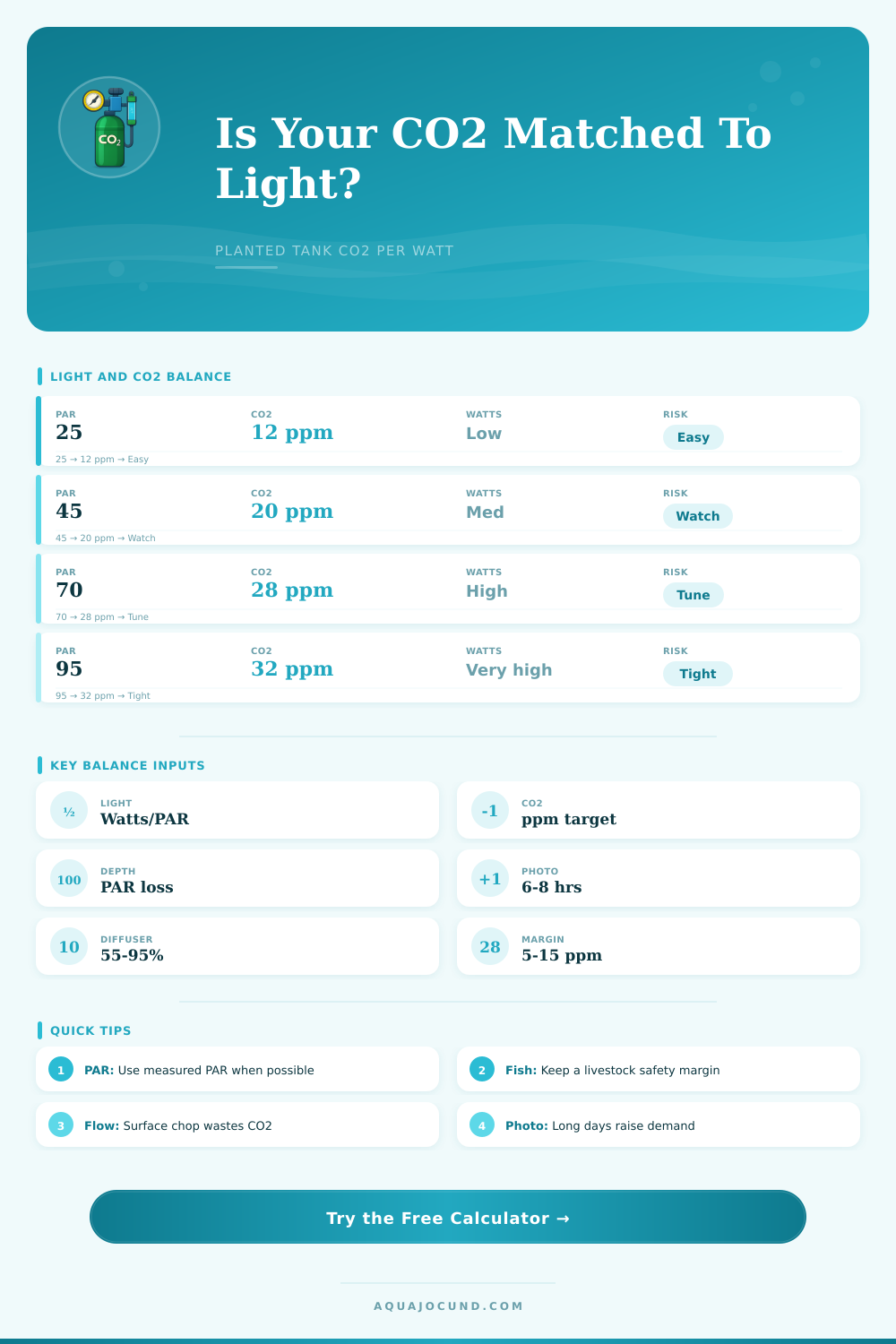
| 15-30 PAR | 8-15 ppm | 6-8.5 hr/day | Low demand and algae-resistant |
| 30-45 PAR | 15-20 ppm | 6-8 hr/day | Moderate growth with easy tuning |
| 45-65 PAR | 20-26 ppm | 6-7.5 hr/day | Strong plant growth, needs consistency |
| 65-85 PAR | 26-30 ppm | 6-7 hr/day | High demand; margin gets tighter |
| 85+ PAR | 28-35 ppm | 5.5-6.5 hr/day | Advanced tuning and livestock caution |
| Common Tank | Dimensions | Volume | Typical Balance Target |
|---|---|---|---|
| 10 gallon | 20 x 10 x 12 in / 51 x 25 x 30 cm | 38 L | 12-20 ppm at 10-25 W LED |
| 20 long | 30 x 12 x 12 in / 76 x 30 x 30 cm | 76 L | 18-26 ppm at 25-45 W LED |
| 29 gallon | 30 x 12 x 18 in / 76 x 30 x 46 cm | 110 L | 20-28 ppm because depth reduces PAR |
| 40 breeder | 36 x 18 x 16 in / 91 x 46 x 41 cm | 151 L | 22-30 ppm for dense planting |
| 55 gallon | 48 x 13 x 21 in / 122 x 33 x 53 cm | 208 L | 24-30 ppm with strong spread |
| 75 gallon | 48 x 18 x 21 in / 122 x 46 x 53 cm | 284 L | 24-32 ppm for high light layouts |
| 125 gallon | 72 x 18 x 21 in / 183 x 46 x 53 cm | 473 L | 24-32 ppm with even distribution |
| Adjustment | Planning Effect | Typical Range | Why It Matters |
|---|---|---|---|
| Surface agitation | CO2 loss multiplier | 0.90-1.35 | More surface renewal strips CO2 faster |
| Diffuser efficiency | Delivery multiplier | 45-95% | Lower efficiency needs more injection for same ppm |
| Plant density | Demand multiplier | 0.85-1.25 | Dense fast growth consumes carbon faster |
| Photoperiod | Light pressure | 5.5-9 hr/day | Long days can outpace safe CO2 targets |
| Livestock margin | Target cap | 5-15 ppm | Keeps the suggested target below the group cap |
Then again you may spend big money on CO2 systems and lights but your tank turns green with algae. This happen because you purchased them separately rather than as parts of a single process. The plants don’t read shopping lists or invoices. They only know that they require dissolved carbon and light striking their substrate. If one is missing, the other becomes waste or pollution.
After plugging in your tank sizes and your fixture details, the calculator do the work. You no longer have to guess how much is taken up based off depth. For most of us, our journey begins with watts… An accessible metric. However, watts are just a proxy for light pressure. An array of 60-watt fluorescents will be dimmer than a single ten-watt LED if its optics is tighter.
Finding the Right Balance for Your Tank
The tool recognizes this and allows you to specify your fixture type, which includes PAR factors that take those differences into account. Otherwise, you may be starving plant under a bright light or overfeeding carbon in a dimmed tank. Also remember (depth makes a difference). For example, when light strike an eighteen inch deep tank’s surface it may only be half as bright at the substrate level. That energy are needed by rooted plants.
Adding more gas won’t help if your light doesn’t reach the bottom. Adding more won’t matter. It will simply depress the pH but not increase plant growth. The calculator makes up for this loss and provide a reasonable target range.
Where it differs is in the diffuser. Some may only pass through ceramic disc which will break down 60% of the gas, but will let the remaining 40% out into air. Others such as an external reactor or an inline atomizer can get closer to 90%. That’s the reason why it makes a difference to both your wallet and how stable your tanks stays. Every bubble that gets lost is money. The system takes your diffuser choice and then re-calculates the amount of volume being injected based on achieving your desired parts per million. It demonstrate that hardware trumps the raw output capacity.
Now we add some more variables… Surface agitation. A light ripple can help gas exchange without removing all carbon from water. However, strong chop or skimmer-like overflows will act as a degasser, constantly bleeding off pressure to the atmosphere. High flow and low injection can starve plants in a tank, even if bubbles is rising from the substrate. The tool takes into account that loss so you won’t be chasing ppm readings that never stick.
The last guardrail is livestock safety. There’s a limit to what fish and shrimp can tolerate. Beyond 30 parts per million of carbon (CO2), they will be stressed. Too rapid a drop in pH will push them over their comfort zone as they struggle to adapt. Depending on which animal you keep, this creates a safety margin so that the target stays within a livable range. You must strike a balance between animal comfort and plant hunger.
Achieving a nice balance between gas and light isn’t about growing as fast as possible. It’s about establishing an even keel that allows for strong plant life while denying any edge to the algal competition. Let the numbers tell you something (not everything) and tweak accordingly. Watch those leaves. Adjust the dial. Achieve balance… and keep each side of the equation honest. That’s how your tank can breathe easy every single day.