Planted Macro Nutrient Dosing Calculator
Calculate nitrate, phosphate, and potassium dosing for planted aquariums using dry salts or liquid macro solutions, with potassium carryover from KNO3 and KH2PO4 included.
🌿Planted Tank Macro Presets
📐Tank Volume and Macro Targets
Macro Nutrient Dose Estimate
⚙Macro Source Comparison Grid
🔬Dry Salt Nutrient Content
| Source | Main nutrient | Potassium added | Best use |
|---|---|---|---|
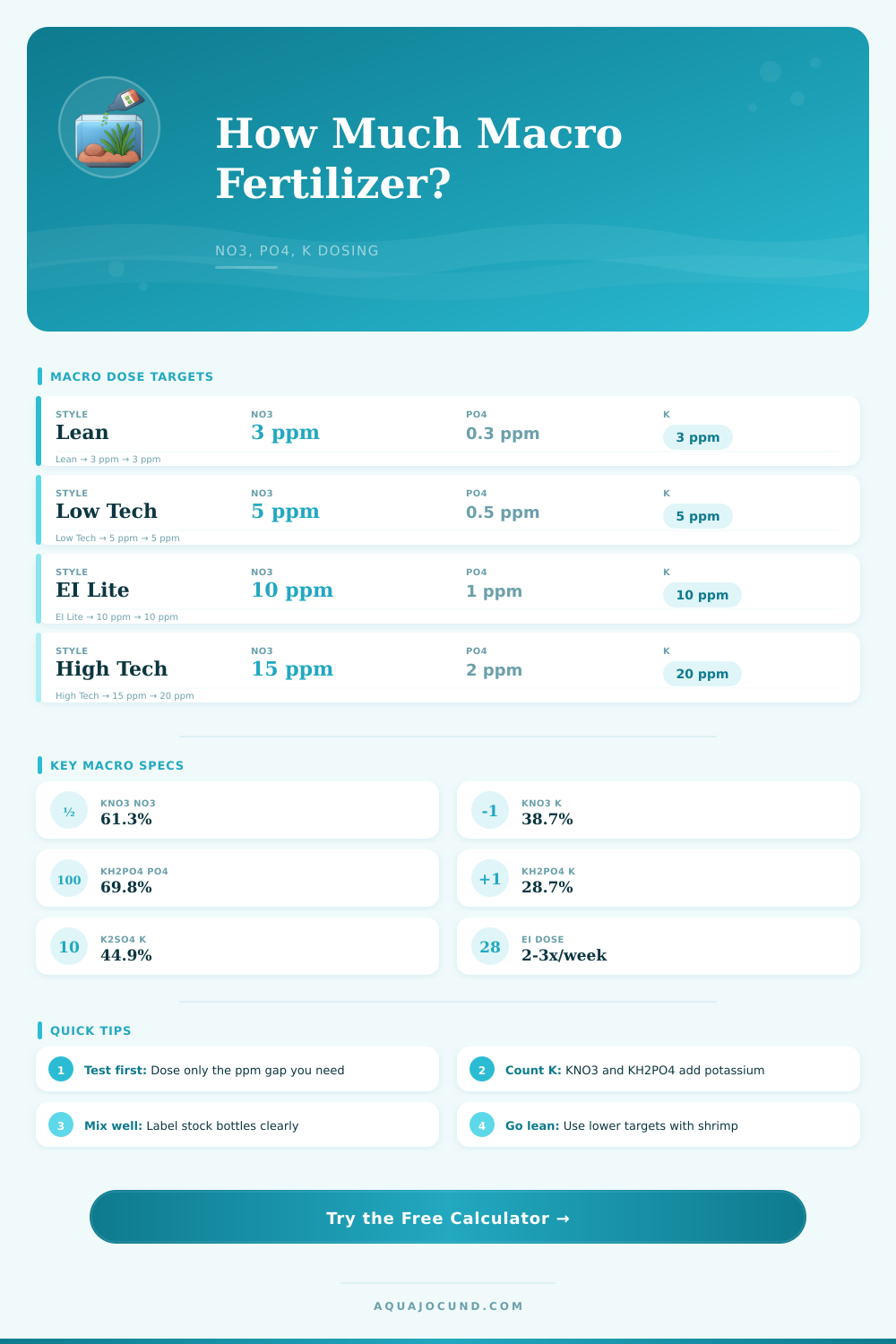
| KNO3 potassium nitrate | 61.3% NO3 | 38.7% K | Nitrate plus K |
| NaNO3 sodium nitrate | 72.9% NO3 | 0% K | Nitrate without K |
| Ca nitrate tetrahydrate | 52.5% NO3 | 0% K | Soft water nitrate |
| KH2PO4 mono potassium phosphate | 69.8% PO4 | 28.7% K | Phosphate plus K |
| K2SO4 potassium sulfate | 44.9% K | 44.9% K | Potassium only |
| KCl potassium chloride | 52.4% K | 52.4% K | Small K corrections |
📊Planted Tank Macro Target Ranges
| Dosing style | NO3 target | PO4 target | K target |
|---|---|---|---|
| Shrimp lean | 2-5 ppm | 0.1-0.5 ppm | 2-6 ppm |
| Low tech planted | 5-10 ppm | 0.3-1 ppm | 5-10 ppm |
| EI lite | 10-15 ppm | 1-2 ppm | 10-20 ppm |
| High light CO2 | 15-30 ppm | 1.5-3 ppm | 20-30 ppm |
| Fish-heavy top-up | 0-5 ppm added | 0.2-1 ppm | 5-15 ppm |
📏Common Tank Macro Dose Planning
| Tank size | Dimensions | Water volume | Typical weekly style |
|---|---|---|---|
| 10 gallon | 20 x 10 x 12 in / 51 x 25 x 30 cm | 38 L | Lean or liquid |
| 20 long | 30 x 12 x 12 in / 76 x 30 x 30 cm | 76 L | Low tech |
| 29 gallon | 30 x 12 x 18 in / 76 x 30 x 46 cm | 110 L | EI lite |
| 40 breeder | 36 x 18 x 16 in / 91 x 46 x 41 cm | 151 L | Split dosing |
| 75 gallon | 48 x 18 x 21 in / 122 x 46 x 53 cm | 284 L | CO2 high tech |
| 125 gallon | 72 x 18 x 21 in / 183 x 46 x 53 cm | 473 L | Stock solution |
🧪Dry Salt vs Liquid Solution Notes
| Method | Input to use | Strength check | Watch-out |
|---|---|---|---|
| Dry dose | Salt grams per tank dose | Use a 0.01 g scale | Pre-dissolve before adding |
| Stock from dry salts | Bottle volume and doses | Shake until dissolved | Label macro-only bottle |
| Commercial liquid | mg nutrient per mL | Read guaranteed analysis | Do not double count K |
| Daily dosing pump | Split into daily dose | Prime tubing first | Check real pump output |
Most planted tank failures begin with the best of intentions; they usually conclude with an algae bloom. Why? This happens because you didn’t know what you were adding or how much of it. You purchased some potassium nitrate, shook it around in the water until it looked just right, then hoped for the best. That might work if you are just guessing while cooking, but that method isn’t any better than guessing amount of salt.
The problem is that when you use the calculator above, all you do is plug-in the target parts per million and size of your tank and let the calculator run numbers for you. It removes volume conversion and coefficient guesswork while converting chemistry to a straightforward recipe.
How to Stop Guessing When You Add Food to Plants
How is this different from your view on plant health? Knowing what potassium, phosphate, and nitrate are allows you to understand their function. Nitrate is fuel; plants can’t make protein without it, hence yellowing of plants. Phosphate is like a spark plug; it helps transfer energy inside plant cells (photosynthesis). Potassium is the structural engineer, it regulates water flow and strengthens cell wall. When any one of these nutrients are absent, the system stalls.
You need to know that these three nutrient act in a certain ratio. Overloading your tank with nitrate, for instance, and leaving phosphate out will result in inefficient usage of nitrogen by plants. Free food for nuisance algae! So, that imbalance kill many aquascapes.
Those errors were prevented by design in this tool. It lets you choose your nitro source (typically potassium nitrate), and then your phos source (mono potassium phosphate). That’s important because each salt contain potassium as well, the tool accounts for that “hidden” potassium in either salt. Many newbies will overdose without knowing it due to carryover, adding another potassium supplement in addition to what they’ve already dosed. By accounting for that contribution first, the calculator allows you to figure out your last dose only from potassium sulfate or chloride. Finally, it keeps you from accidently overdosing, which is far easier to do than underdosing when you are juggling multiple bottles.
What’s my target level? That depends on how you’ve set things up. In one extreme, a lean shrimp tank should have minimal phosphates and nitrates because higher levels will harm the clarity of the water, put stress on invertebrates and make it harder for them to regulate their bodies (osmoregulatory stress). At the other extreme, if you’re running high tech with injected CO2 and strong lighting, you’ll need to feed heavily to accommodate the rapid growth.
The reference tables I include on the page help here. They lay out typical ranges so you can plan what you want to achieve before you begin mixing solutions. Knowing whether you want a jungle or more of a delicate ecosystem, for instance, guides which direction you go.
Another factor that gets some hobbyists tripped up is dosing frequency. While some like to do one big dose each week (usually following a water change), others will use a dosing pump to break up their dose into smaller amounts spread throughout the day. This calculator allows you to configure number of doses per bottle so it suits your preference.
If you choose to go this route (splitting), it tends to keep your nutrients at more consistent levels. This can help prevent plant binging after an extended dry period. It can also help prevent algal blooms resulting from the binge-eating. But splitting does require upkeep (regularly checking for clogs in tubing and drying out) and a good pump. Consistency matters more then perfection on this front.
The advantage of buying liquid commercial fertilizers is that they’re convenient. But also less transparent than making your own by mixing dry salts. With the latter, at least you know exactly how many grams of each ingredient are in every liter of solution. Since molecular weights are fixed constants, you also know the exact percentage of each element, such as potassium or nitrogen. With a proprietary liquid you have no choice but to believe its label.
If you like liquid fertilizer, though, you can still enter your own custom strength(s), as long as you want. And then you can see exactly how much salt goes into a five-hundred milliliter bottle versus a two-liter jug. It is a five-hundred milliliter bottle. So inventory management is also simpler; you won’t end up with some stock solutions more concentrated than others from sloppiness or evaporation over time.
The last step cannot be substituted by any calculator: testing! These figures here are starting points, depending on the concentration change you want relative to the volume of water. They don’t factor in what your substrate may leach (i.e., nutrients), or amount of food you might have fed the day prior. Before dosing, test kits will tell you where you’re starting from. Measure the difference between where you’re at versus where you want to be, then add the calculated dose that fills the appropriate gap. That’s a feedback loop that turns guessing into accuracy.
Begin with conservative targets, observe plant response, and tweak accordingly. Last, we don’t just add stuff, we foster life, one measured drop at a time.