Pico Tank Stocking Calculator
Estimate safe pico stocking from real water volume, surface area, candidate species, adult count, shrimp, snails, filtration, tank maturity, feeding, planting, and water-change routine.
📏Tank volume and surface area
Use exposed water surface, not glass footprint, for covered or partitioned pico tanks.
🐟Stocking plan
🧪Filtration and maintenance
Use gentle real flow through sponge, matten, hang-on-back, or internal filter media.
Calculation Breakdown
📊Selected stocking profile
🧭Species suitability comparison grid
| Candidate | Pico suitability | Minimum group | Minimum tank | Why it matters |
|---|---|---|---|---|
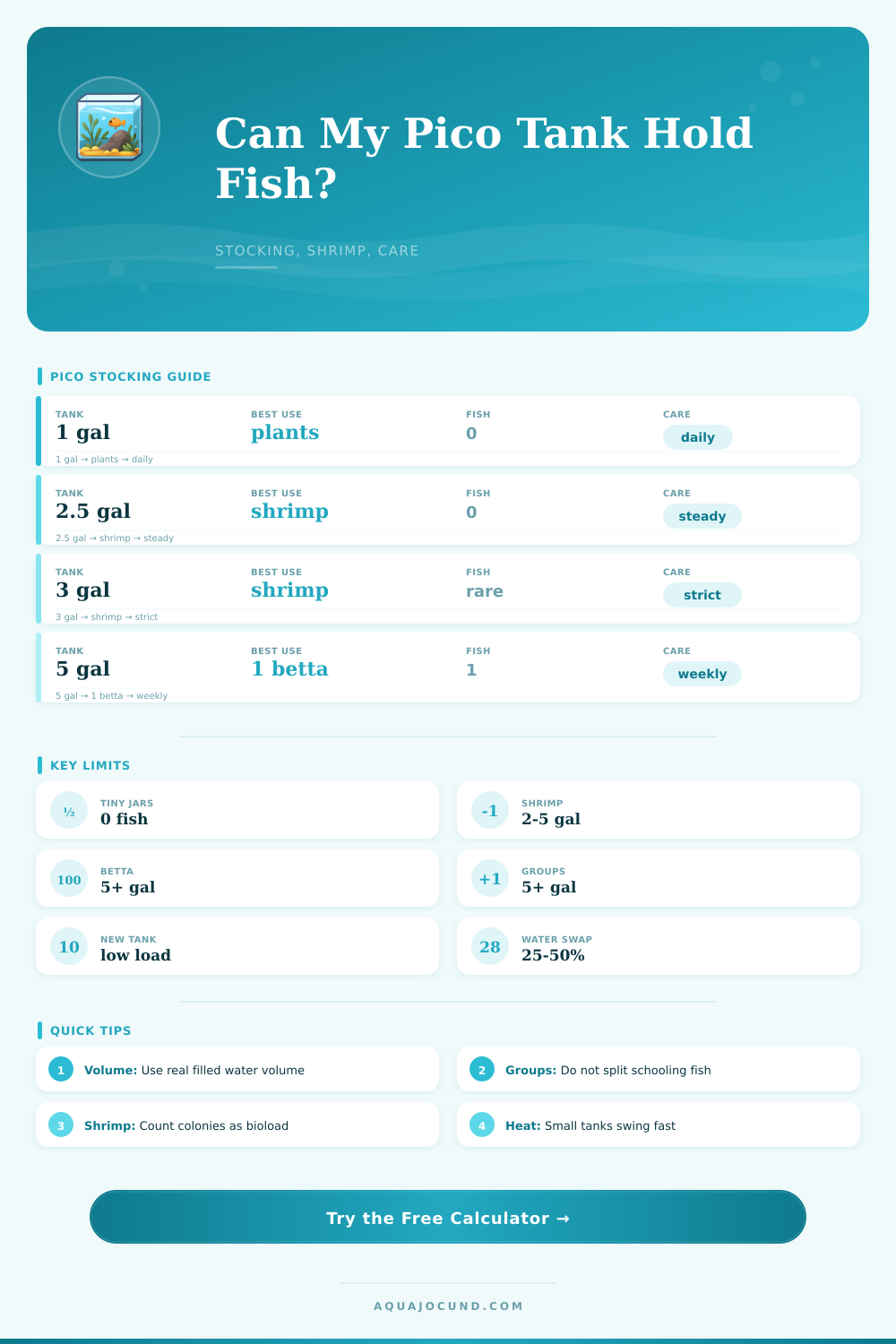
| Shrimp and snails only | Excellent | Colony | 1 to 2 gal / 4 to 8 L | Low bioload, still needs stable water |
| Single betta | Good at 5 gal | 1 | 5 gal / 19 L | Needs warmth, cover, and surface access |
| Least killifish | Possible | 3 | 3 gal / 11 L | Small livebearer, colony can multiply |
| Chili rasbora | Borderline | 6 | 5 gal / 19 L | Needs group comfort and calm flow |
| Clown killifish | Borderline | 4 | 5 gal / 19 L | Surface fish, jump risk, stable cover |
| Male Endlers | Borderline | 3 | 5 gal / 19 L | Active fish; avoid breeding colony in pico |
| Ember tetra | Poor | 6 | 10 gal / 38 L | Schooling and swimming space limit |
| Pygmy cory | Poor | 6 | 10 gal / 38 L | Group and floor area are too limited |
📐Pico tank volume reference
| Nominal size | Typical dimensions | Usable water after scape | Stocking direction |
|---|---|---|---|
| 1 gallon jar | 8 x 8 x 8 in / 20 x 20 x 20 cm | 0.7 to 0.9 gal / 3 to 3 L | Plants, micro snails, no fish |
| 2 gallon cube | 9 x 9 x 10 in / 23 x 23 x 25 cm | 1.5 to 1.8 gal / 6 to 7 L | Shrimp colony, no fish |
| 2.5 gallon tank | 12 x 6 x 8 in / 30 x 15 x 20 cm | 2.0 to 2.3 gal / 8 to 9 L | Shrimp and snails only |
| 3 gallon long | 14 x 8 x 8 in / 36 x 20 x 20 cm | 2.5 to 2.8 gal / 9 to 11 L | Shrimp; very limited fish cases |
| 5 gallon standard | 16 x 8 x 10 in / 41 x 20 x 25 cm | 4.1 to 4.6 gal / 16 to 17 L | Single betta or tiny group with care |
| 5.5 gallon standard | 16 x 8 x 10 in / 41 x 20 x 25 cm | 4.6 to 5.0 gal / 17 to 19 L | Best upper edge of pico stocking |
| Bioload item | Calculator load | Hidden risk | Adjustment to use |
|---|---|---|---|
| Single betta adult | 3.2 to 3.6 points | Warm water raises metabolism | Use normal or strict margin |
| Tiny schooling fish | 0.55 to 0.75 points each | Group minimum can exceed capacity | Keep group intact or choose no fish |
| Dwarf shrimp | 0.035 points each | Colony grows after feeding well | Enter the expected adult colony |
| Small snail | 0.18 points each | Uneaten food increases snail waste | Raise feeding intensity if algae wafers are used |
| Pea puffer | 3.8 points each | Messy frozen foods and hunting behavior | Needs strong filtration and larger planning |
| Maintenance factor | Low risk | Watch closely | High risk |
|---|---|---|---|
| Biofilter age | 3+ months stable | 1 to 3 months | Under 4 weeks |
| Weekly water change | 25 to 40% | 15 to 25% | Under 15% |
| Temperature swing | Under 2 F / 1.1 C | 3 to 4 F / 2.2 C | Over 5 F / 2.8 C |
| Surface movement | Gentle ripple | Still corners | Film or stagnant top |
| Feeding control | Food gone fast | Occasional leftovers | Regular uneaten food |
💡Pico stocking tips
Small tanks are appealing because they’re neat in their glassy spaces, use minimal power, and take up hardly any real estate on the floor. A one gallon jar should be like a miniature version of a bigger tank, right? Nope. Biological systems has no regard for whether you’re keeping fish in a big tank or a little tank. They don’t care what it looks like or how much room it occupies. A tiny tanks water chemistry will rapidy change, and it will punish you swiftly for any mistakes.
Use this calculator to run the numbers for you. Plug in your desired livestock and dimensions, and it will tell you whether your set-up has a chance at surviving long haul.
Why Small Fish Tanks Are Hard to Keep
Most folks begin with volume, assuming that is all they have to worry about. They purchase a so-called 5g tank and reason it has five gallons of liveable space. What they don’t consider is displacement. Thick plants, substrate, and rock all physically occupy space within the glass. A deep layer of gravel or lots of heavy hardscape can reduce amount of liveable space in your tank to less than its advertised size. Half-filling a tank with something heavy will result in maybe three gallons of actual water to support life within it.
Diluting waste and providing sufficient surface area for gas exchange to provide oxygen is key for your fish. Remember: The tool asks for the water height, not external dimensions. Think about how much space actually contains water versus how much hold rocks. So once you know the actual volume, you’re left with surface area.
Gas exchange occurs in the uppermost layer of water because there are no air bubbles inside your filter to do this for you. So, imagine taking a tall, skinny vase. While it may hold lots of volume, it has extremely low surface area. This means the water will be very still and dangerous. It will appear perfectly fine on the surface. The calculator takes this into account because although two vases might contain equal volumes, a shallow, wide bowl is safer for a betta than a thin, deep column.
In other words, you’re accounting for how much breathing space your fish have in comparison to their metabolic output. Yes, the number of gallons matters, but so does how well that water can refresh itself with oxygen. That’s where this comes into play, which is why I have that reference table on the page detailing some scores for the relative suitability for various species.
Five gallons will work great for one betta provided it’s filtered gently and has decent surface area. Six chili rasboras will probably perish within the same five gallon container, but not due to waste output. They’ll need space to swim and feel safe. Enough so that they’re comfortable behaving naturaly as a group.
The hidden difference between failed pico tanks and successful pico tanks is maintenance. Because there’s so much water in big tanks, a mistake won’t hurt you. For example, if you don’t do a water change for a week, the water mass will dilute any toxins just enough to keep your fish alive most of the time. However, a single missed maintenance day will spike your ammonia levels into the toxic range in a matter of hours in a two-gallon cube.
How frequently do you commit to doing a water change? How long after cycling did you start adding fish? How old and established is your biological filter? These variables affects how much waste your biological media can handle. Therefore, the calculator takes these factors into account when recommending a good amount of water to change.
A brand new tank has zero beneficial bacteria. It is biologically sterile; in the best possible way, meaning it can’t process waste whatsoever. Before you feed fish, you must feed the system. So getting a higher safety rating comes from having a fully cycled mature tank versus putting livestock into a new tank. It teaches patience. The most difficult aspect of maintaining small tanks.
Folks want to get something in right away. The water’s clean, it must be OK! Clean and okay are two different things. Nitrates can build up for weeks without being visible. Once they stress your fish enough to make them sick, you will see just how unsafe your water has been.
You should think differently about your stock density. “How much waste can I export?” isn’t a bad question. “How many fish can I fit?” is different question. A betta exports more waste then a shrimp. Shrimp produce less waste per individual than a betta. However, when you have a breeding colony, they will expand exponentially. Ten shrimp go into the planner. Three months later, there are forty because they multiplied. Your waste load just quadrupled without any change in tank size. To make up for this reality, the tool considers shrimp numbers to be meaningful bioload amounts.
Why? Because you need to think not of those cute little babies in the bag at the LFS, but of what their adult selves will do in your tank.
Temperature stability also gets overlooked until it’s too late. Small tanks heat up (and cool down) quickly. That same air conditioner can chill a two-gallon tank faster than it can chill a fifty-gallon setup. Because of that draft, that tank will cool down faster. This puts stress on the fish and weakens their immune system. Parasites love stressed out fish. For this reason, temperature fluctuations (daily or otherwise) are a penalty in the calculator.
Stability matters far more then exact values. If your water chemistry sucks but it’s stable, you’ll be ok. The key is that you will also do better during bad days when things stay stable.
Bottom line: running a pico tank successfully requires far less attention to getting the “right” gear as it does knowing its limitations and running within them. That means leaving some space open. That’s where your safety margin lies.