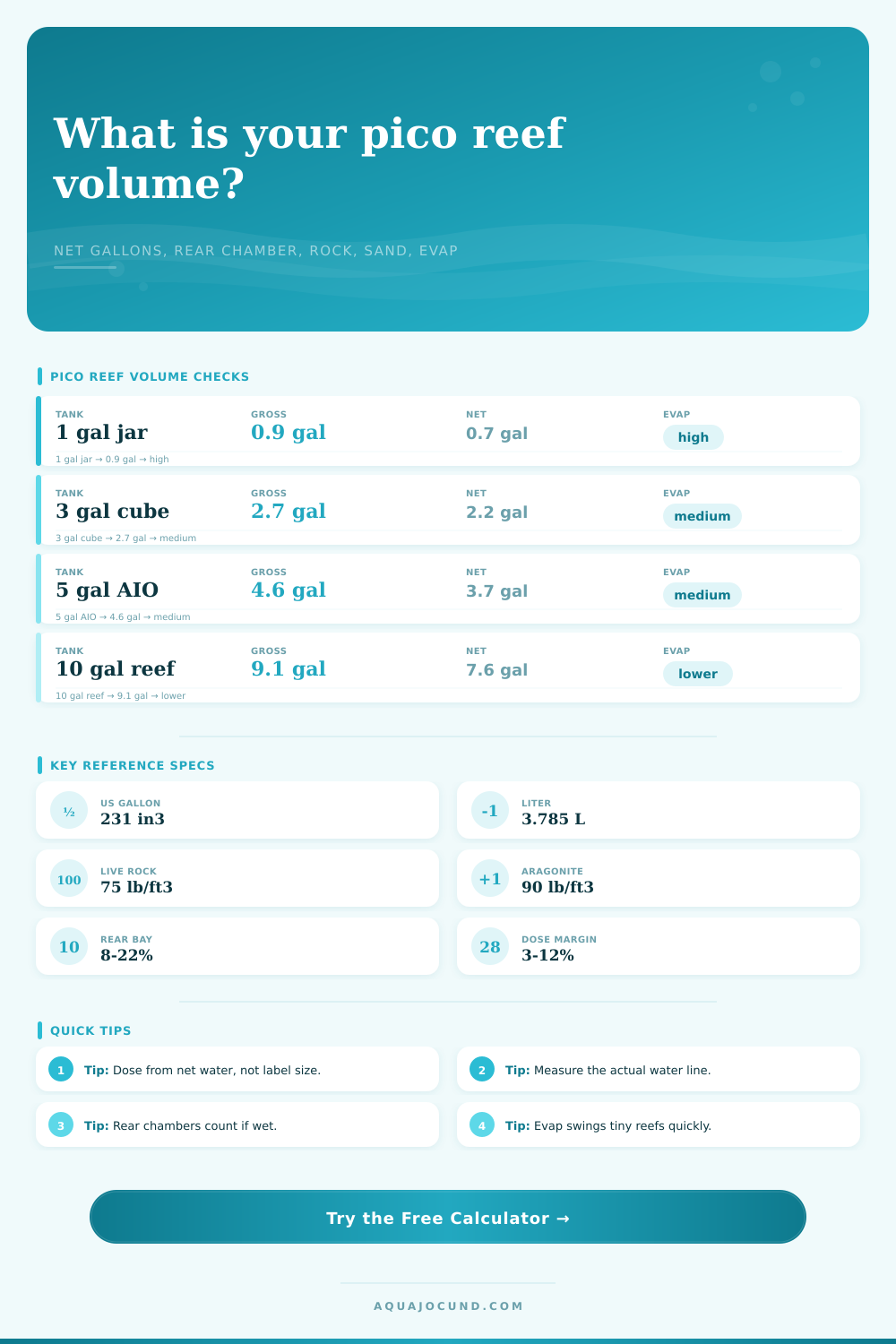
Pico Reef Volume Calculator
Estimate the real dosing volume of a tiny reef after rear chamber water, fill line, rock, sand, and evaporation sensitivity are counted.
📌Pico Reef Presets
⚙Calculator Inputs
Calculation Breakdown
📊Current Volume Grid
🗂Pico Reef Comparison Grid
🧱Rock Displacement Reference
| Rock type | Density used | Water exclusion | Best estimate use |
|---|---|---|---|
| Porous live rock | 75 lb/ft³ / 1200 kg/m³ | 68% | Mature reef rock with visible pores |
| Dry reef rock | 82 lb/ft³ / 1310 kg/m³ | 72% | Common aragonite reef structure |
| Ceramic bio media rock | 62 lb/ft³ / 990 kg/m³ | 55% | Very porous artificial structures |
| Branch rock | 88 lb/ft³ / 1410 kg/m³ | 74% | Open branches with less compact mass |
| Rubble zone rock | 78 lb/ft³ / 1250 kg/m³ | 70% | Back chamber rubble or small chunks |
| Dense base rock | 105 lb/ft³ / 1680 kg/m³ | 88% | Heavy foundation pieces |
| Minimal frag plug rock | 95 lb/ft³ / 1520 kg/m³ | 80% | Frag racks, plugs, tiny islands |
📐Common Pico Reef Size Reference
| Pico style | Typical inside dimensions | Rear chamber range | Usual dosing net |
|---|---|---|---|
| 1 gallon reef jar | 7 in diameter x 6 in fill / 18 x 15 cm | 0% | 0.6 to 0.8 gal / 2.3 to 3.0 L |
| 2 gallon desk cube | 8 x 8 x 7.5 in / 20 x 20 x 19 cm | 0-8% | 1.4 to 1.7 gal / 5.3 to 6.4 L |
| 3 gallon soft coral cube | 10 x 8 x 8.5 in / 25 x 20 x 22 cm | 0-12% | 2.1 to 2.6 gal / 8 to 10 L |
| 5 gallon AIO pico | 12 x 8 x 9 in / 30 x 20 x 23 cm | 12-20% | 3.5 to 4.2 gal / 13 to 16 L |
| 8 gallon cube AIO | 12 x 12 x 11 in / 30 x 30 x 28 cm | 14-22% | 6.2 to 7.0 gal / 23 to 26 L |
| 10 gallon nano reef | 20 x 10 x 11 in / 51 x 25 x 28 cm | 8-16% | 7.2 to 8.6 gal / 27 to 33 L |
🌊Rear Chamber And Fill Line Reference
| Adjustment | Typical range | Volume effect | Use in calculation |
|---|---|---|---|
| Rear chamber footprint | 8-22% of tank footprint | Adds hidden water or removes display footprint | Enter the chamber share behind the divider |
| Rear operating fill | 75-100% of display fill | Lower pump bays reduce system water | Use the normal running level, not pump-off level |
| Water line below rim | 0.25-1.25 in / 0.6-3.2 cm | Large percent loss in tiny tanks | Measure after flow is running |
| Sand coverage | 0-100% of display footprint | Sand displaces water only where it sits | Reduce coverage for bare islands or rock bases |
| Dosing safety margin | 3-12% | Rounds volume downward | Useful for strong additives in tiny reefs |
💧Evaporation Sensitivity Reference
| Dosing-safe volume | 50 mL/day evap | 100 mL/day evap | Salinity attention |
|---|---|---|---|
| 0.75 gal / 2.8 L | 1.8% per day | 3.5% per day | Top off very often |
| 2.0 gal / 7.6 L | 0.7% per day | 1.3% per day | Daily top off is important |
| 4.0 gal / 15 L | 0.3% per day | 0.7% per day | Stable with routine top off |
| 8.0 gal / 30 L | 0.2% per day | 0.3% per day | Lower daily swing |
💡Practical Tips
For example, you bought a one gallon reef jar because it’s a gallon of water (on the label) and it’ll fit on your desk. It sounds easy. But once you fill it with some rock, some sand, and some live coral, you realize your alkalinity isn’t doing what it should have be doing after each dose.
Why? It is not because you’re dosing wrong. Because you’re dosing based off a volume of water that doesn’t realy exist in the glass anymore. Tank sizes advertised aren’t chemical reality; they’re marketing reality.
Why Your Tank Volume Is Wrong
Enter your dimensions into the calculator above, and let it do all the number crunching so you don’t have to guess at conversions and factors. One of those factors is how much volume things like rock and sand displaces. The water level is also a factor. The fill line limits how much water you can hold. When the pump turns on, nobody fills their tank to the top because then you gets waves spilling over the side.
Losing even half an inch in height from a little tank is huge. It’s not just a small change in the percentage of your total volume. So what you think is ten gallons might realy be only eight, depending on how high the water gets. That changes how fast water evaporates it also changes your calcium requirements. It is small, but it is important.
Finally, we have the rear chamber. An all-in-one tank appears as one solid block of glass, but it’s divided up into two chambers (the sump and display). Even though the hidden back bay is water within your system, it doesn’t necessarily hold as much than the front. For example, if your pump chamber is holding ninety percent of the display height, then it has fewer gallons than what’s suggested by its footprint.
This tool allows you to change both the fill level AND the chamber percentage so you get an accurate view of how many gallon are actualy being used.
Until your settings fail, most folks never think about the hidden reservoir. Water takes up physical space that rock and sand take up. Adding a pound of rock to a gallon of water won’t change the fact that you still only have a gallon of water. Rocks (live or otherwise) displaces water. Heavy rocks with low porosity like ceramic media are less dense than porous live rock; therefore, they will displace water differentaly. A heavy rock structure displaces more water then a lightweight branching rock structure.
The table on this page helps with this. Different substances impact the final amount differently. Because volume is small in a small tank, overdosing is much easier than underdosing. A small mistake in estimating volume becomes a big difference in concentration.
A big tank seems like it loses less water from evaporation because it’s such a small percentage. A hundred mils/day isn’t much in a pico. However, that is a three percent change in salinity if you aren’t topping off. This wrecks the nitrifying bacteria and stresses corals. Knowing your net volume will show you how prone your system is to evaporative loss. If you’re on the dry side, top off more frequently.
The size of water you lose doesn’t matter. It’s the ratio of what you lose versus what you have. Additives such as trace elements and/or alkalinity are potent, and a five-gallon error in a ten-gallon tank is a fifty percent mistake. You want to be precise with dosing! For this reason, I recommend figuring your net volume conservatively. That way, you’re safe against accidentally overdosing any product.
This feature exists within the calculator and you can specify a “safety margin” amount that will round the volume downward so you always stay on the safe side. It’s great for starters who don’t know how their particular setup reacts to a change yet. It’s not about having the precise number of milliliters of water. It’s about getting as close as possible so you can dose safely while maintaining stable parameters.
Getting your tank stabilized means you’re no longer depending on sticker on the glass but rather the water actualy available to do chemistry with. The inputs becomes consistent with the reality and the parameters stop their swings. That’s when you create a reef that thrives consistently.
It is not by luck, but by design. That’s the secret to keeping those tiny ecosystem alive.