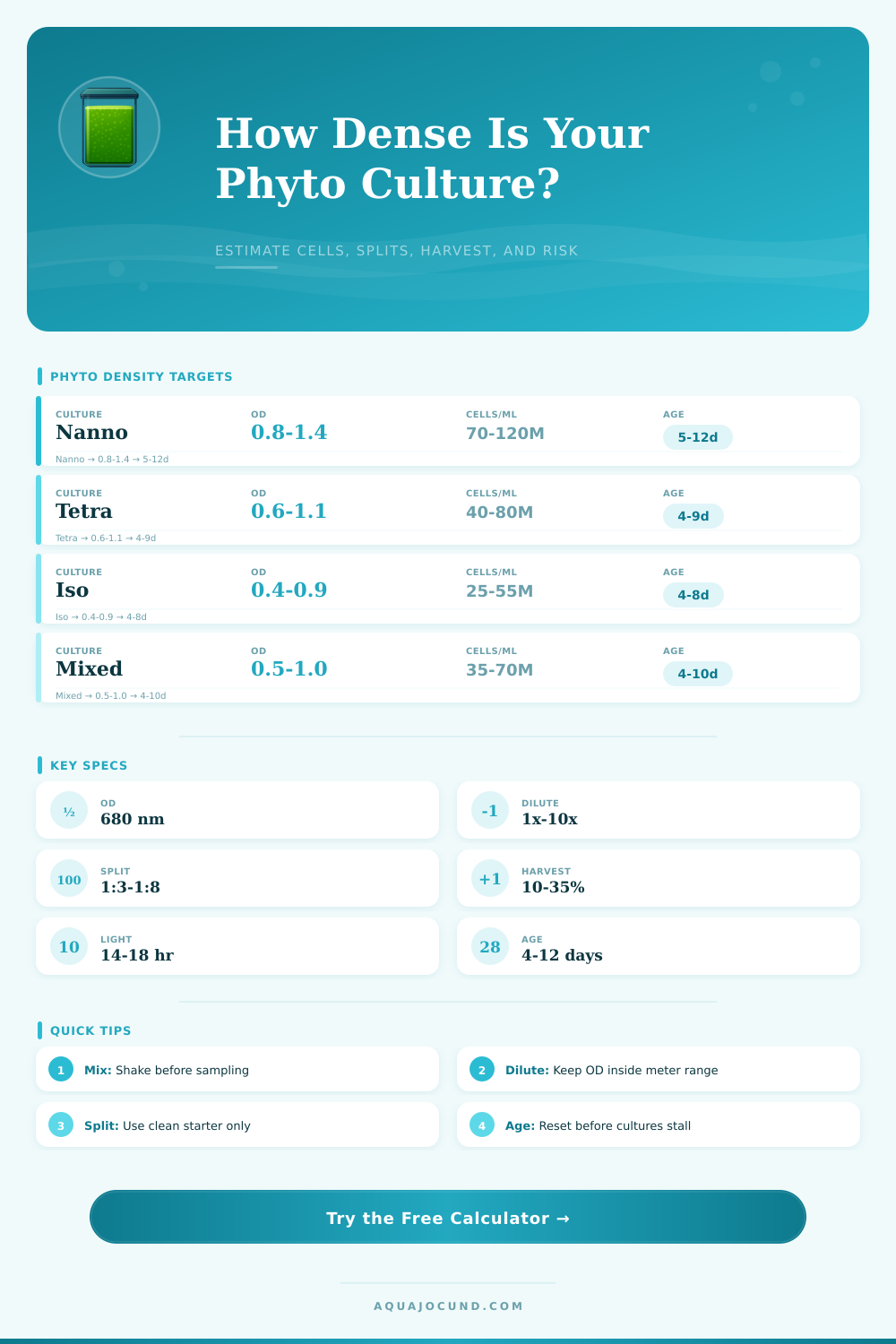
Phytoplankton Culture Density Calculator
Estimate culture density, split ratio, daily harvest volume, starter inoculation, and age-based crash risk from a simple optical density proxy.
Calculation breakdown
| Culture | Cells/mL at OD 1 | Routine OD target | Typical split | Crash watch age |
|---|---|---|---|---|
| Nannochloropsis | 85 million | 0.8 to 1.4 | 1:4 to 1:8 | 10 to 14 days |
| Tetraselmis | 65 million | 0.6 to 1.1 | 1:3 to 1:6 | 8 to 11 days |
| Isochrysis / T-Iso | 55 million | 0.4 to 0.9 | 1:3 to 1:5 | 7 to 10 days |
| Chlorella | 90 million | 0.8 to 1.5 | 1:4 to 1:8 | 10 to 15 days |
| Chaetoceros | 40 million | 0.4 to 0.8 | 1:2 to 1:4 | 6 to 9 days |
| Rhodomonas | 35 million | 0.3 to 0.7 | 1:2 to 1:4 | 5 to 8 days |
| Spirulina | 20 million | 0.7 to 1.4 | 1:3 to 1:6 | 12 to 18 days |
| Mixed reef phyto | 60 million | 0.5 to 1.0 | 1:3 to 1:6 | 8 to 12 days |
| Vessel | Metric volume | US volume | 20% harvest | Starter at 1:4 |
|---|---|---|---|---|
| Small bottle | 1 L | 0.26 gal | 200 mL/day | 250 mL |
| Soda bottle | 2 L | 0.53 gal | 400 mL/day | 500 mL |
| Bench jar | 4 L | 1.06 gal | 800 mL/day | 1.0 L |
| Small carboy | 10 L | 2.64 gal | 2.0 L/day | 2.5 L |
| Large carboy | 20 L | 5.28 gal | 4.0 L/day | 5.0 L |
| Culture tote | 40 L | 10.6 gal | 8.0 L/day | 10 L |
| Corrected OD | Visual cue | Density use | Split action |
|---|---|---|---|
| 0.15 to 0.35 | Light tint | Early growth | Do not harvest heavily |
| 0.35 to 0.70 | Readable color | Building density | Small harvest only |
| 0.70 to 1.20 | Opaque green/brown | Routine harvest | Split on schedule |
| 1.20 to 1.80 | Very dark | Dense starter | Dilute or split soon |
| Above 1.80 | Almost black | Stressed dense culture | Reset backup culture |
| Culture condition | Daily harvest | Starter reserve | Risk note |
|---|---|---|---|
| Young and pale | 0 to 10% | Keep all | Allow density rise |
| Healthy target OD | 10 to 25% | 20 to 35% | Routine production |
| Dense but young | 25 to 40% | 25 to 40% | Split before shading |
| Old and dense | 0 to 15% | Cleanest top layer | Backup and reset |
| Clumping or clearing | 0% | Use backup only | Likely crash |
It begins with a bottle of cloudy water. Your rotifers appear happy enough…for now. It’s green and smells like the ocean…it appears fine to the naked eye. But hiding within that bottle, there is a biological clock ticking.
Cultures of phytoplankton aren’t static reserves. They’re living factories. They grow fast, they peak quickly, and they crash hard if you ignores the signals. The difference between a smelly puddle of dead algae and a steady supply of food for your larvae usually boils down to one thing. Before it happens to you, you need to know what is actualy happening inside that liquid.
How to Grow Phytoplankton Correctly
Hobbyists use color as their main indicator. Good = dark green. But then they’re often wrong. Pigment concentration doesn’t equal health/cell count. A culture may appear vibrant but be old & stressed-out and poised to fall apart at the first sign of temperature fluctuation. So instead, optical density readings matters. An OD reading at 680 nanometers measures the amount of light the cells absorb. In other words, it measures biomass.
That OD reading in raw form goes into the calculator above. It does the math for you, translating that raw number into split ratio estimates, harvest volume estimates, and estimated cell counts. It translates your vague feeling of “I think this is ready” into something concrete. But here’s the thing: The numbers are only meaningful if you know what those inputs mean in the real world.
Sure, volume is straightforward. But then there’s the dilution factor. Dilute? You say. Oh, yeah. Then you’ve got to add some media or sterile water because your sample is so dark the meter can’t even read it. And once you enter that dilution ratio into the tool, it’ll adjust the reading back up to full strength. Otherwise, all of the other numbers throughout your process is guesses. Think you’re starting a new batch with ample starter culture? You really only have half of what you thought. That’s what most people screw up on. They take their meter reading as truth, without factoring in how they prepared the sample.
Then there’s the factor of age, day ten and day three cultures can be exactly the same color yet very different internally. Young cultures is actively growing, hungry, and in exponential growth mode. Old cultures have depleted nutrient resources and has collected waste products. This causes the population to crash and wipe everything out overnight. To guess how likely this is, the tool accounts for the age of your culture. It warns you if things aren’t going well so you know when to harvest gently or reset the whole batch by adding fresh media and clean starter cells.
Culture splitting is the art of splitting your culture. The trick here is how do you split your culture? It’s half biology, half ambition. Don’t assume you can throw all your algae in one big bucket and it will be OK. Overdilute and your cells won’t have enough food to fight over; they’ll go really slowly because there’s so much room between them. Underdilute and your culture will shade itself out. The light won’t penetrate very far, and the lower levels starves.
The chart on this page gives some general split ratios (how much more water to put in) based off common species. For example, sensitive Isochrysis can only take thinner splits compared to Nanno which tolerates denser ones. Following these general rules avoids the mistake of pushing a slow growing species into an unrealistic rapid expansion plan.
Density management also has a lot to do with light cycles. Home growers typically maintain their plants under a fifteen or sixteen hour light period, and this can be fine for routine care each day. However, if you are managing high density because you are waiting for harvest day, you may push things a little longer. You must assume your cooling system can handle the bulb’s heat. Often density issues hide a temperature problem. Twenty-four degrees Celsius may seem like a solid culture, but it will crash quickly if it spikes into the thirties. The calculator takes the temperature input and adjusts growth expectations accordingly. Biology meets environment, and it tells you so.
Ultimately, growing phytoplankton isn’t so much about forcing nature as it is understanding her rhythms. It’s like tending a miniature ecosystem, one which reacts immediately to shifts in your inputs: food, light, available space. With accurate measurements, you can eliminate guesswork and transform worry into habit. That milky liquid in the bottle no longer appears mysterious; now it’s just something you know how to control. No more wondering whether you’re ready for culture; now you’ll always know precisely when you are.
It would of been better if you had known sooner.