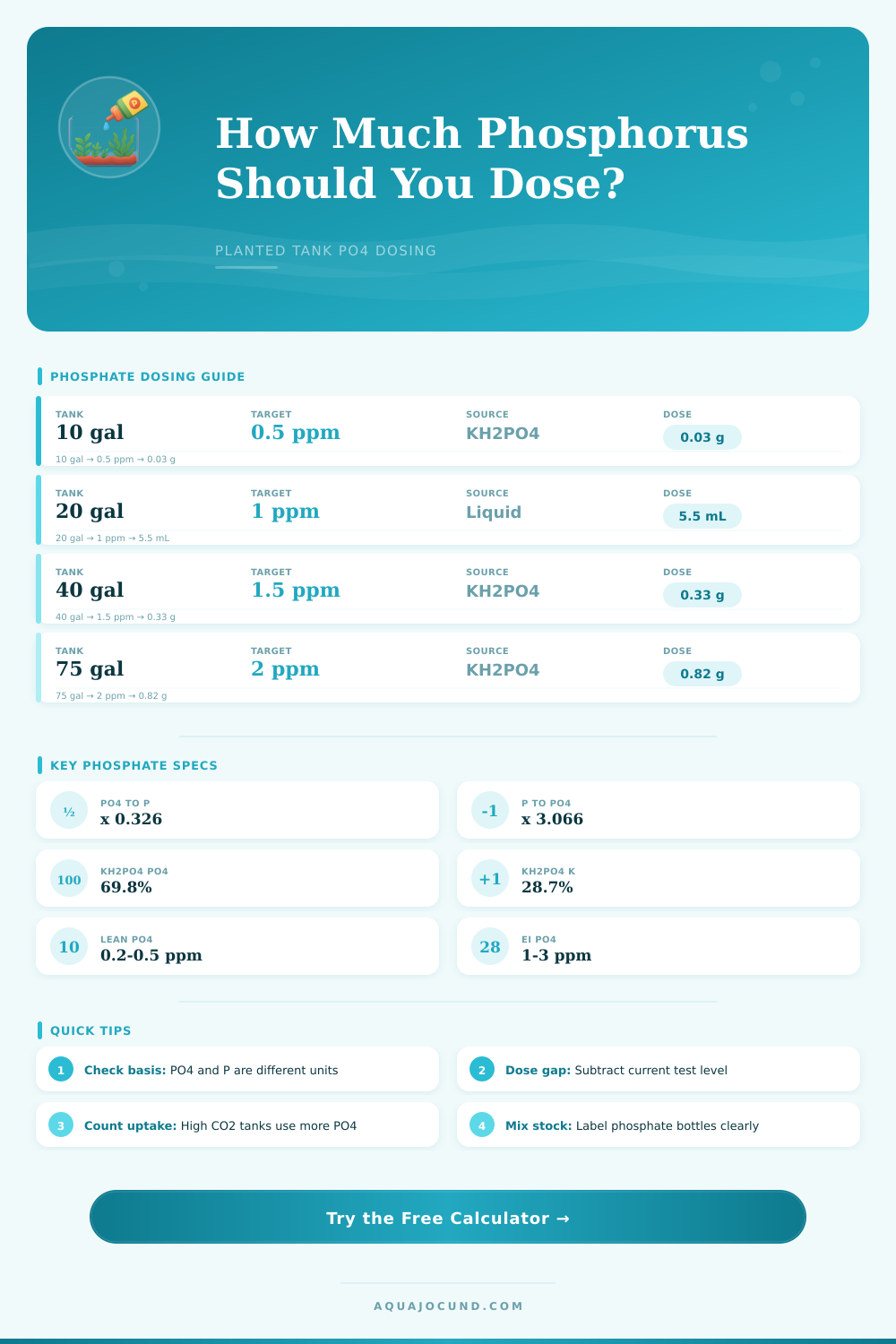
Phosphorus Dosing Calculator
Calculate planted tank phosphate dosing from PO4 or elemental P targets, fertilizer source, tank volume, uptake demand, and dosing schedule.
🌿Real Planted Tank Presets
📏Tank Volume
🧪Phosphate Target and Fertilizer Source
💡Plant Demand and Uptake Between Doses
Phosphorus Dose Estimate
⚗Phosphate Source Comparison
📋Dry Salt and Liquid Source Specs
| Source | PO4 equivalent | Other ion added | Best use |
|---|---|---|---|
| KH2PO4 | 69.78% PO4 | 28.73% potassium | Most planted tank dry dosing |
| K2HPO4 | 54.52% PO4 | 44.89% potassium | When extra K is acceptable |
| NaH2PO4 | 79.16% PO4 | 19.16% sodium | Potassium-free phosphate dosing |
| NaH2PO4.H2O | 68.82% PO4 | 16.66% sodium | Hydrated sodium phosphate salts |
| Na2HPO4 | 66.90% PO4 | 32.38% sodium | Buffer-aware phosphate use |
| Liquid concentrate | User mg/mL | Formula dependent | Small tanks and easy measuring |
🌱Planted Tank PO4 Target Ranges
| Dosing style | PO4 target | Typical demand | Notes |
|---|---|---|---|
| Lean shrimp tank | 0.10-0.40 ppm | Very low | Use small liquid or dilute stock doses |
| Low tech community | 0.30-0.80 ppm | Low to moderate | Weekly or twice-weekly is common |
| Balanced CO2 planted | 0.80-1.50 ppm | Moderate | Best with nitrate and potassium balance |
| EI high tech | 1.50-3.00 ppm | High | Often split across 2-3 macro doses |
| New aquasoil start | 0.50-1.50 ppm | Variable | Soil can bind or release phosphate |
📐Common Tank Dose Examples with KH2PO4
| Tank | Water volume | PO4 rise | KH2PO4 dose |
|---|---|---|---|
| 5.5 gallon nano | 4.8 gal / 18 L | 0.50 ppm | 0.013 g |
| 10 gallon standard | 8.8 gal / 33 L | 0.75 ppm | 0.036 g |
| 20 long | 17.5 gal / 66 L | 1.00 ppm | 0.095 g |
| 40 breeder | 35 gal / 132 L | 1.50 ppm | 0.284 g |
| 75 gallon | 66 gal / 250 L | 2.00 ppm | 0.717 g |
💧Schedule and Uptake Reference
| Setup | Daily PO4 uptake | Best schedule | Adjustment cue |
|---|---|---|---|
| Sparse low light | 0.02-0.06 ppm | Weekly | Reduce if PO4 accumulates |
| Low tech planted | 0.05-0.12 ppm | 2 times weekly | Watch slow plant response |
| CO2 stem tank | 0.12-0.25 ppm | 3 times weekly | Keep nitrate stable too |
| High tech aquascape | 0.25-0.45 ppm | Daily or 3 times weekly | Test before water change |
I think of phosphorus as the fuel for your planted tank ecosystem. While growth (i.e., nitrogen) gets the most attention, phosphate fuels the cellular processes that convert light to biomass. Without sufficient phosphorus, plant growth cease and leaves will turn yellow. Too much and you risk an algae bloom if you don’t check the other two nutrients (potassium and nitrogen).
Getting the ratio just right isn’t easy and test kit readings may not reflect what’s happening in your tank. After specifying the phosphate concentration you want and the volume of your tank, the calculator takes care of the chemistry for you. It spares you from having to convert back and forth from elemental phosphorus.
How to Add Phosphorus for Healthy Plants
Most consumer test kits report the heavier phosphate ion. What does the liquid reagent vial or test strip mean? Do you know what’s on that thing? Tests available from most aquarium vendors report PO4, which is mass of the element plus any oxygen atoms attached to it. Scientific literature and lab soil reports might report just P, meaning weight of the phosphorus alone. The two numbers aren’t equivalent unless you do the math. A phosphate ion weight is about 3.066 times than the weight of the corresponding P. If you test for a PO4 concentration of 1.5 ppm and assume that is the P goal, you will overdose by a large amount which will probably cause an algae explosion.
The app takes this into account automaticly based on what you choose from the dropdown menu. Yes, it’s a tiny toggle. But it makes all the difference between feeding the plants vs. It feeds the nuisance organisms.
There’s also one more twist to choosing what to feed your plants that most hobbyists ignore: What do you use as a source of fertilizers? For example, why not pick the cheapest option, like monopotassium phosphate (KH2PO4)? This compound stays suspended indefinitely and is inexpensive. But here’s the catch: It’s bringing potassium into the equation too. By weight, potassium comprises approximately 28 percent of the salt.
So if you’re already dosing heavily with macro blends or your plants are demanding lots of potassium, maybe that additional ion isn’t such a bad thing. Maybe it’s just fuel for them. On the flip side, perhaps you’re swimming in potassium from other sources; in that case, you’re throwing good money after bad, and you may be mucking up your nutrient ratios as well. Using a sodium-based phosphate source eliminates potassium as a variable, but now you need to deal with the sodium load. Again, the reference table on the page spells out the pros and cons of adding either sodium ions or an additional dose of potassium.
Dosing is always thought of as the boring part, and it often is… except for volumes. Volume calculations are where things get imprecise. For example, does a 20g tank contain 20g of water? No. Once you add rocks, driftwood, substrate, and equipment, you’re typically looking at displacement of 10-15% or so. If your water volume is the same as your gross volume then all doses are slightly high. To offset this, the hardscape percent input adjusts your effective water volume and calculates the weight of salt required accordingly.
Hardscape percent input will adjust your effective water volume and calculate the weight of salt required accordingly. Two gallons doesn’t sound like much to worry about. But if you’re targeting precise levels on a high-tech tank, that’s all it takes to knock you out of your healthy target and right into excess nutrients.
How much phosphate do your plants consume? That depends on what type of setup you have and how long lights is on/off. If you run pressurized carbon dioxide and have an aquascape with carpeting, it’ll eat up phosphate like crazy. If you don’t run any CO2 at all and just have some anubias and java fern in a low tech shrimp tank, you are hardly using up any of the phosphate reserves. Unless you account for uptake between dosings, you risk swinging phosphate levels. This stresses the livestock and gives algae opportunists an environment they love where levels fluctuate.
The phosphate calculator considers carbon source (CO2) and also lighting intensity to help estimate how much phosphate has been taken away by the time you need to add more. Without significant carbon input, lots of light means excess nutrients and wasted light energy. Hence the question about CO2 levels too.
Don’t go right to maximum dose at once; start conservatively. Observe plants’ reactions during a week or two and increase accordingly. Keep in mind that phosphate moves slowly through the system and may stick to soils. This means immediate results of a test don’t necessarily tell you what is happening over time. Gradually adjusting avoids jarring impacts that could cause a bloom event or kill off vulnerable invertebrate life.
It’s not precise because it’s always exact but rather because it tells you what direction you are heading with your water. Knowing exactly how many grams of PO4 adding X amount of salt results in for your tank volume removes guesswork and gives you control over the equation. It also gives you the confidence to make slight adjustments to other parameters without worrying about undoing everything you’ve worked so hard to achieve.
Your goal isn’t just survival, it’s thriving. Mastering the fuel source your plants use is the key to their success.