🧪 Phosphate Weekly Dose Calculator
Estimate weekly PO4 additions from KH2PO4, NaH2PO4, or liquid stock while accounting for uptake, water changes, algae-sensitive caps, split dosing, and potassium contribution.
| Source | PO4 fraction | Extra ion | Best use |
|---|---|---|---|
| KH2PO4 dry salt | 69.8% PO4 | 28.7% K | Planted aquariums needing phosphate and potassium |
| NaH2PO4 anhydrous | 79.1% PO4 | 19.2% Na | When potassium should not be raised |
| NaH2PO4.H2O monohydrate | 68.8% PO4 | 16.7% Na | Hydrated product labels or lab stock |
| Liquid PO4 stock | Label mg/ml | Depends on label | Small reef and nano doses where dry weighing is too fine |
| Custom dry blend | User assay | Label dependent | Commercial powders with guaranteed PO4 percentage |
| Tank | Water volume | Typical weekly PO4 | KH2PO4 dry amount |
|---|---|---|---|
| 10 gal shrimp tank | 38 L | 0.2 to 0.6 ppm | 0.011 to 0.033 g weekly |
| 20 long low-tech | 76 L | 0.6 to 1.5 ppm | 0.065 to 0.163 g weekly |
| 40 breeder CO2 | 151 L | 2 to 5 ppm | 0.433 to 1.082 g weekly |
| 75 gal display | 284 L | 3 to 8 ppm | 1.221 to 3.255 g weekly |
| 25 gal reef system | 95 L | 0.02 to 0.10 ppm | 0.003 to 0.014 g weekly |
| Setup type | Usual PO4 target | Per-dose cap | Split pattern |
|---|---|---|---|
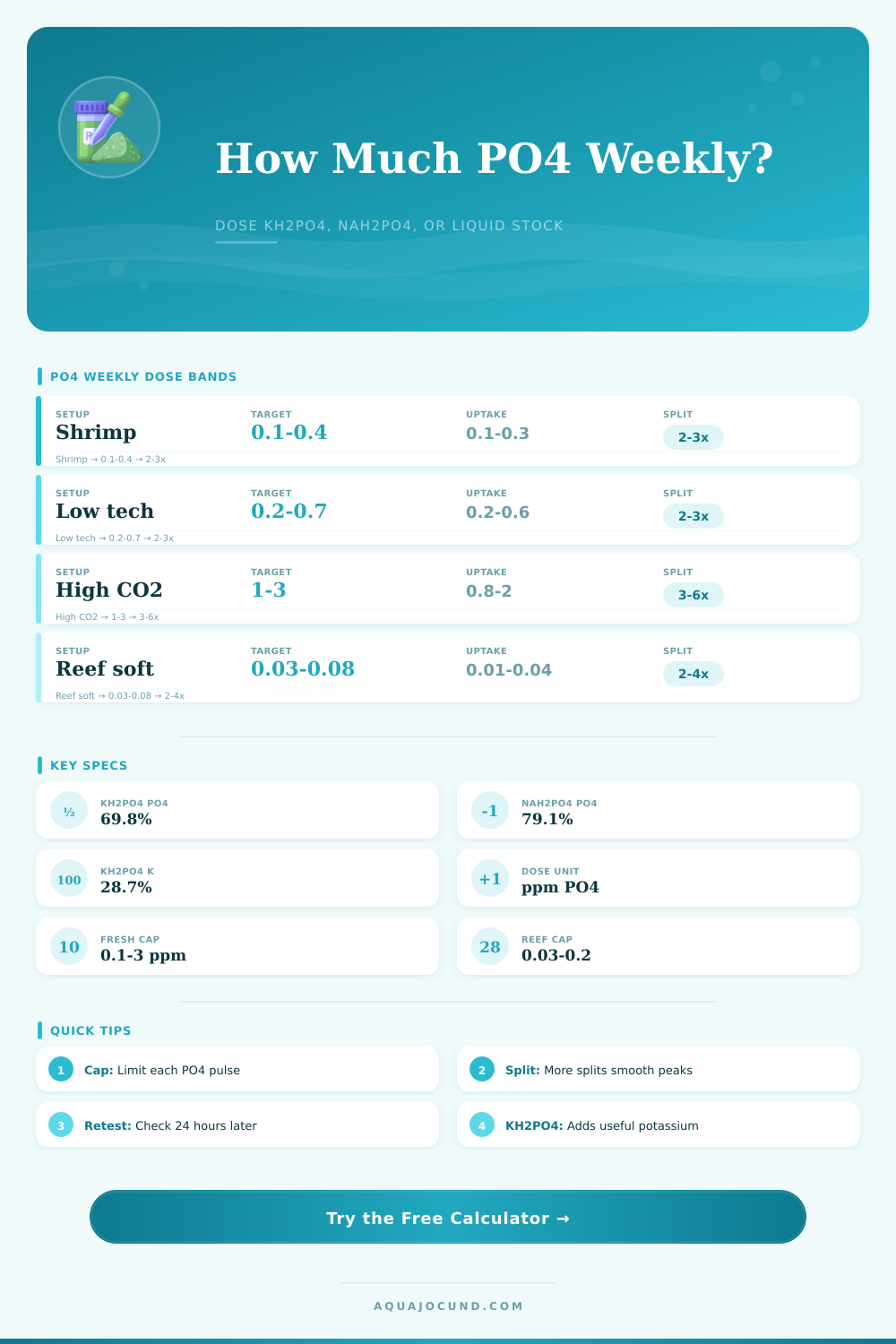
| Caridina or algae-sensitive shrimp | 0.1 to 0.4 ppm | 0.10 to 0.20 ppm | 2 or 3 small doses after feeding days |
| Low-tech planted tank | 0.2 to 0.7 ppm | 0.20 to 0.40 ppm | 2 or 3 doses across the week |
| Moderate planted tank | 0.5 to 1.5 ppm | 0.50 to 0.80 ppm | 3 doses after water change reset |
| High-light CO2 aquascape | 1.0 to 3.0 ppm | 0.80 to 1.50 ppm | 3 to 6 doses matched to macro days |
| Soft or mixed reef | 0.03 to 0.12 ppm | 0.01 to 0.04 ppm | 2 to 7 very small liquid doses |
| Step | Calculation role | What to measure | Adjustment clue |
|---|---|---|---|
| Before water change | Starting tested PO4 | Use a reliable low-range kit | If reading is high, dose only uptake replacement |
| After water change | Reset value after dilution | Estimate tap or new saltwater PO4 if known | Large changes lower the starting point |
| During dosing week | Split dose peak control | Watch algae film and plant response | Raise split count if each pulse is too high |
| Next test day | Uptake calibration | Compare target to actual residual | Update weekly uptake estimate next time |
Begin with a plan that looks reasonable on paper and a clean tank. Add plants and livestock, feed your livestock, and provide nutrients. Despite all this work, algae begins showing up. It covers your healthy plant before you can get rid of it. Mats form or it clings to glass.
Rather than reaching for the bleach, check your phosphate plan. Dosing is more about frequency (how often) and volume (how much) added. Dosing failures is most often related to time. Specifically, it’s about when those nutrients are added relative to each other and in relation to tank water volume. The amount of water in the tank and estimated uptake rates are handled by the calculator above. That way there’s no guesswork as to if adding a nutrient spike benefits or hurts your tank.
Why You Should Add Phosphate Slowly
Plants require phosphate as a limiting nutrient. If you add too much phosphate it feeds algae that overgrow beneficial plant species. What is tested is critical. What is being reported is residual that remains after biology does its thing. If your results are high, don’t add more phosphate. Instead, you has to get rid of what’s there first. Adding more simply stacks the dose on top of the reserve; a weekly water change will act as your reset button by diluting concentration and giving you a clean place to start from. Without dilution, target concentrations mean nothing, you’re stacking new dosing on top of old.
Most aquarists use monopotassium phosphate (KH2PO4) as their source. Why? Because it’s dependable, it provides both phosphate and potassium, which plants readily take up. That is the secret. Potassium has its own effect in the water. With each increment of phosphate applied, there is also a corresponding amount of potassium that enters the water. Unless you adjust accordingly, adding supplemental potassium in your fertilizer will throw things out-of-whack if you dose KH2PO4. The calculator takes into account the side-effect of the additional ion load from the potassium and shows the amount of potassium that comes along with phosphate dose.
Phosphate is not treated as a stand-alone input but is instead linked to a different element. In sensitive environments, it’s not so much how much you add per week than when you add it. In a high-light planted tank with rapid plant growth, big weekly doses may work since excess gets cycled fast. A low tech tank or shrimp tank isn’t metabolically so hot. If you add too much all at once, there are spikes then algae takes advantage of it before plants can respond. Smaller, regular doses maintains consistent levels without spikes. That means using several small dose instead of a huge weekend dose, like this reference table recommends. It also mimics nature better than a mega-dump of nutrients.
For reef tanks, it’s even more exacting. Unlike freshwater plants, which are generally tolerant of abrupt shifts in phosphate, corals aren’t so forgiving. Some soft corals may do fine on trace amounts, while stony corals will either become stained or starved when the amount varies widely. Because liquid supplies can be microdosed in very small quantities, they outperform dry salts. Measuring a few milliliters of liquid is far more forgiving than weighing milligrams of powders, partikularly with static cling. Varying the dosing interval also keeps within the tight range needed for good coral health but avoids spurring an algae outbreak.
With phosphate, it’s a game of rhythm instead of force. You aren’t overfeeding nutrients in an attempt to overwhelm your tank. Instead, you’re feeding just enough to maintain a head start on algal growth and decay without causing chaos. Monitor your livestock, test your water, make adjustments to splits, then monitor again. It’s numbers that direct your hand; it’s observations that confirm reality. Go for consistency, keep the peaks low, and the tank will reward you with stability.