Peat Moss Dose Calculator
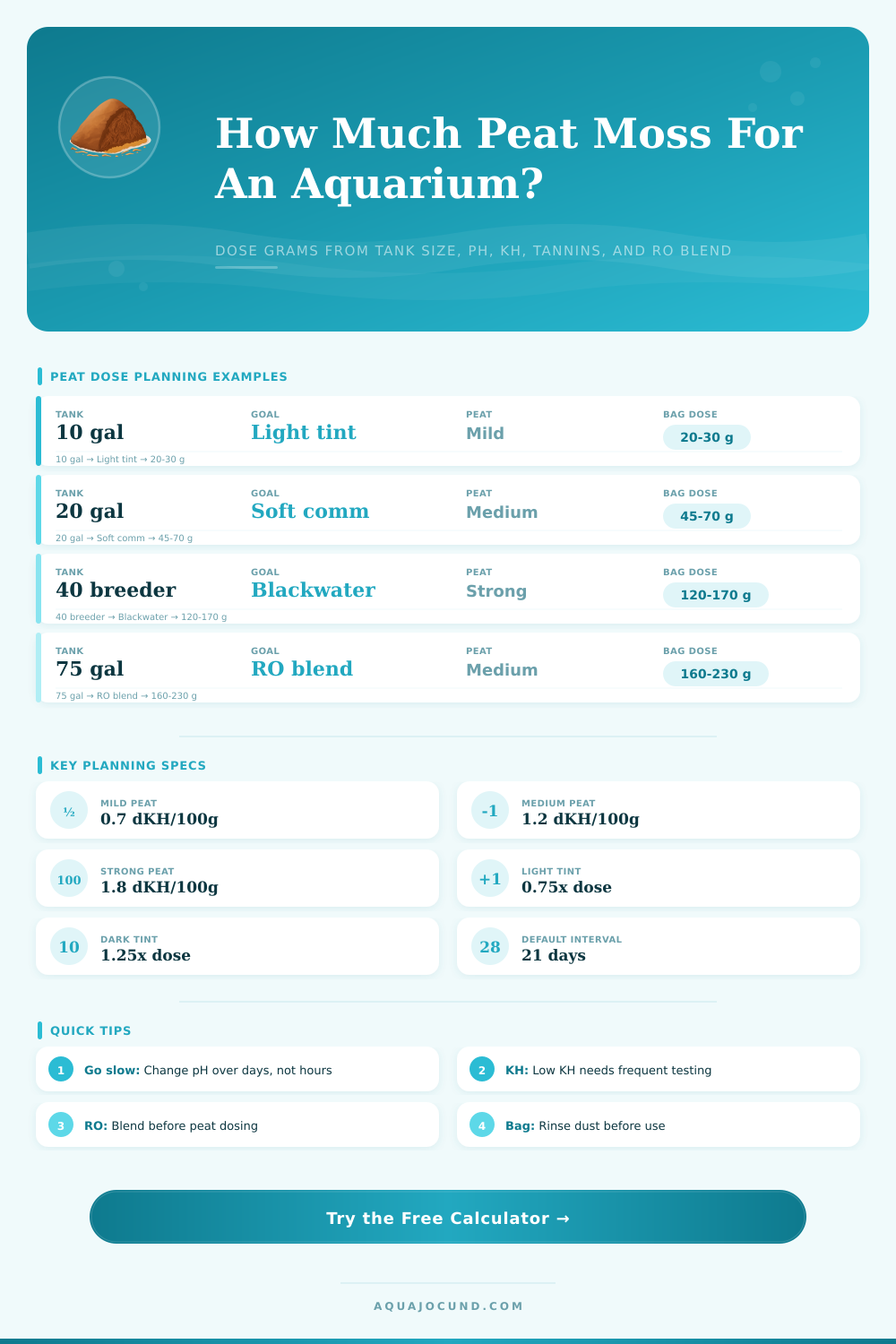
Estimate aquarium peat bag grams from tank volume, target pH and KH softness, peat strength, tannin preference, replacement interval, and RO water blend.
Calculation breakdown
| Peat profile | KH pull planning value | Tannin index | Contact behavior | Use in calculator |
|---|
| Tank | Dimensions | Volume | Light tint dose | Soft blackwater dose |
|---|
| RO blend | Source KH 6 dKH | Source KH 10 dKH | Peat workload | Planning note |
|---|
| Factor | Formula role | Range used | Why it matters |
|---|---|---|---|
| KH gap | Blended KH minus target KH | 0-12 dKH | More carbonate buffering requires more peat contact. |
| pH demand | Extra factor from target pH drop | 1.00-1.80x | Lower pH targets need more acid reserve when KH remains. |
| Contact flow | Efficiency multiplier | 0.65-1.25x | Passive bags extract less than canister or pre-brew contact. |
| Replacement interval | Activity duration factor | 3-60 days | Long intervals need more material because peat exhausts gradually. |
| Water changes | Dilution and rebound factor | 0-90% weekly | Frequent changes bring in more alkalinity unless the blend is matched. |
The problem with peat moss is that peat doesn’t lower pH magically. You add it to the filter, the water goes black and you assume it’s good now. Alas, this strategy frequent backfires because the peat’s humic acids work by neutralizing carbonate hardness. If you have hard water (alkaline) the peat will struggle in vain against buffering capacity of your water. The result is dark water with a neutral pH, which leads to frustration and over-dosing.
To understand what I mean, it’s necessary to look beyond bag count. Plug your water parameters and your tank volume into the calculator (above) and it do the math for you. No more guessing about acid reserve. It also makes you think about the KH gap, the gap between the KH of your starting water and the KH of your target water.
Why Peat Moss Often Fails
Why? Because pH isn’t a standalone variable. PH is a reflection of the balance of base vs It is the acid in the water. Adjusting for pH without taking into account carbonate hardness don’t work.
What goes into it also matters. A lot of people uses peat without using an initial round of reverse osmosis filtration. Using both RO and peat are preferable to just peat alone, but you don’t have to buy as much. Mixing half RO/deionized water into your tap water before adding the peat lessens burden on the peat. By softening the carbonate hardness ahead of time, the peat only need to deal with tweaking acidity and delivering those pleasant tannins. If it has to try to bust up hard minerals too, then it will burn out. As you can see from the reference charts, peat dosing drop significantly if you start off with a 50% RO mix different than directly treating tap water. This little change in approach is easier on the wallet while keeping the tank parameters more stable long-term.
The peat also works differently depending on how it is physically presented. Pelletized or granulated peats has larger surface areas and offer faster acid extraction (better for canisters with high flow). Passive bags of sphagnum placed in a tank corner are much less efficient than forcing material through a chamber under strong current (reactor style). Match your filter setup to the kind of peat you use. A dense block of compressed peat might not extract enough acid before it gets exhausted if you are using a hang-on-back filter with moderate flow. Looser fiber/granule size allow more water to come into contact with each gram of peat.
But just as critical is timing and care. Because peat will absorb minerals over time (in weeks), it’s not forever. Depending on your flow rate and the type of water changes you do, most keepers gets new bags every 3-4 weeks. Changing water often dilutes the tannins. Because of this, you will need larger water changes more often, or more peat at first to make up for the change in chemical balance.
Again, test, test, test, there’s no getting around it. What might visually appear as dark blackwater may actualy have a pH of seven due to high alkalinity buffering the acidic peat. Always check both pH and KH after adding peat. Take a conservative approach; It’s always better to start with less peat than to overdo it and have to back off quickly (which can harm beneficial bacteria and upset your fish). You should of give your system time to adjust (a few days) between any additional peats. Again, you’re looking to slowly adjust your parameters towards your desired targets, not do it all at once.
Afterward, your aquarium will be a stable place that accommodates even the most sensitive inhabitants without having to fuss constantly. Yes, the tea color is an unintended byproduct of the chemical reaction but it’s not what you’re aiming for. When used correctly, peat functions like a precise instrument instead of a “shotgun” cure. In other words, use it confidently and consistantly to maintain your water quality.