🧪 ParaGuard Dose Calculator
Convert verified ParaGuard label ratios, net water volume, displacement, product concentration notes, measuring-device rounding, and repeat intervals into dose-volume arithmetic.
| Input type | What the calculator does | Default or unit | Verification check |
|---|---|---|---|
| Label ratio | Divides product mL by label water volume, then multiplies by net water volume. | 5 mL per 40 L | Confirm your current bottle label or official product page. |
| Custom ratio | Uses the same ratio math with user-entered product mL and water volume. | mL per gal or mL per L | Use when a label, lot sheet, or vet plan lists a different ratio. |
| Concentration | Converts verified mg/L active-equivalent target through a verified mg/mL concentration. | mg/mL, percent w/v, or mg/cap | Do not infer proprietary strength; enter only verified numbers. |
| Measured amount | Applies schedule, rounding, and total-volume math to a fixed mL amount. | mL | Useful for record checks when the mL amount is already verified. |
| Device | Typical math step | Best arithmetic use | Rounding note |
|---|---|---|---|
| 1 mL syringe | 0.01 mL | Small containers and fractional mL checks | Shows fine rounding changes clearly. |
| 10 mL syringe | 0.1 mL | Most tank-size label-ratio calculations | Usually closer than capful rounding. |
| Bottle capful | 5 mL | Label capful comparison | Small tanks may round coarsely by capful. |
| Dropper estimate | 0.05 mL | Approximate drop count records | Drop size varies; verify with your dropper. |
| Pump stroke | 1.25 mL | Repeating a calibrated dispenser amount | Measure real output before relying on strokes. |
| Nominal size | Common dimensions | 90% net volume estimate | Label-ratio mL |
|---|---|---|---|
| 5.5 gal aquarium | 16 x 8 x 10 in / 41 x 20 x 25 cm | 5.0 gal / 18.7 L | 2.34 mL |
| 10 gal aquarium | 20 x 10 x 12 in / 51 x 25 x 30 cm | 9.0 gal / 34.1 L | 4.26 mL |
| 20 long aquarium | 30 x 12 x 12 in / 76 x 30 x 30 cm | 18.0 gal / 68.1 L | 8.52 mL |
| 29 gal aquarium | 30 x 12 x 18 in / 76 x 30 x 46 cm | 26.1 gal / 98.8 L | 12.35 mL |
| 40 breeder aquarium | 36 x 18 x 16 in / 91 x 46 x 41 cm | 36.0 gal / 136.3 L | 17.03 mL |
| 55 gal aquarium | 48 x 13 x 21 in / 122 x 33 x 53 cm | 49.5 gal / 187.4 L | 23.42 mL |
| 75 gal aquarium | 48 x 18 x 21 in / 122 x 46 x 53 cm | 67.5 gal / 255.5 L | 31.94 mL |
| Events | Interval | Elapsed time from first to last | Total formula |
|---|---|---|---|
| 1 | 0 hours | 0 hours / 0 days | first measured amount only |
| 3 | 24 hours | 48 hours / 2 days | first + 2 repeat amounts |
| 7 | 24 hours | 144 hours / 6 days | first + 6 repeat amounts |
| 14 | 24 hours | 312 hours / 13 days | first + 13 repeat amounts |
Forgetting that “measured by the glass” is a no-no when measuring aquarium water. So you fill a bucket, pour it into the tank and do it again till you’re convinced there’s ten gallons in the tank. But you don’t see all the things inside the tank: the rocks, the filter sponge, the cool-looking decorative driftwood. There isn’t as much water in your tank as the stated size would lead you to think. And if you’re dosing to prevent ich or treat for parasites, that water lost translate directly into an incorrect dose.
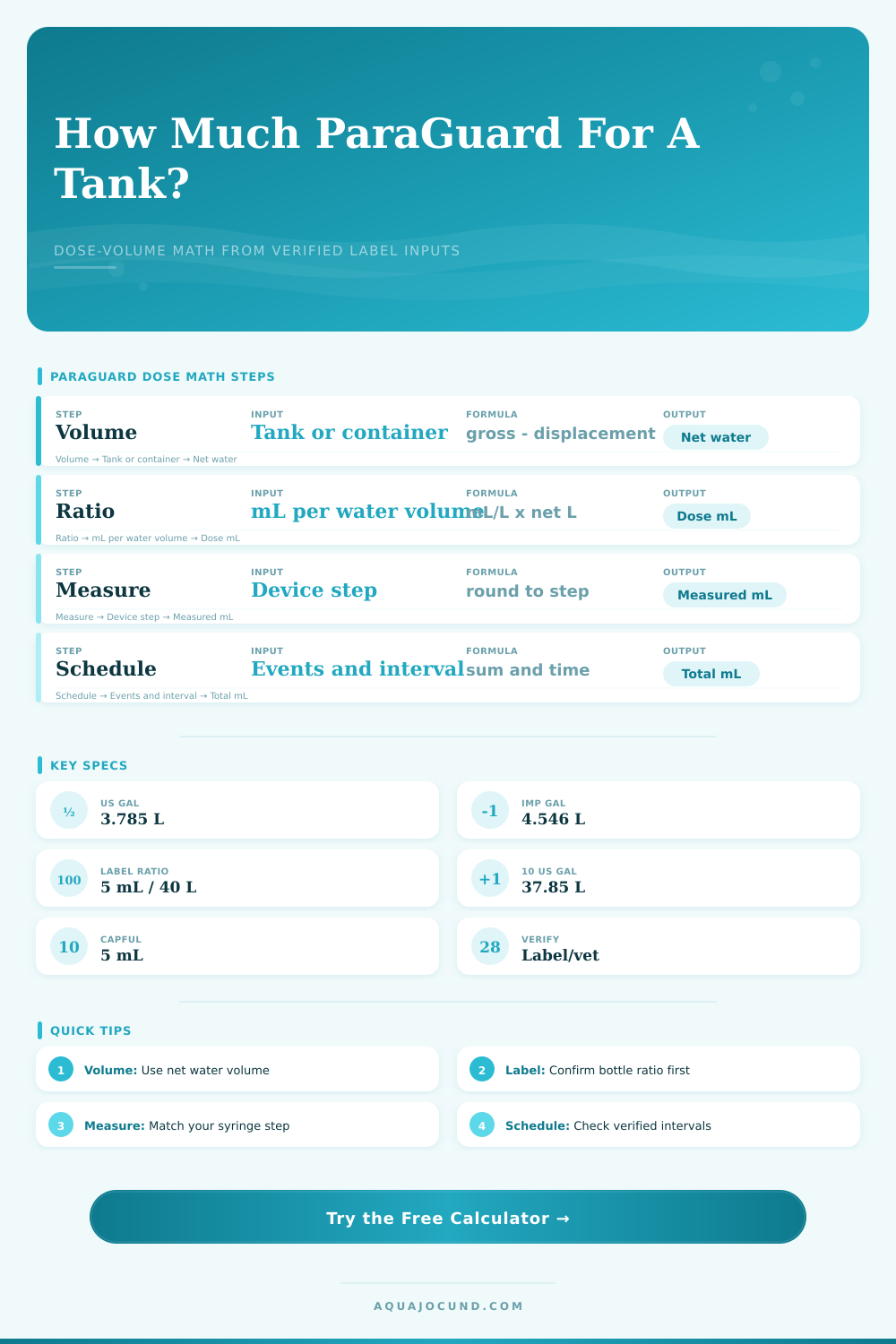
Dosing with ParaGuard is easy. Just not the math part. To make life easier, we’ve added a dose calculator which will handle the math for you while you concentrate on biology. First, it asks for either a direct volume estimate or the dimensions of your tank, and then it immediately asks you to subtract displacement from total.
Why You Need a Dose Calculator
The variable that kills treatments is displacement. Thirty percent of the volume in one tank may be made up of roots and substrate if it’s a densely planted tank. That same tank might have ten percent displacement if it were a bare-bottom tank instead. That’s where entering a percentage comes into play. It adjusts net water volume before a dose is ever calculated. It’s a tiny step, but a very important one since otherwise, you’re dosing for a tank that doesn’t even exist.
From there, the tool takes the standard label ratio, which on most products is five milliliters per every forty liters. That’s the baseline, but you can adjust that too using the calculator. For example, maybe your veterinary plan call for something else entirely or perhaps you know that you’ll be performing a partial water change. You can enter a target concentration or a custom ratio directly into the interface. Then once you get it set up to the right ratio and volume, it calculates actual amount in milliliters.
That’s where measuring instruments kick in. Do you have a syringe? Then maybe you’re measuring down to a hundredth of a milliliter. Or do you just have the bottle cap? Then it’s rounded off to every five milliliters. And it rounds off to whatever instrument you’ve selected. It makes you measure something real. It is something you can actualy achieve. It is probably closer to what you can actually achieve then a theoretical measurement.
And then you’ll see on here there are schedule options. Most of them call for multiple doses spaced twenty-four hours apart. So this adds up the total amount of product you’d need for the whole thing. That way you can see whether you might have enough left in your bottle before you go ahead and start taking the dose.
Half the fight is knowing what it does, and the other half is knowing how much to use. In this case, para is a treatment against ich-causing protozoan parasites (the free swimming stages). These parasite come in two forms. Encysted forms stick to the fish, while free swimming stages live in the water, cycling from one form to another. To treat them, we need to capture the free swimming stage again and again for multiple days. That’s where the schedule comes in. Because the cysts naturaly break open on their own schedule, a single dose is rarely enough. The math behind the intervals helps you map these days so they all fall into the right place. It also assumes consistency. Miss a day? Part of the population reset its clock.
There are also reference tables on the page showing typical tank sizes and estimates for the net volume contained in each tank. This is more of a sanity check. Did your 20 gallon long calculate to eight mils using the tool but remember from the label you needed five with ten gallons? Then the numbers matches up.
When you’re anxious, there’s a tendency to overdose. You panic, you see some white spots and you just dump some more in. That is totally understandable, but it is counterproductive. Within limits, ParaGuard is safe, but it clouds the water and stresses fish if you use too much. The trick is consistent, steady concentration over time not a toxic shock. The tool enforces discipline by locking the math to the label’s verified ratios. It takes out the guess work of the equation. You’re left with a clear schedule and clear number.
The rest is observation. Observe your fish for any behavior changes. Check your filter for clogging. Adjust your water changes accordingly, keeping in mind that new water dilutes the product. The calculator will account for replacement water in the volume math. This ensures you aren’t dosing into an empty tank.
So in conclusion, it’s all about respecting your creation, your eco system that is a delicate and balanced aquarium. And when you throw medicine into that equation, that delicate balance change. When you use something precise, take into account the length of time it runs, the device’s precision, and the amount of water displaced, you reduce your impact on that delicate balance. You’re treating what is wrong but not fighting the tank in the process.
The math is simply a path to the goal. The effort comes after the fact. Maintain good water, reduce stressors, let the chemistry handle the rest. That’s how you beat parasites. You do not win by overpowering, but by outlasting through precision.