PAR to PPFD Conversion Calculator
Convert aquarium light readings by sensor unit, spectrum, meter correction, water depth, reading type, and daily light integral.
Corrected Light Result
| Input Unit | Conversion Basis | Best Aquarium Use | Main Caution |
|---|---|---|---|
| PAR / PPFD, µmol m-2 s-1 | 1 PAR reading = 1 PPFD reading before correction | Plants, coral placement, fixture tuning | Sensor spectral response and immersion factor still matter |
| Lux | PPFD = lux divided by spectrum lux-per-µmol factor | White freshwater LEDs and rough fixture comparison | Blue and red spectra can make lux estimates very wrong |
| Foot-candles | Convert to lux with 10.7639, then divide by spectrum factor | Older light meters and photography meters | Same spectrum limitation as lux |
| PAR W/m2 | PPFD = W/m2 times µmol per joule factor | Radiometric sensors that report PAR-band energy | Photon factor changes with wavelength mix |
| Tank Goal | Target PPFD at Organism | Typical Photoperiod | Approx DLI Band |
|---|---|---|---|
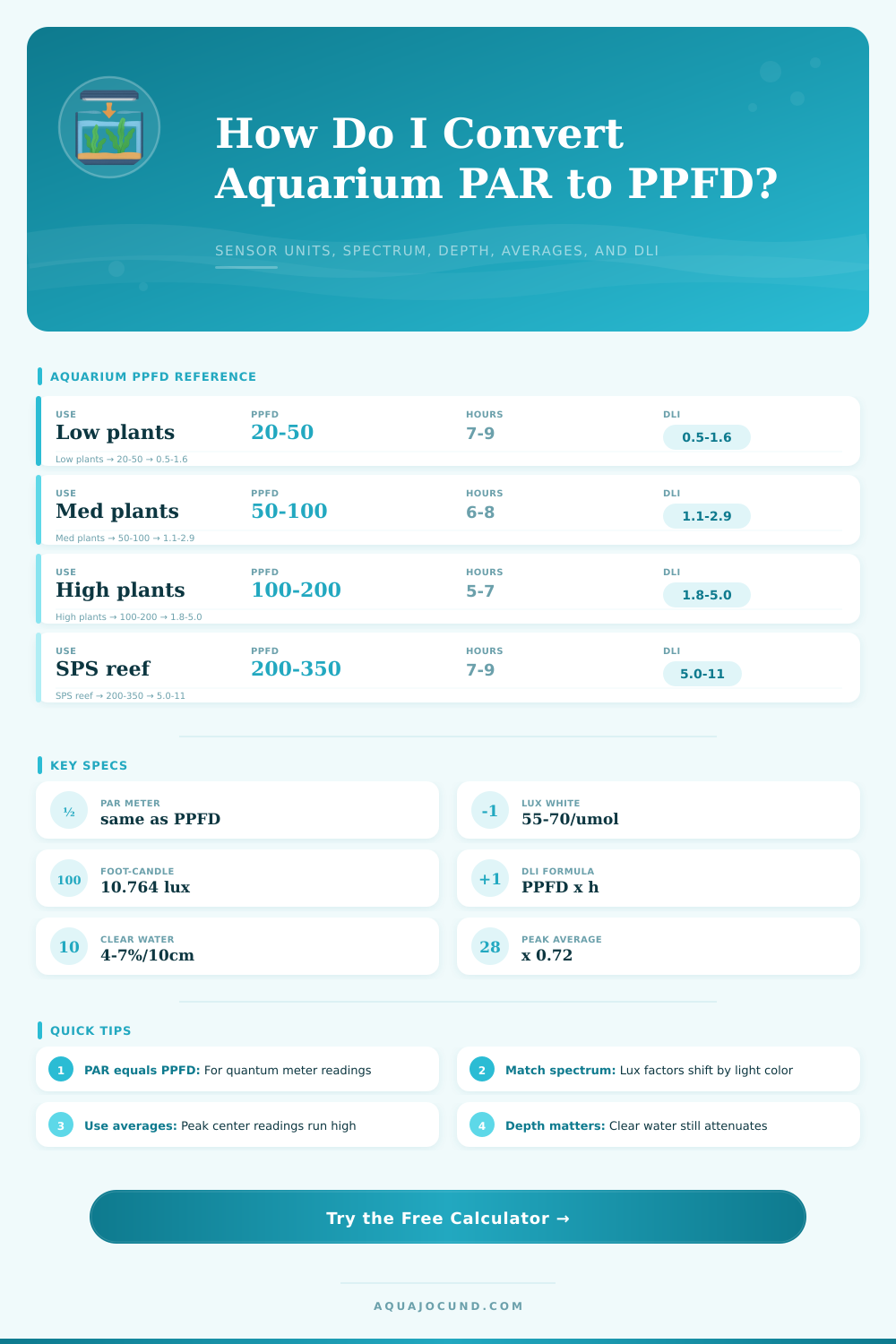
| Low-light freshwater plants | 20-50 µmol m-2 s-1 | 7-9 hours | 0.5-1.6 mol m-2 day-1 |
| Medium planted community | 50-100 µmol m-2 s-1 | 6-8 hours | 1.1-2.9 mol m-2 day-1 |
| High-light carpet or Dutch tank | 100-200 µmol m-2 s-1 | 5-7 hours | 1.8-5.0 mol m-2 day-1 |
| Soft coral reef | 50-120 µmol m-2 s-1 | 7-10 hours | 1.3-4.3 mol m-2 day-1 |
| LPS coral reef | 80-180 µmol m-2 s-1 | 7-9 hours | 2.0-5.8 mol m-2 day-1 |
| SPS coral shelf | 200-350 µmol m-2 s-1 | 7-9 hours | 5.0-11 mol m-2 day-1 |
| Tank | Common Footprint | Use Case | Useful Reading Pattern |
|---|---|---|---|
| 10 gallon | 20 in × 10 in / 51 cm × 25 cm | Low plants, shrimp, betta | 3-point average across front, center, back |
| 20 long | 30 in × 12 in / 76 cm × 30 cm | Planted community or shallow reef | 5-point average because ends can be dim |
| 40 breeder | 36 in × 18 in / 91 cm × 46 cm | Dutch planted or mixed reef | Grid average with front-back spread check |
| 75 gallon | 48 in × 18 in / 122 cm × 46 cm | Large planted or LPS reef | Separate left, center, and right averages |
| 120 gallon | 48 in × 24 in / 122 cm × 61 cm | Deep display or SPS zones | Measure shelves and sandbed separately |
| Correction | Typical Value | Formula Used | When to Adjust |
|---|---|---|---|
| Clear freshwater attenuation | 4-6% per 10 cm | PPFD × (1 - loss)depth/10 | Use lower loss for polished clear water |
| Clear reef attenuation | 6-8% per 10 cm | Includes blue scattering and water path | Use measured PAR when possible |
| Tinted or hazy water | 10-18% per 10 cm | Same exponential loss model | Raise loss for tannins, algae, or particulates |
| Peak-to-average reading | Multiply by 0.72 | Average PPFD = point PPFD × spread factor | Use a real grid average for final tuning |
| DLI | PPFD × hours × 0.0036 | mol m-2 day-1 | Compare daily dose, not only instant intensity |
Also, your eyes don’t measure all wavelengths of light the same way. Some are easy to see, like yellows and greens, but plants don’t perceives them. Because of this, those LEDs may look very bright, yet they might not be supplying much energy for plant to use.
Some blue-heavy lights can look dim but blast out a ton of photons damaging any newly set down coral, you have to get past simply judging how “bright” something looks and go to the amount of photon delivered per unit time at the organism level. So this is where conversion between PAR and PPFD takes us.
Why Bright Light Is Not Enough for Plants
For those new to this, there’s some confusion between PPFD and PAR. They’re both technically the same thing once you calibrate your sensor. However, PPFD mean Photosynthetic Photon Flux Density, which is how many photosynthetically active photons strikes a square meter per second. PAR means Photosynthetically Active Radiation, which is wavelength range used by corals and plants. Most moddern quantum meters show PAR values that is numerically equal to their PPFD. All the calculator does is run the numbers for you, you don’t have to divide anything yourself. Just make sure your sensor is actualy measuring what it says it’s measuring.
The primary place where many converter fall down is with spectrum correction. Visible light measured by a lux meter is only relevant to human eye. To use that meter to get an accurate measurement of PPFD, there needs to be some kind of conversion factor applied. For instance, one particular light might produce about sixty lux per micromole if it’s a cool white LED. Another might be twenty-five or less if it’s more of a royal blue actinic, which is something that the human eye barely perceives.
If you have those two running together and enter them both into a converter using a default conversion factor, then you’ll get widely off reading. This is why the tool allows you to pick what lights you’re measuring and corrects math to match. This way, a thirty to fifty lux reading on a reef setup won’t be treated like a fifty lux reading from white fixture.
Everything else depends based off depth. Water absorbs light and scatters light that hits particles. It does so quickly, with about a 4% loss for each 10cm in clear freshwater. This loss can be up to twice that if there’s just a bit of algae haze or tannin in the tank. Unless you’re measuring your light at the surface (easier!), be sure to correct for depth of water between the source and your measurement point since this will tell you how much actual light is reaching your substrate. That’s particularly important on shelves in reefs or very tall tanks where organisms that live near the bottom depends on whatever light trickles down from above.
A lot of people underestimate how important it is to know what your reading mode is for. If you get one reading right in the middle of the beam, you’re getting max output, but that’s just a small part of the total footprint of the light which covers plants and corals. The spot where you read will generally be a hotspot, often dropping off around the edges. This means if you want a good idea about the overall health of the tank, you need to take an average of multiple reading across a grid or apply some sort of reduction factor to that high number. A high number with bad spread can cause things to bleach out in the center while the corners starve.
This calculator fills that gap and lets you turn your spot readings into usable averages. It all comes together in Daily Light Integral. You can have as much intense light as you want. However, if there is not enough time to use that intensity, you won’t get better growth then someone who has a more modest but constant amount of light for twelve hours a day rather than one really bright hour and eleven dark ones.
DLI is the overall photon dosage per day. Use it to help figure out how to adjust the intensity versus the duration (how long the tank is on). This helps you avoid photoinhibition while still delivering enough energy so your livestock can thrive.
It is a small detail, but it matters. Wrong numbers will cost you money. You’ll avoid over-melting your corals due to excessive light intensity at the wrong depths, or because of poor light quality. You won’t spend hundreds on unnecessary supplemental lights trying to address nonexistent light deficiencies. Aquarium lighting becomes less guess-work and more a science of delivery. It is not just about bright water, but about useful light.