🐸 Paludarium Land to Water Ratio Calculator
Balance dry shore, aquatic space, water depth, and displaced volume for mixed habitat builds.
✅ Paludarium Ratio Results
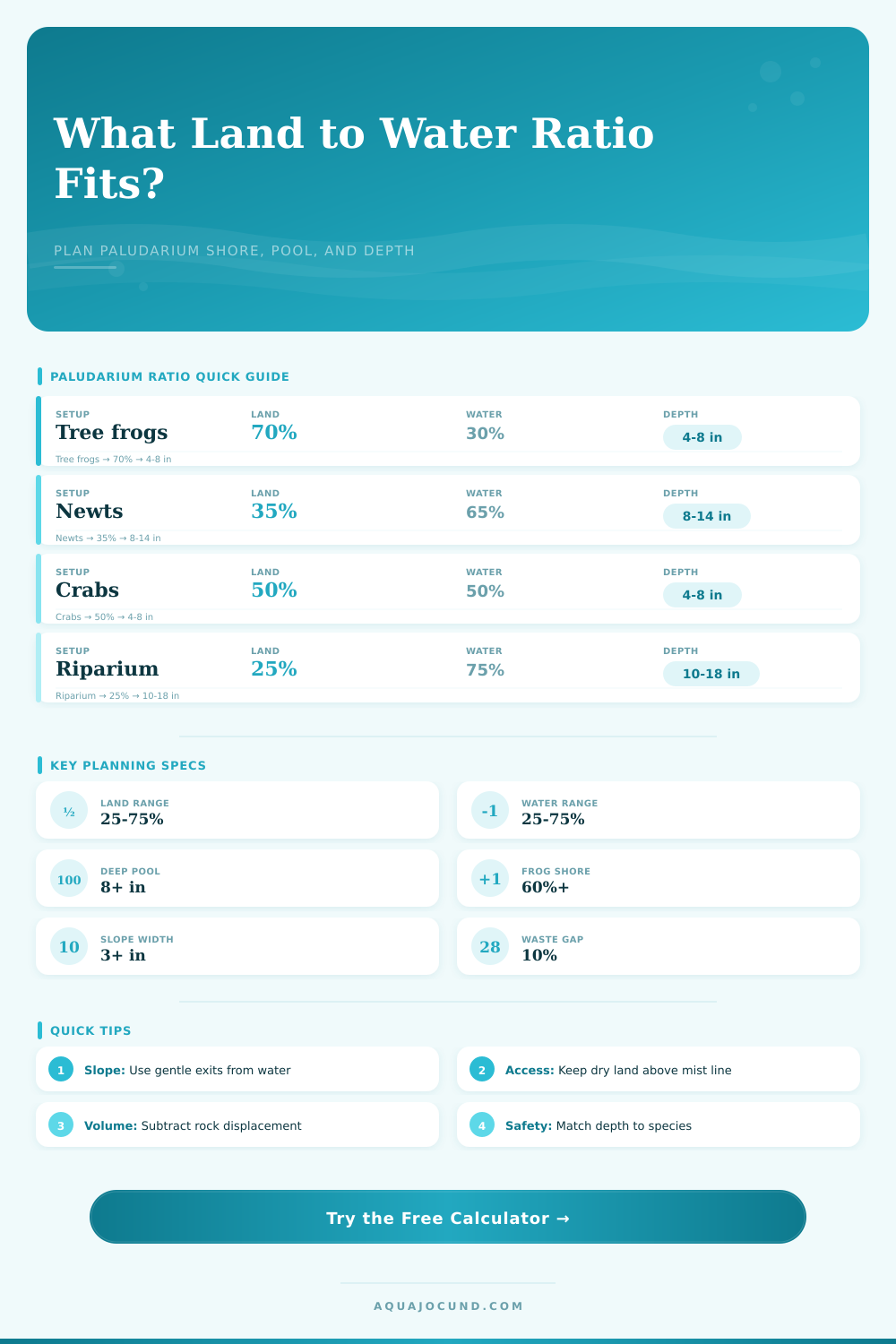
| Paludarium Use | Land Ratio | Water Ratio | Depth Range | Planning Note |
|---|---|---|---|---|
| Tree frogs | 65-80% | 20-35% | 4-8 in | Tall dry planting and easy exits matter more than pool volume. |
| Dart frogs | 75-90% | 10-25% | 1-3 in | Use very shallow water unless the species is known to use pools. |
| Fire-belly newts | 25-45% | 55-75% | 8-14 in | Prioritize stable water volume with a secure island or cork shore. |
| Vampire crabs | 45-65% | 35-55% | 3-6 in | Build several dry hides above the waterline and a climbable bank. |
| Mudskippers | 40-60% | 40-60% | 3-8 in | Wide muddy shelves are more important than tall open water. |
| Turtle basking | 15-30% | 70-85% | 12-20 in | Land must be fully dry, sturdy, heated, and easy to climb onto. |
| Riparium plants | 15-35% | 65-85% | 10-18 in | Use submerged volume for filtration and emergent roots above it. |
| Stream bank display | 35-55% | 45-65% | 4-10 in | Leave room for pump returns, current breaks, stones, and moss banks. |
| Tank | Dimensions | Footprint | 50/50 Land | Useful Build |
|---|---|---|---|---|
| 10 gallon | 20 x 10 x 12 in | 200 sq in | 100 sq in | Nano shore, small plants, micro crabs only |
| 20 long | 30 x 12 x 12 in | 360 sq in | 180 sq in | Newts, small riparium, planted stream edge |
| 29 gallon | 30 x 12 x 18 in | 360 sq in | 180 sq in | Crab colony or taller planted bank |
| 40 breeder | 36 x 18 x 16 in | 648 sq in | 324 sq in | Balanced frog, crab, newt, or stream layout |
| 55 gallon | 48 x 13 x 21 in | 624 sq in | 312 sq in | Long bank for mudskippers or river display |
| 75 gallon | 48 x 18 x 21 in | 864 sq in | 432 sq in | Deep water with raised island or turtle basking |
| 90 gallon | 48 x 18 x 24 in | 864 sq in | 432 sq in | Taller plants, waterfall wall, deeper pool |
| 125 gallon | 72 x 18 x 22 in | 1296 sq in | 648 sq in | Large display stream or mixed-bank paludarium |
| Structure Type | Displacement | Land Stability | Water Access | Best Use |
|---|---|---|---|---|
| Foam background ledge | 5-12% | Medium | Needs ramps | Tree frogs and plant walls |
| Egg-crate false bottom | 8-18% | High | Easy to shape | Crabs, frogs, planted banks |
| Stacked stone bank | 15-30% | High | Many crevices | Stream layouts and mudskippers |
| Cork island | 2-8% | Medium | Excellent | Newts and temporary basking zones |
| Substrate slope | 12-25% | Medium | Very gentle | Crabs, shallow banks, emergent plants |
| Raised hard tray | 4-10% | High | Depends on ramp | Dry vivarium-style land over water |
| Formula Item | How It Is Estimated | Why It Matters | Adjustment Range |
|---|---|---|---|
| Footprint | Length x width, or circular base area | Controls land and water surface split | Measured directly |
| Land area | Footprint x land percentage | Shows usable dry or damp terrestrial space | 5-95% |
| Water surface | Footprint minus land area | Sets swimming area and gas exchange | 5-95% |
| Water volume | Water surface x average depth | Estimates filtration capacity and stability | Depth input |
| Displacement | Subtracts rock, soil, foam, and false bottom | Prevents overestimating actual water volume | 0-25% |
| Transition bank | Portion of footprint reserved for slope | Improves animal access between zones | 3-18% |
People’s first error with paludariums is to think they are half-terrarium, half-aquarium by volume. And that doesn’t work because glass boxes don’t scale the same way for surface area and volume. For example, maybe you’ve got plenty of water for filtration but not enough flat shore to allow frog to dry himself off. Or perhaps you constructed a great big rock garden, leaving just a small swimming hole. The newt then spend all his nights clinging in terror to the glass.
It isn’t about the ratio; it’s what each zone do. It is about more than aesthetics; think about the animals. A tree frog drinks moisture from leaves (he’s a climber), so he need dry perches and height, not a big pool to swim in. If you provide a 50-50 split, water side will go stagnant since there’s nothing to move it, while land side gets overcrowded.
How to Choose the Right Land and Water Size
So you’d ideally have most of that footprint as terrestrial. That’s what the tool on this page does: It calculates how much actual square inches of wet vs. It calculates the dry surface area by accounting for the hidden soil and rocks that takes up space. This lets you visualize the split.
Displacement is the quiet assassin here. Pouring in a false bottom of egg crate foam or stacking lava rock doesn’t just make your tank look nice, it take water out of the equation. You might think adding a couple inches of something is only 10% displacement. However, that 10% displacement mean your filtration media now has fewer gallon of water to cycle through. So the calculator account for what was lost and doesn’t let you overestimate how many fish your tank can support. It makes you admit that your tank is smaller on the inside than the label on the side say.
And then there’s the transition zone. You don’t see many critters hop right off dry land into deep water. They require a slope. A gentle bank offers an exit ramp. Unless you account for the width of that slope, your animals is going to get stuck in the deep end or slide back in as they attempt to climb up and out.
The buffers included in the page presets take this into account. They assume you’ll want a couple inches of gradient between wet and dry. It is not just for looks. It is for survival.
Another variable that gets overlooked until it is too late are depth. Newts are great swimmers, fire-belly newts especially. The fire-belly wants depth and stable water parameters. Vampire crabs aren’t like that. They want to come out. Put a vampire crab in deep water without a secure dry hide above the water line. They will use all their energy trying to get out of swimming area. Match the depth to the natural behavior of your species. A newt would of starve in a shallow pool, but crabs do fine in one.
It breaks this down by species in the reference tables that are part of the layout. Turns out turtles require a deep area where they can swim (a swim zone) and a dry spot to bask on (a basking platform). Dart frogs need virtually no water whatsoever.
How much is enough? You don’t have to memorize the numbers. Just know there’s a trade-off. More water mean more stable chemistry but less room for plants and hides. Less water means less buffer from an ammonia spike and better climbing or ventilation space.
Select your animal first. Next, determine what portion of the tank you want them to occupy. Enter that info into the calculator (above) and see whether your ideal setup will even fit within limits of the glass. Adjust the displacement setting to reflect how heavy your hardscape will be. Does the available water volume decreases too far? Dial back on rocks or increase surface area. Is the dry land insufficient? Raise the waterline a little or flatten out the slope.
There’s no such thing as having your cake and eating it too when planning a tank with both land and water. You get to decide what compromises are worth making. Do you want a huge waterfall wall? Or do you want a large swimmin hole? Neither choice will be made for you by the numbers, but they’ll inform you of their respective price tags.
When you discover how much actual real estate you have in each space, then you’re free to go wild. No more guesswork, only creation. That clarity transforms a jumbled mess of water and rock into a well-balanced home for its inhabitants.
The number is simply the beginning. It all comes down to following through.