Octagon Aquarium Volume Calculator
Estimate regular octagon floor area, gross fill volume, glass-thickness allowance, net gallons, liters, and center column displacement.
🐟Octagon Tank Presets
📏Octagon Inputs
Calculation Breakdown
📊Regular Octagon Comparison Grid
🗂Octagon Measurement Methods
| Method | Formula used | Glass handling | When to use |
|---|---|---|---|
| Inside across flats | area = flats² x 0.8284 | No side glass subtraction | Most accurate water-space measurement |
| Outside across flats | inside flats = outside flats - 2 x glass | Subtracts both opposite panes | When only outside width is easy to measure |
| Inside side length | area = 2 x (1 + sqrt2) x side² | No side glass subtraction | For tanks sold by panel side length |
| Outside side length | converts side to apothem, subtracts glass | Offsets every panel inward | Custom octagon builds with outside panels |
📐Octagon Aquarium Preset Reference
| Preset | Typical size entered | Height and fill | Column allowance |
|---|---|---|---|
| Desk nano | 12 in flats / 30 cm | 12 in, 88% fill | No center column |
| Shrimp column | 14 in flats / 36 cm | 18 in, 90% fill | 1.5 in tube |
| Betta prism | 7 in side / 18 cm | 14 in, 87% fill | No center column |
| Planted display | 22 in flats / 56 cm | 20 in, 91% fill | 2 in column |
| Reef column | 28 in flats / 71 cm | 26 in, 90% fill | 4 in overflow |
| Large custom | 42 in flats / 107 cm | 30 in, 88% fill | 6 in dry column |
💧Fill Percent Reference
| Fill level | Headspace habit | Use in calculator | Why it matters |
|---|---|---|---|
| 80-85% | Large open-top headspace | Conservative display or splashy livestock | Net volume is far below nameplate |
| 86-90% | Common rimmed waterline | Many freshwater octagon tanks | Leaves room below rim and trim |
| 91-94% | High display waterline | Rimless or quiet overflow setup | More water volume but less buffer |
| 95-100% | Nearly full internal height | Only when measured safely | Useful for nameplate capacity checks |
⚪Center Column Displacement Table
| Column diameter | Displacement per 12 in height | Metric equivalent | Typical use |
|---|---|---|---|
| 1 in / 2.5 cm | 0.04 gal | 0.15 L | Airline or small pipe chase |
| 2 in / 5.1 cm | 0.16 gal | 0.62 L | Small decorative tube |
| 3 in / 7.6 cm | 0.37 gal | 1.39 L | Common center support sleeve |
| 4 in / 10.2 cm | 0.65 gal | 2.47 L | Compact overflow column |
| 6 in / 15.2 cm | 1.47 gal | 5.57 L | Large dry center overflow |
💡Practical Tips
Why buy an octagon? It’s mostly an aesthetic choice, and that’s okay! You love that octagonal shape, you see how it cuts up visual line of your livivng space. You figure the numbers will be roughly equivalent to what you’re used to with a traditional rectangular tank, right? Nope.
That shape, while visually pleasing, works against you subtly influencing every aspect of keeping from water weight to fertilizer dosing. The shape is pretty…but it conceals its real capacity behind angles and glass thicknesses you can’t even see. Before you settle on a filtration system or even what livestock to keep, it’s important to understand what’s really going into that frame.
Why Octagon Tanks Are Hard to Measure
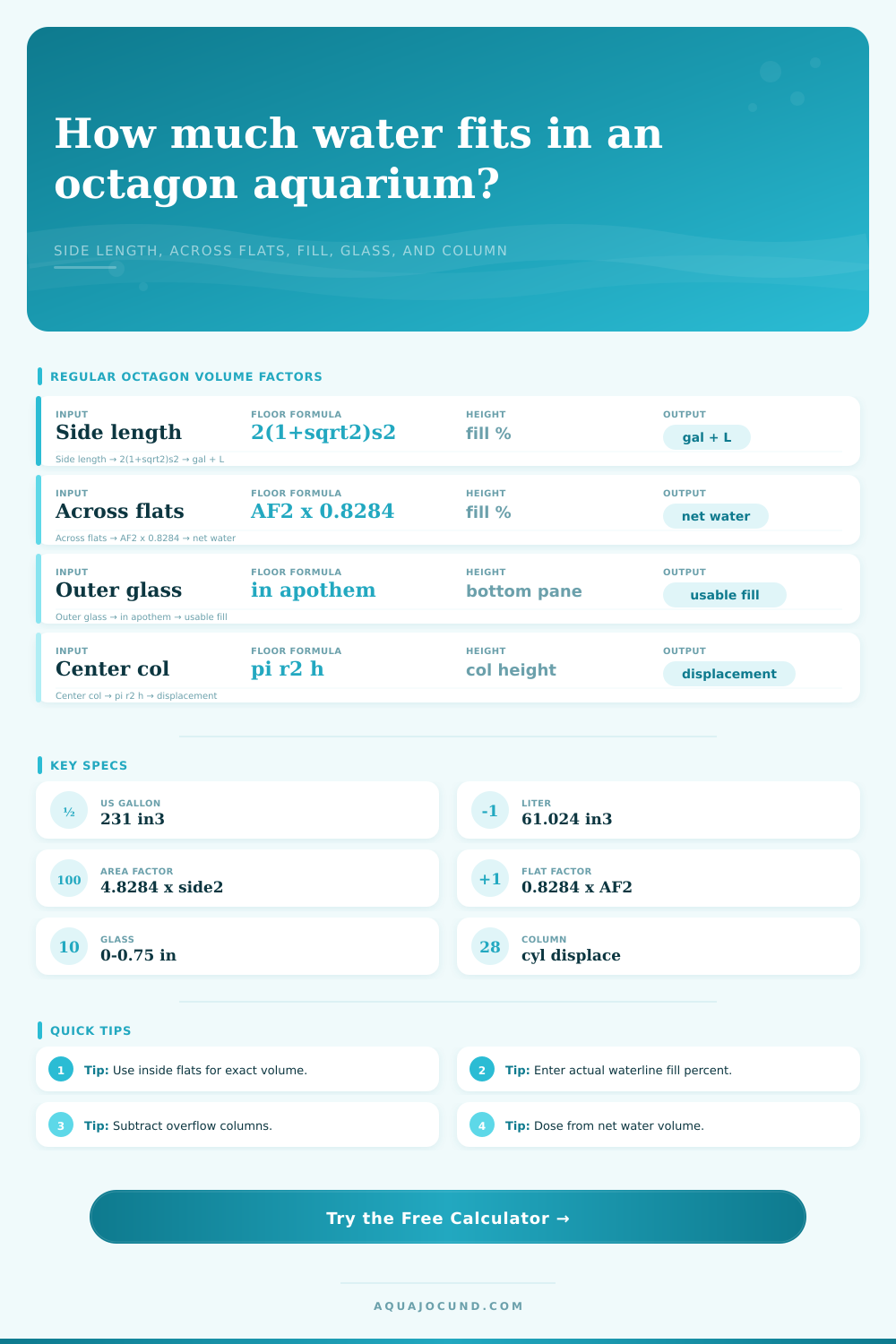
The first challenge are defining the perimeter. Is this the length of one side panel? It could be distance from one glass pane to its mirror-image parallel. That’s across flats. Each number will yield a different result in math. Select your input and calculator does the math for you. Converting it to the other if necessary.
Once geometry type is selected, it plugs in the correct geometric coefficient (the part that calculates the actual floor area). If you measure across flats, the tool use a factor of roughly 0.8284. If you’re using side length, it multiplies by a very different number involving square root of two. It is a minor detail but it is important nonetheless.
Getting an accurate measurement of the length along a tight corner of your desk are not easy because you have to fight against perspective distortion. Across flats is more straightforward to eyeball with a regular old tape measure (since they’re straight up at you, panes are flat).
Less glass means less volume. More glass means less interior volume. It’s one thing for glass to narrow your interior width by a half inch on each side, it also narrows the interior radius of the whole design. Since area formula squares the dimension, a slight decrease in interior flat size create a disproportional decrease in floor area. What’s that? A quarter inch isn’t significant? Guess again. Multiply that across eight sides and you’re losing a lot of usable water column.
For this reason, the tool let you choose if your measurement is internal or external. Then it takes away how much glass to arrive at actual water space. Why does this matter? If you don’t account for this, you could overestimate your tank’s size, something risky when determining biological load or chemical treatment.
And then what about the center column? Most octagon tanks has some kind of overflow sleeve or dry tube in middle. That’s a cylinder that takes up space where plants or fish cannot go. Failure to account for that displacement means you’ll dose incorrectly. Treat the tank like it’s full when there’s a three-inch column in the center… over-dose!
The calculator has a field where you can input the height and diameter of the column. That cylindrical volume get subtracted out of gross fill. That’s a real world tweak that converts a theoretical volume to a net usable volume.
Another overlooked variable is the fill level. Unless you like cleaning your carpet when water spills, most tanks aren’t at 100% full (if they’re even close). Why? Because you need space above the water for evaporation, surface agitation and jumping livestock. Once you enter a realistic fill percentage (e.g., 90% if the tank has a rim), you get a number that represent real life. Knowing you have twenty gallons of water rather than assuming you have twenty-five because the tank’s external dimensions imply it is better.
You should of known this. Finally, the dosing safety margin feature serve as a last buffer. It makes sure you have a conservative starting point when adding medication or salts. That protects your livestock against accidentally overdosing due to overestimating capacity.
The presets they have in the tool are typical shapes found in market ranging from large display pieces down to small desktop nanos. They’re there as a sanity check against your own measures. If you build an octagon yourself and come up with a number that’s way off than a similarly sized preset, then chances are you’ve used an external dimension instead of an internal one.
Geometry is exacting and forgiving of nothing. Removing the guesswork around glass offsets and dimensions of the sides lets you concentrate on the biology without getting hung up on architecture. Your net volume is the starting point for a stable tank. It makes a beautiful piece of furnitures functional. It takes the water and puts life in it.
The octagon might get your attention but the water sustains the life.