🧪 Nitrate Phosphate Ratio Calculator
Balance aquarium NO3 and PO4 readings with target ratios, water-change dilution, and practical nutrient dosing estimates.
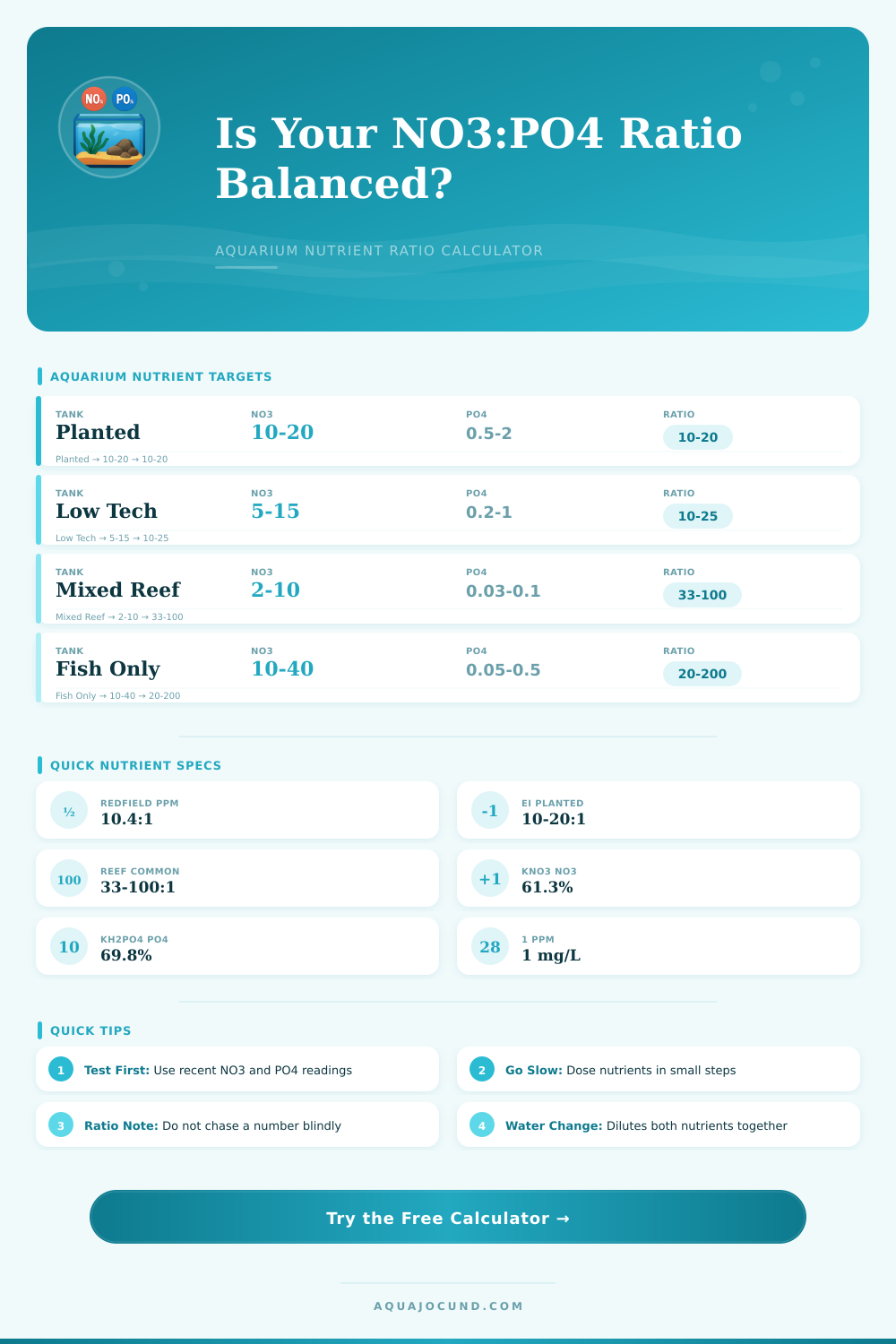
| Aquarium Type | Typical NO3 ppm | Typical PO4 ppm | Useful NO3:PO4 Ratio | Main Risk |
|---|---|---|---|---|
| High-Tech Planted | 10 to 20 | 0.5 to 2.0 | 10:1 to 20:1 | Deficiency |
| Low-Tech Planted | 5 to 15 | 0.2 to 1.0 | 10:1 to 25:1 | Slow Uptake |
| Shrimp / Moss | 3 to 10 | 0.1 to 0.5 | 10:1 to 30:1 | Stability |
| Cichlid / Fish-Heavy | 10 to 40 | 0.05 to 0.5 | 20:1 to 200:1 | Waste Load |
| Nano Reef | 1 to 8 | 0.02 to 0.08 | 25:1 to 100:1 | Fast Swings |
| Mixed Reef | 2 to 10 | 0.03 to 0.10 | 33:1 to 100:1 | Algae / Pale Coral |
| SPS-Dominant Reef | 1 to 5 | 0.02 to 0.06 | 40:1 to 120:1 | Burnt Tips |
| Fish-Only Marine | 10 to 40 | 0.05 to 0.50 | 20:1 to 200:1 | Nuisance Algae |
| Source | Nutrient Strength | Calculator Output | Best Use | Caution |
|---|---|---|---|---|
| Potassium Nitrate (KNO3) | 61.3% NO3 by weight | grams or milligrams | Freshwater planted nitrate | Adds potassium too |
| Monopotassium Phosphate (KH2PO4) | 69.8% PO4 by weight | grams or milligrams | Freshwater planted phosphate | Small amounts are potent |
| Sodium Nitrate (NaNO3) | 72.9% NO3 by weight | grams or milligrams | Marine nitrate adjustment | Adds sodium |
| Sodium Phosphate (NaH2PO4) | 79.1% PO4 by weight | grams or milligrams | Marine phosphate adjustment | Dose in tiny steps |
| Standard Nitrate Liquid | 10,000 ppm NO3 stock | milliliters | Measured small dosing | Check bottle strength |
| Standard Phosphate Liquid | 1,000 ppm PO4 stock | milliliters | Reef or nano fine tuning | Retest after mixing |
| Measured NO3:PO4 | Freshwater Reading | Reef Reading | Common Response |
|---|---|---|---|
| Below 5:1 | NO3 may be limiting | High PO4 relative to nitrate | Raise nitrate or reduce phosphate input |
| 5:1 to 20:1 | Often workable for plants | Usually phosphate-rich for reefs | Judge by livestock and algae signs |
| 20:1 to 80:1 | Often nitrate-heavy | Common mixed reef zone | Watch for phosphate bottoming out |
| Above 80:1 | Possible PO4 limitation | Low PO4 relative to nitrate | Feed, dose PO4, or reduce nitrate |
| PO4 reads zero | Plant stalling possible | Coral paling risk | Confirm with a sensitive test kit |
| Water Change | Nutrient Left | 30 ppm NO3 Becomes | 0.30 ppm PO4 Becomes | Ratio Effect |
|---|---|---|---|---|
| 10% | 90% | 27 ppm | 0.27 ppm | Ratio unchanged |
| 25% | 75% | 22.5 ppm | 0.225 ppm | Ratio unchanged |
| 40% | 60% | 18 ppm | 0.18 ppm | Ratio unchanged |
| 50% | 50% | 15 ppm | 0.15 ppm | Ratio unchanged |
| 75% | 25% | 7.5 ppm | 0.075 ppm | Ratio unchanged |
NO3:PO4 ratios are useful for spotting imbalance, but aquariums respond to absolute concentrations too. A reef with 3 ppm nitrate and 0.03 ppm phosphate can be fine even though the ratio looks high.
When a nutrient reads zero, dose only part of the calculated amount, allow the tank to circulate, then retest. Phosphate in particular can bind to rock, substrate, and algae before the test kit shows the full change.
Maintaining teh nitrogen and phosphate level in your aquarium are the factor that will allow your planted or coral aquarium to grow. An limiting nutrient is the nutrient that is missing from the aquarium water. The missing nutrient will make the biological process within the aquarium to stop.
For instance, if the nitrate levels within the aquarium are high but the phosphate level are low, the plants within the aquarium will stop growing because they are lacking the phosphate nutrient that they need to grow. Algae such as cyanobacteria will begin to grow in the aquarium when the phosphate nutrient is missing. In order for the plants within the aquarium to grow, both nitrogen and phosphate nutrient must be provided to them so that they can out compete the algae for the nutrients.
How to Use a Nutrient Calculator for Your Aquarium
The nutrient calculator allow you to compare the current nutrient levels within your aquarium to the target levels. Using the nutrient calculator will allow you to understand which nutrient levels are limiting the biological processes within the aquarium. For instance, if the ratio of the nitrogen to the phosphate levels is high within the aquarium, this means that an amount of phosphate that is present within the water limits the aquarium.
If the ratio level of nitrogen to phosphate is low within the aquarium, the nitrogen levels are the limiting factor for the aquarium. The nutrient calculator will allow you to understand the metabolic state of your aquarium. It will do this by comparing the current levels of the nutrients within your aquarium.
Water changes is one form of aquarium maintenance. However, water changes will not change the ratio between the nitrate and phosphate levels within your aquarium. Water changes will only dilute the amount of nutrient in your aquarium.
For instance, if the ratio levels of nitrate and phosphate levels are already out of balance within your aquarium, performing a water change will not balance out the levels. Only the levels of these nutrients will decrease. However, the imbalance between the two nutrient will remain the same.
The nutrient calculator will allow you to understand what the levels of both nutrient will be after a water change. There is different ways to dose the nutrients. For instance, you can use dry salts such as potassium nitrate since it will add both nitrogen and potassium to the aquarium water.
Potassium is a primary macronutrient for the plants within the aquarium. Alternatively, you can also dose the nutrients in the aquarium using liquid doses. This is especially helpful if you have a nano-tank for your aquarium life since dosing liquid nutrients provides more precision when adding nutrients to the aquarium.
Additionally, the nutrient calculator will allow you to avoid dosing too much nutrient into the aquarium. The nutrient calculator will convert the required ppm nutrient levels to the amount of ml or grams of nutrients to add to the aquarium. You can use the nutrient calculator to remove the guesswork of how much nutrient to add to your aquarium.
Nutrient ratios are only guidelines for the nutrient management of your aquarium. For instance, the lighting cycle, flow of the water within the aquarium, and the number of fish within the aquarium will all impact the biological processes within the aquarium. Therefore, you should not aim to chase the numbers indicated by the nutrient calculator.
Additionally, you should not add nutrients to your aquarium with the intention of balancing out the nutrient ratios as calculated by the nutrient calculator if the livestock within the aquarium is healthy and thriving. The numbers indicated on the nutrient calculator are only a guide to help you make decisions regarding the aquarium. However, the actual growth and health of the plants and corals within the aquarium should be the primary guide for your nutrient management decisions.
If you find that the aquarium has a deficiency of one of the nutrients, you should add that nutrient to the aquarium in small increments. If you add the nutrient in large increments all at once, the nutrient levels will take some time to begin to balance out in the aquarium water. For instance, if the phosphate levels within the aquarium are low, the phosphate nutrient will bind to the substrate or rocks within the aquarium.
Therefore, the levels of the nutrient will not become balanced immediate. However, if you add the nutrient in small increments, it will take time for the nutrient to bind to the substrate or rocks. Additionally, there will be time for the nutrient levels within the water to even out.
By using the nutrient ratio as a diagnostic tool for the aquarium, you can gain a better understanding of how to manage your aquarium water and create a system for managing the nutrients in the aquarium water.