Mushroom Coral Spread Calculator
Estimate mushroom coral polyps, pedal laceration growth, monthly rock coverage, containment margin, and when an isolated reef island may need trimming.
Spread breakdown
| Month | Projected polyps | Covered area | Rock coverage | Action note |
|---|---|---|---|---|
| Run calculator | - | - | - | - |
| Mushroom type | Typical laceration rate | Disc diameter | Light preference | Spread note |
|---|---|---|---|---|
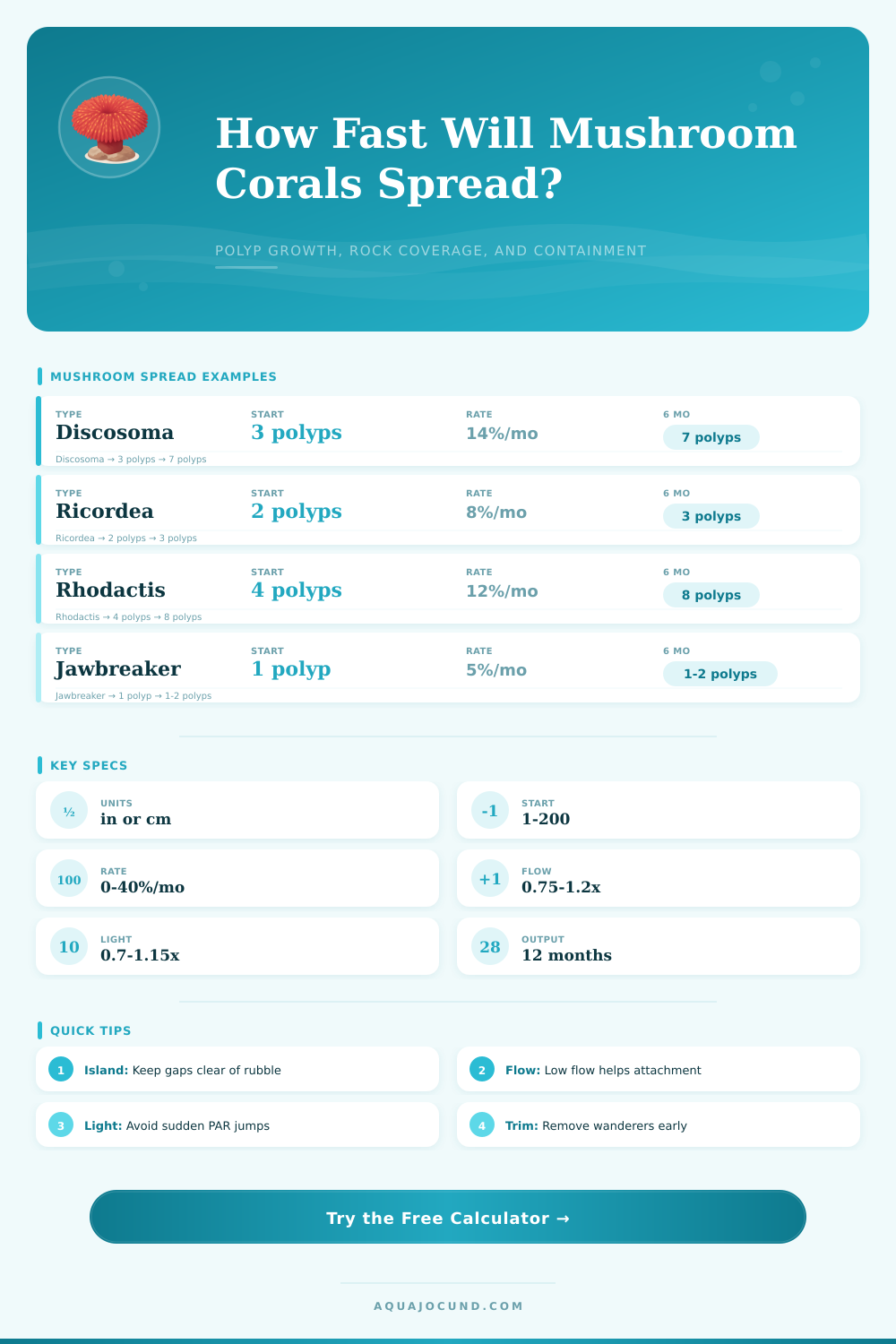
| Discosoma standard | 10-18% per month | 1-2 in (2.5-5 cm) | Low to moderate | Fast island colonizer |
| Ricordea florida / yuma | 5-10% per month | 1-2.5 in (2.5-6 cm) | Moderate | Usually slower, thicker discs |
| Rhodactis standard | 8-14% per month | 1.5-3 in (4-8 cm) | Low to moderate | Can shade nearby small discs |
| Jawbreaker / premium | 3-8% per month | 1-2.5 in (2.5-6 cm) | Low to moderate | Often slow, valuable, trim gently |
| Bounce mushroom | 4-9% per month | 1.5-3 in (4-8 cm) | Moderate, stable | Large expansion needs buffer |
| Hairy mushroom | 7-12% per month | 2-4 in (5-10 cm) | Low to moderate | Large discs fill area quickly |
| St. Thomas mushroom | 6-11% per month | 1.5-3 in (4-8 cm) | Moderate | Allow room for textured disc edge |
| Mixed mushroom rock | 8-13% per month | 1-3 in (2.5-8 cm) | Mixed | Use the fastest type for planning |
| Condition | Calculator effect | Low score | Best score | High stress signal |
|---|---|---|---|---|
| Flow attachment | Rates best around 3-5 for most mushrooms | 0.82x | 1.20x | Discs lifting or tumbling |
| Light match | Rates best near type PAR preference | 0.70x | 1.15x | Bleaching, shrinking, wandering |
| Nutrient condition | Stable feeding can increase laceration | 0.75x | 1.18x | Algae smothering foot tissue |
| Disc packing | Coverage uses 0.78 packing factor | Loose | Natural overlap | Shading smaller polyps |
| Trim threshold | Flags action before full island coverage | 10% | 70% | Bridge risk or detached babies |
| Island style | Usable area | Good starting count | Containment margin | Planning note |
|---|---|---|---|---|
| Nano plug cluster | 6-10 sq in (39-65 sq cm) | 1-3 polyps | 1 in (2.5 cm) | Best for slow premium mushrooms |
| Small rubble island | 12-20 sq in (77-129 sq cm) | 2-5 polyps | 1-2 in (2.5-5 cm) | Remove loose chips before babies attach |
| Medium display island | 24-45 sq in (155-290 sq cm) | 4-10 polyps | 2 in (5 cm) | Works for discosoma or rhodactis gardens |
| Large lagoon rock | 60-120 sq in (387-774 sq cm) | 10-30 polyps | 2-3 in (5-8 cm) | Plan shaded zones under large discs |
| Mixed reef barrier | Custom | Any count | 3+ in (8+ cm) | Keep sand path clear for containment |
| Status | Coverage signal | Gap signal | Suggested action |
|---|---|---|---|
| Low spread pressure | Under 40% covered | Gap exceeds margin | Monitor monthly photos |
| Growing garden | 40-70% covered | Gap still clear | Remove loose rubble nearby |
| Trim window | At threshold | Margin getting tight | Cut or trade outer polyps |
| Containment risk | Over threshold | Gap below margin | Isolate rock, scrape wanderers |
Reef keepers has a special kind of anxiousness. They purchase one mushroom coral and plop it down on rock. Before they know it, the coral expands beyond what they expect. Suddenly there’s a small disc, another one, and before you know it, the entire tank is covered in coral.
Enter your initial number of polyps, the size of the rock, and let the calculator do the math for you. No need to guess whether your coral will remain confined or overwhelm your tank.
How Mushroom Corals Grow Fast
The growth is an example of pedal laceration. Unlike a vine that stretches its tissue outwards, mushrooms creates new polyps by ripping off small pieces at their base. This process allow for exponential growth different than linear growth. If conditions are favorable, a small population could double in size within months. To account for that, the tool takes into consideration a monthly laceration rate as part of your inputs. From there you’ll see how fast three discs becomes a dense carpet. Understanding this factor will help you properly plan your aquascape.
Different mushrooms is not created equal. When making your choice of mushroom, be sure to select the right kind. For example, a typical Discosoma can expands 15% per month and a Jawbreaker could expand only five percent. These differences are well illustrated in the reference tables found on that page. Knowing whether your mushroom is a hiker or racer helps you plan out where it’ll go.
Don’t want to end up trimming away extra tissue sooner than expected? Make sure you don’t mislabel an aggressive growing mushroom for a more sedate one. Want to waste some space? Then think about labeling a slow-growing mushroom to be more aggressive.
In addition to the biology of the coral, the physical constraints of your tank has a big part to play. Both light and flow impact how firmly a fragment sticks to rock; both are asked for by calculator. Too much turbulence may blow off baby discs until they anchor down, capping growth potential. Insufficient lighting causes stress that stop reproduction altogether. It’s an ecosystem, so you’re dealing with hardware that either stunts or encourages biological drive. Tweaking those values in the tool will help you estimate actual performance versus the maximum theoretical performance.
One thing I rarely see mentioned about growing mushrooms is containment. Hobbyist frequently put rocks right next to one another, providing simple bridge ways for their polyps to wander into one another’s territory. The area of “clear” space surrounding a rock is called an island margin, where you want to stop a species from crossing over and mingling with another. If you’re getting close to your established threshold for coverage, do something about it.
Trim. It doesn’t have to be a penalty. It is just part of maintaining a healthy colony. This will also keep it out of its neighbors’ lights and away from their coral.
If you keep mushroom corals, you have to accept that they will grow. And they will spread. They has strong survival instincts, so most people find they cannot keep their mushrooms from spreading, especially if they try to limit them. That’s fine, though; don’t fight against them. Instead, expect them to spread and set boundaries by keeping enough rock separation so you know what is covered at any time. Use the calculator to predict how much more of the tank they will cover as time passes. You can make the most of them by directing their spread instead of trying to stop it. This way, your tank remains an organized display, not a jungle. It’s less effort to know exactly where new discs will appear next month, and it’s also peaceful.